
01.09.1886–17.01.1973
Tarsila do Amaral
Tarsila do Amaral grew up on a coffee fazenda in São Paulo state and studied in Barcelona and in Paris with André Lhote, Fernand Léger and Albert Gleizes. Her Abaporu (1928), a gift to her husband, the poet Oswald de Andrade, set off the Anthropophagic Manifesto and a whole current of Brazilian modernism. She painted about 230 pictures; in 1931 she exhibited in Moscow.
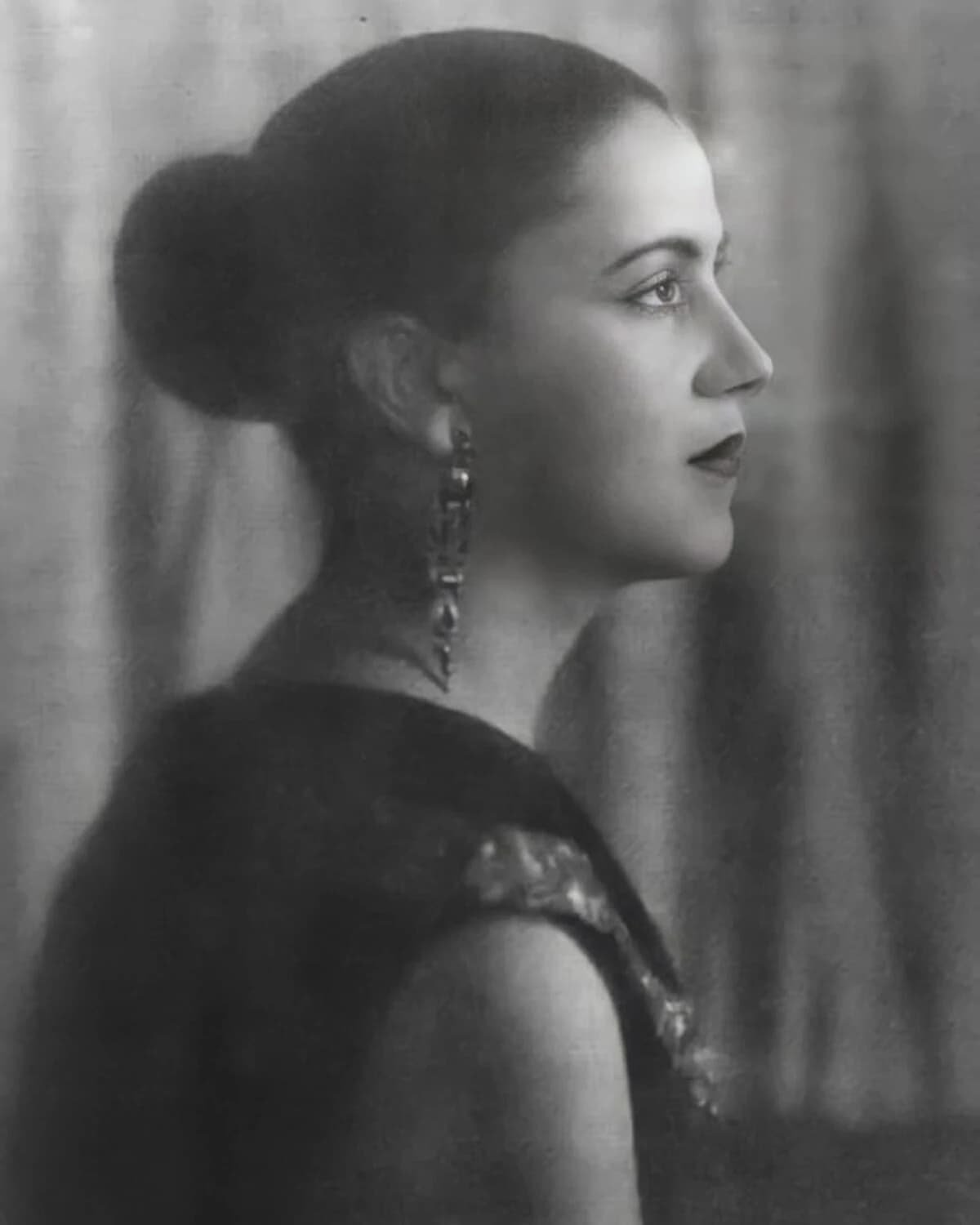
Biography
In 1928 Tarsila do Amaral gave her husband an untitled painting for his birthday. In it a huge human figure with a tiny head and gigantic feet sits on the ground beside a cactus, and the sun above them looks like a slice of lemon. The title was invented by Oswald de Andrade himself together with the poet Raul Bopp: Abaporu, Tupi-Guarani for “the man who eats”. Soon afterwards Andrade wrote the Anthropophagic Manifesto, a call to “devour” European art instead of imitating it, and put the painting on the cover.
She was born on 1 September 1886 in Capivari, a small town in the interior of São Paulo state, on the estate of her parents, wealthy landowners with coffee plantations. Slavery would be abolished in Brazil two years later. Girls from well-off families were not much encouraged to study at the time, but Tarsila's parents supported her. As a teenager she went with them to Spain, attended school in Barcelona and first attracted attention there: she drew and painted copies of works she found in the school's archive.
From 1916 she studied in São Paulo, first sculpture, then drawing and painting with Pedro Alexandrino, a respected but very conservative academic painter. The city at the time had neither a public museum nor a serious gallery.
In 1920 she left for Paris and enrolled at the Académie Julian. In 1922 her work was accepted at the Salon of the Société des Artistes Français.
Meanwhile, in São Paulo in February 1922, the Modern Art Week took place, the event from which Brazilian modernism is customarily dated. Tarsila missed it. On her return she at once fell in with its organisers: the painter Anita Malfatti, the writers Mário and Oswald de Andrade, and the poet Menotti Del Picchia. So the “Group of Five” came together, wanting an art that did not repeat Europe.
In 1923 she was back in Paris, and this time she studied with André Lhote, Fernand Léger and Albert Gleizes. European artists were then taken with African and “primitive” cultures, and this unexpectedly turned her gaze towards her own country. It was here that she painted A Negra (1923). A huge figure with a single heavy breast, the space flattened, the background filled with geometric forms. In April 1923 she wrote to her family: “I want to be the painter of my country.” In the same letter she recalls her childhood on the fazenda and the straw dolls she played with, and observes that in Paris everyone is expected to contribute something of their own country, hence the success of the Russian ballet, Japanese prints and black music. To my mind, this letter explains her next ten years better than any article.
In December 1923 she went home, and together with Oswald she set out to look for “their own” Brazil. In March 1924 they saw the carnival in Rio de Janeiro, and in April, during Holy Week, they travelled with the “modernist caravan” through the baroque mining towns of Minas Gerais. Her travel drawings became the basis of the paintings São Paulo, Morro da Favela (both 1924) and Lagoa Santa (1925). She illustrated Oswald's book of poems Pau-Brasil (1924), which gave the period its name. Her colour became bright: she later wrote that she had found the colours she adored as a child, which she had afterwards been taught to think ugly and countrified.
In 1926 Tarsila and Oswald married and travelled a great deal in Europe and the Middle East. That same year her first solo exhibition opened at the Galerie Percier in Paris, the culmination of the Pau-Brasil period. Critics called these works now “exotic”, now “naive”, now “cerebral”, and all of them remarked on the bright colour and tropical motifs.
After Abaporu came the period known as anthropophagic. In her Paris years she had got to know the Surrealists, and now fantastic figures took the place of city views. In Antropofagia (1929) the figure from Abaporu and the woman from A Negra sit side by side, surrounded by a banana leaf, a cactus and the same lemon sun. In 1929 she had her first solo exhibitions at home, at the Palace Hotel in Rio and the Salon Gloria in São Paulo, and in 1930 her work was shown in New York and Paris. That same year her marriage to Andrade broke up, and their shared cause ended with it.
In 1931 Tarsila went to the USSR, exhibited in Moscow at the State Museum of New Western Art and travelled around the country. Returning in 1932, she supported the Constitutionalist Revolution in São Paulo against the regime of Getúlio Vargas and, along with others regarded as left-wing, spent a month in prison: the trip to the Soviet Union had made her suspect. From then on social themes appear in her painting. Second Class shows poor Russian people, men, women and children. Workers is also named among her well-known paintings. Until 1952 she wrote a weekly column on art and culture for the newspaper Diário de São Paulo.
From 1938 Tarsila lived permanently in São Paulo and painted Brazilian people and landscapes. In 1950 the Museum of Modern Art of São Paulo held an exhibition of her work, and a reviewer called her the most Brazilian of the local artists. She took part in the first São Paulo Biennial (1951), the seventh (1963) and the Venice Biennale. In all she left about 230 paintings, hundreds of drawings, illustrations and prints, murals and five sculptures. One of her works, The Fisherman, is in the Hermitage; Abaporu is in the Museum of Latin American Art in Buenos Aires.
Tarsila do Amaral died on 17 January 1973 in São Paulo and was buried in the Consolação Cemetery. In 2017–2018 her large exhibition Tarsila do Amaral: Inventing Modern Art in Brazil was shown at the Art Institute of Chicago and the Museum of Modern Art in New York.
Related context
Associations
Works connected through artistic movements, cultural context and period. Priced works available in this market appear first.








Profile notes
Profile and sources
Image
Artist image
Unknown author Unknown author; Wikimedia Commons; Public domain.
