
14.07.1777–20.10.1835
Tanomura Chikuden
Tanomura Chikuden (1777–1835), the son of a Confucian physician of Oka Domain on Kyushu, served until 1813 at his domain’s school and worked on a history of Bungo Province. After his reform proposals failed he resigned and devoted himself to Nanga painting: landscapes, portraits, flowers and birds. He also wrote “Sanchūjin jōzetsu”, a work on Japanese literati painting.
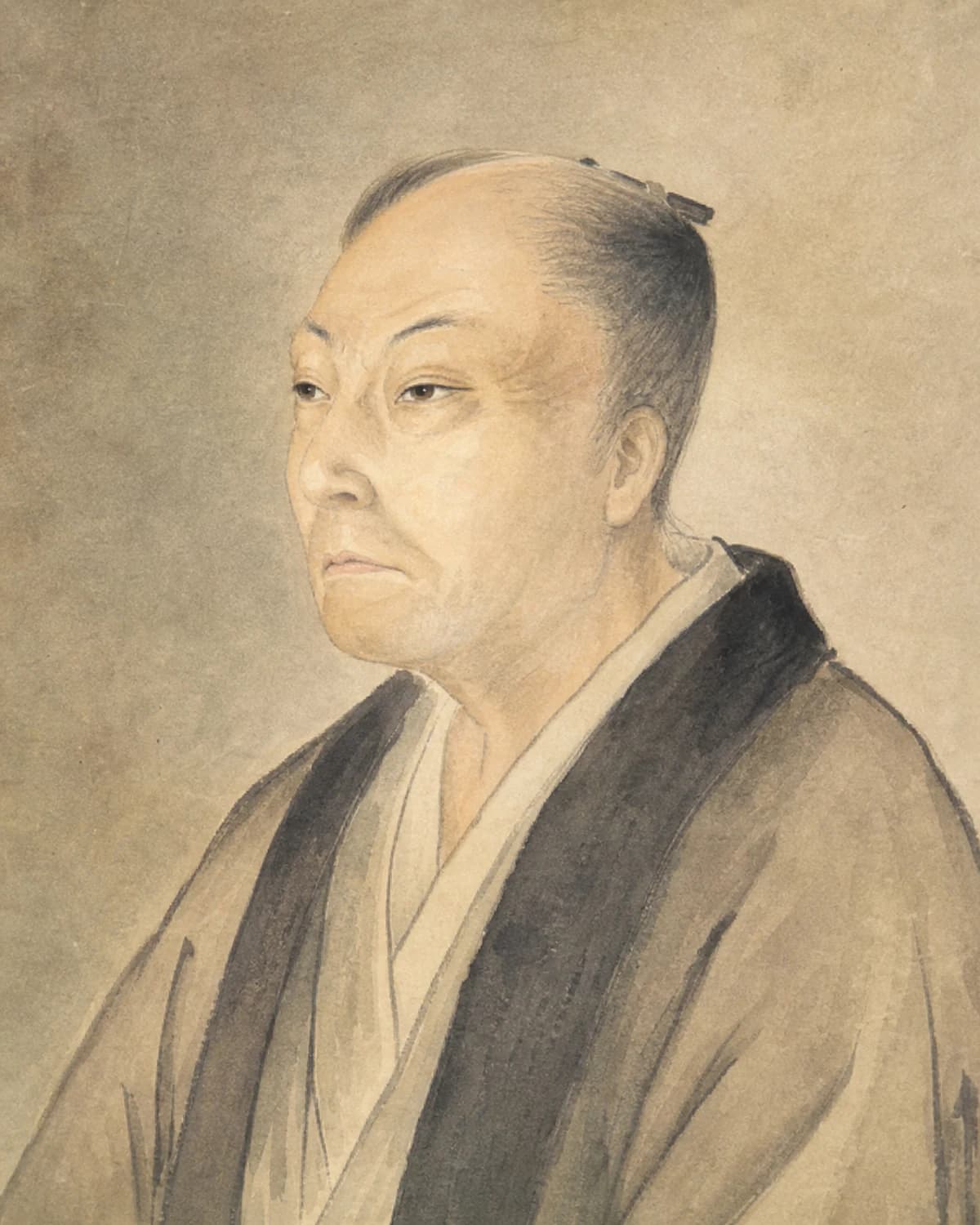
Biography
Chikuden left his post in the wake of a peasant uprising. In 1811 unrest broke out in Oka Domain against the monopoly system, and he twice submitted petitions to the domain’s administration with proposals for reform: relief for farmers and support for learning.
He was born on 14 July 1777 in the village of Taketa, in Bungo Province, the second son of Nomura Sekian, a Confucian physician of Oka Domain. His family’s standing among the samurai of the domain was low: the stipend was 12 koku, and because of the domain’s poverty about sixty percent of it was actually paid. He began reading at six and at eleven entered the domain school, the Yugakukan. He did brilliantly, his gift for poetry was noticed early, but he had to leave school because of his health. In 1794 his mother and elder brother died, and a year later he became heir of the Tanomura family and was received by the daimyo. He studied painting from about the age of twenty: first with a local painter, then, as one would now say, by correspondence with Tani Bunchō of Edo, a well-known master of bunjin-ga (the painting of scholar-literati). I could find no documents on how exactly this exchange went, and I would not invent details. At twenty-two he taught Confucianism at the Yugakukan and in time became its head. He gave up the practice of medicine for scholarship, and by order of the shogunate he took part in compiling an official history of Bungo Province.
In 1801 he went to Edo to prepare this work. On the way he called on Kimura Kenkadō in Osaka, and in Edo he visited Tani Bunchō. In 1805 he went to Kyoto for two years to treat his eyes and study Confucianism, stopping at Hakata, Nagasaki, Kumamoto, Kokura and Shimonoseki. In Osaka he became acquainted with Uragami Gyokudō, Okada Beisanjin and Ueda Akinari. In 1811 he met Rai San’yō, and they became close friends; in the autumn of that year Noro Kaiseki taught him painting techniques.
His proposals for reform were not accepted. In 1812 he submitted his resignation, citing the need for medical treatment, and in 1813 he left service. The resignation brought him a nominal allowance of two koku, which, to my mind, shows the trust of those around him. He spent the rest of his life travelling between Bungo and the Kansai region and associating with writers and painters: Rai San’yō, Okada Hankō, Uragami Shunkin, Kan Chazan and Aoki Mokubei. In 1825 he went to Nagasaki and learned Chinese painting techniques from visiting painters of the Nagasaki school.
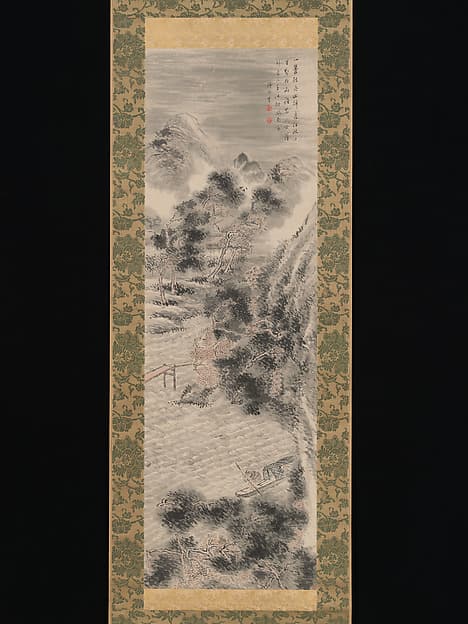
He revered the Four Masters of the Yuan dynasty and Mi Youren of the Song dynasty. Contact with many people taught him different manners, and he painted landscapes, figures, flowers and birds. In his later years he arrived at a delicate manner with gentle brushwork and a melancholy tone. Of his writings on the Nanga school the best known is “Sanchūjin jōzetsu” (“The Recluse’s Tattle”), a history and theory of Japanese literati painting; another book, “Chikudensō shiyūgaroku”, contains notes on his friends and their paintings.
In the summer of 1835, or on 20 October according to other sources, Chikuden died in Osaka, at the Oka Domain residence, at the age of fifty-eight. His works are held in many museums in Japan: about 200 at the Idemitsu Museum of Arts, 45 at the Ōita City Art Museum and 10 at the Taketa City History Museum. Many are designated National Important Cultural Properties. The house where he was born and his grave in Taketa have been protected as a National Historic Site since 1948.
Artist works
Works by the artist
Works by Tanomura Chikuden available in this edition of NEOARCA.
Related context
Associations
Works connected through artistic movements, cultural context and period. Priced works available in this market appear first.








Profile notes
Profile and sources
Image
Artist image
На основе открытого изображения: 田能村竹田; Wikimedia Commons; Public domain.
