
19.08.1905–14.05.1953
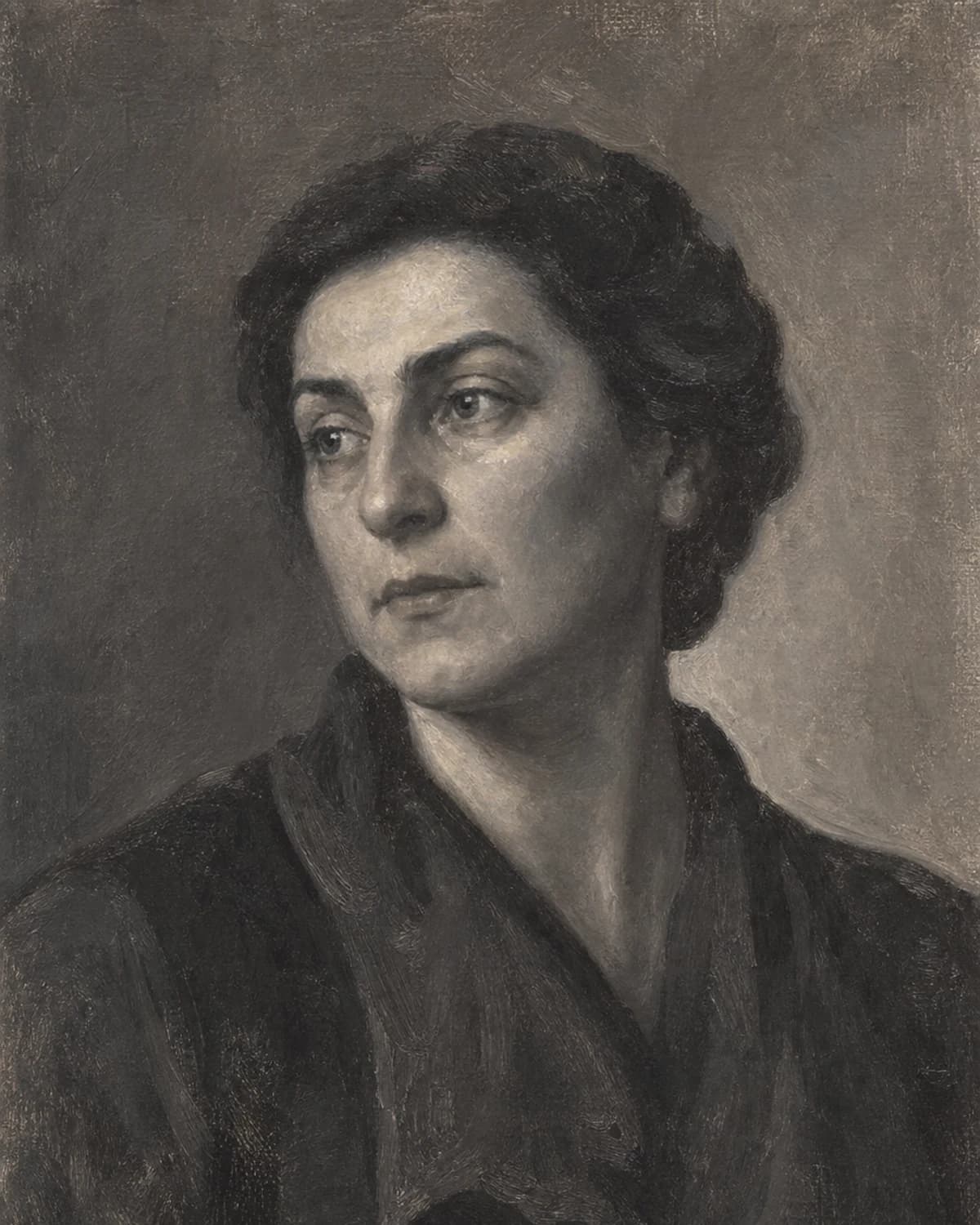
Tamar Abakelia
Tamar Abakelia (1905–1953) began in the theatre under the direction of Kote Marjanishvili, but it was sculpture that brought her recognition: in 1936–1937 she made the frieze on the building of the Georgian branch of the Marx–Engels–Lenin Institute in Tbilisi, and later the monument to Lesya Ukrainka in Surami. She illustrated “The Knight in the Panther’s Skin” and designed several Georgian films.
Biography
In 1938 Tamar Abakelia’s father and uncle were shot. Her father, Grigol Abakelia, was one of the senior prosecutors of the Georgian SSR; her uncle, Ioseb Abakelia, was regarded as a leading Georgian tuberculosis specialist. In the same year she herself began teaching at the Tbilisi Academy of Arts, where she had studied.
She was born on 19 August 1905 (1 September, Gregorian calendar; 19 August, Old Style) in Khoni, in the Kutais Governorate. She entered the Tbilisi Academy of Arts in 1923 or 1924 (the sources differ) and graduated in 1929. Her teachers are said to have included Nikoloz Kandelaki, Yevgeny Lanceray and Yakov Nikoladze; by some accounts, Joseph Charlemagne was another. She specialised in sculpture. She began exhibiting in 1927, and from 1930 she was a member of the Association of Revolutionary Artists of Georgia.
In stage design she worked under the direction of Kote Marjanishvili. Her first known work was “The Commune in the Steppe”, after Mykola Kulish, at the theatre named after him (1930). From 1932 to 1934 she was the designer of the Kutaisi theatre named after Lado Meskhishvili. Later she designed productions in Tbilisi and, by some accounts, also in Yerevan and Batumi. At the Marjanishvili Theatre these were “Shamil” (1935) and “Lali” after Karlo Kaladze (1947, revived in 1953). At the Rustaveli Theatre she designed “Poladauri” (1938), “Deer Gorge” (1944) and “Khevisberi Gocha” (1945). In 1938 she also worked at the Paliashvili Opera and Ballet Theatre on “Maltakva”. For the cinema she designed costumes: “Arsena” (1937), “Giorgi Saakadze” (1942) and “David Guramishvili” (1945).
Her drawings and illustrations ran alongside her stage work. Among her early sheets are “An Imeretian Boy” (1928) and “Pomegranate Harvest” (1930). For books she illustrated Nikolay Tikhonov’s “Poems about Kakheti” (1935), Shota Rustaveli’s “The Knight in the Panther’s Skin” (1936–1937), the Armenian epic “David of Sasun” (1939), works by Vazha-Pshavela (1947) and “Davitiani” by David Guramishvili. In 1949 she illustrated Tikhonov’s “Poems about Georgia” together with another artist, Avaliani. The sheet “Vintage” (1946) is held in the Georgian National Museum of Art.
Sculpture, to my mind, shows best how she worked in these years. The frieze of 1936–1937, made in concrete for the building on Rustaveli Avenue (now the Constitutional Court of Georgia), depicted the stages of socialist construction in the republic. Her wartime pieces for the studio, “The Wounded Soldier” (1942), “The Partisan” (1943) and the bronze composition “Let Us Avenge!” (1944), which is held in the Georgian National Museum of Art, answer to their time. She also made “A Collective Farmer’s Family” (1949). The monument to Lesya Ukrainka in Surami was unveiled on 3 August 1952.
In 1942 she was given the title of Honored Artist of the Georgian SSR. She received the Order of the Red Banner of Labour on 24 February 1946.
She was married to the poet and playwright Karlo Kaladze; their son, Gulda Kaladze, also became a sculptor.
Abakelia died in Tbilisi on 14 May 1953 and is buried in the Didube Pantheon. Posthumous exhibitions were held in Tbilisi in 1954 and 1963. A street in the city is named after her.
Related context
Associations
Works connected through artistic movements, cultural context and period. Priced works available in this market appear first.








Profile notes
Profile and sources
Image
Artist image
На основе открытого изображения: Tamar Abakelia; Wikimedia Commons; Public domain.
