
около 1725–1770
Suzuki Harunobu
Harunobu worked in Edo for about ten years, from 1760 until his death in 1770, and in that time made more than a thousand colour prints and over twenty illustrated books. After the exchange of calendar prints (e-goyomi) in 1765, he became one of the first to print multicolour nishiki-e from several blocks. His sheets rest on soft colours, embossing and literary allusion.
Biography
The first work of Harunobu's that is usually taken as his start dates from 1760: a narrow print with red printing, showing the actors Ichikawa Kamezō as Soga no Gorō and Bandō Sanpachi as Mihoya Shirō, after a play staged that March. After that he had ten years left.
Little is known about his early life. His birth year is given variously as 1724 or 1725, with a question mark. His birthplace is also uncertain: some say Kyoto, others Edo. He came from a samurai family; his grandfather and father, in this version, lost their status as hatamoto (direct retainers of the shogun) and were exiled from Edo to Kyoto. His family name at birth was Hozumi; later he took the name Suzuki, and his everyday name was Jirobei. For an ukiyo-e artist this was unusual: he signed with his own name, not a pseudonym.
Several teachers are named. Some sources speak of Nishikawa Sukenobu in Kyoto, others of Nishimura Shigenaga; the early sheets show the influence of the Torii school and Torii Kiyomitsu, and here and there of the Kanō school. In his first years he worked in the Torii manner: skilfully, but without standing out. He lived in Edo in the Kanda district and owned his house, which suggests a man of means. Among his neighbours was Hiraga Gennai, with whom, it is said, he experimented with techniques of colour printing.
The turning point came through a circle of amateur samurai. In 1764, thanks to his connections, Harunobu was brought in to make calendar prints (e-goyomi). In the lunar calendar the long and short months change from year to year, and the pictures encoded the difference: on the pattern of a kimono, for instance, the numbers of the long months were hidden. These sheets were exchanged at gatherings. The patrons, among them the hatamoto Ōkubo Jinshirō (haiku name Kyosen), spared no expense. They used the best paper, cherry wood instead of catalpa for the blocks, and thick, opaque pigments. Several blocks and up to ten colours went into a single sheet, and the registration of the impressions depended on notches and wedges. This is how nishiki-e, “brocade pictures”, came about, and 1765 is usually given as their beginning.
Success came quickly. For the Edo market Harunobu made pictures of beauties, scenes of city life and book illustrations. Kabuki actors, according to tradition, he did not want to paint, and called them trash. Yet in 1760 he had begun with an actor print, and more than thirty such works by him are known. I would not smooth over this discrepancy: either the words were attributed to him later, or his attitude changed.
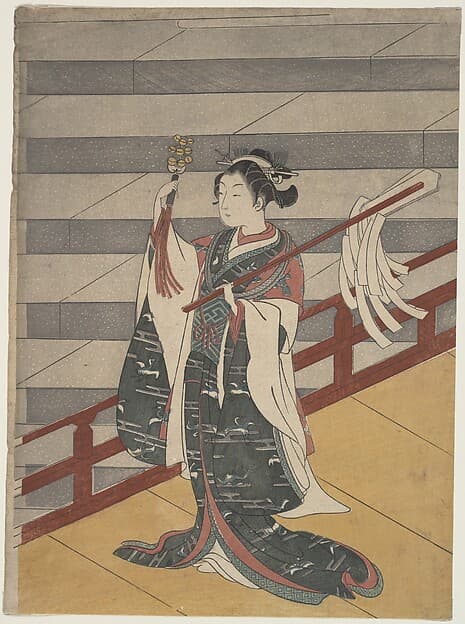
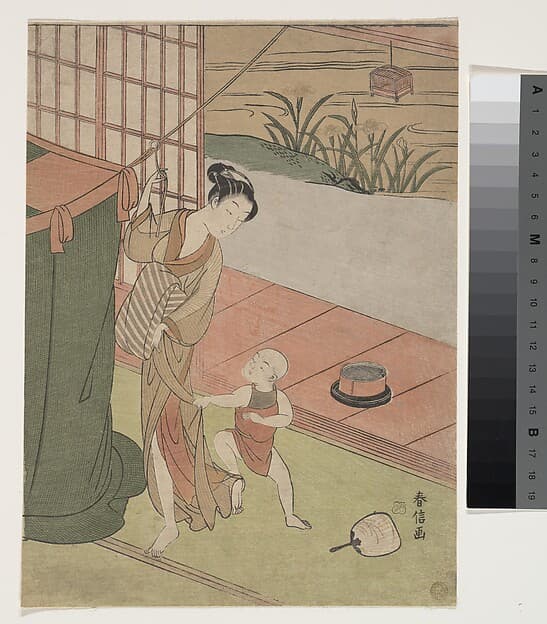
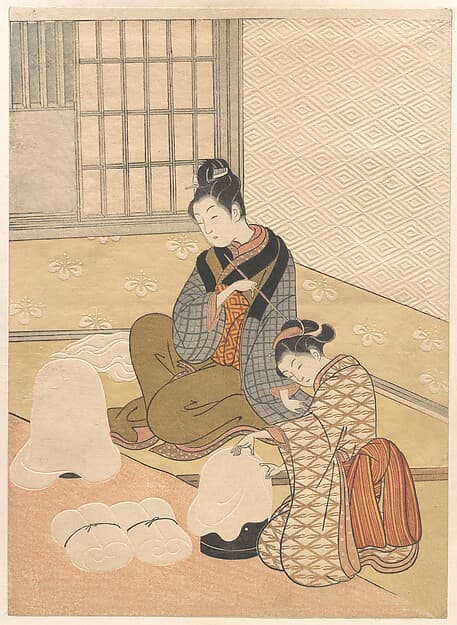
His figures are slender, light, almost childlike, with small hands and feet. The colours are intermediate tones, mixed with white. The background is often filled with a single colour, which sets the mood of the whole sheet. His subjects include courtesans and geisha, but also street vendors, errand boys, and sellers of water and fans. The beauty Kasamori Osen, from a teahouse, is known to have been a model. Many scenes rely on mitate, the device by which a classical subject is transposed into the present day. The series “Eight Parlor Views” (“Zashiki hakkei”) reworks the “Eight Views of Ōmi”, which in turn go back to the Chinese “Eight Views of the Xiao and Xiang Rivers”. In it, in place of Lake Biwa, there are a mirror stand, a fan, a lamp and night rain over a tea-kettle stand. The sheets carry the name of Ōkubo Kyosen as the originator of the idea. The appearance of a patron’s name, and in place of the artist’s at that, was a novelty in ukiyo-e.
Poems from the classics are often quoted, but the illustrations to them frequently poke gentle fun at the text. Like many of his contemporaries, he also made shunga, erotic prints.
Between 1765 and 1770 he produced more than twenty illustrated books, over a thousand colour prints and a few paintings. One of the last of the books, “Seirō bijin awase” (“Beauties of the Green Houses”), appeared in 1770: 166 courtesans of the Yoshiwara pleasure quarter, arranged by season.
Harunobu died in Edo in the summer of 1770; the exact date is unknown, and dates from 15 June to 8 July are given. A gravestone at the Daienji temple in Yanaka, put up in 1919 by admirers, bears his Buddhist name. Pupils and imitators carried on for a long time, and later his manner was eclipsed by Katsukawa Shunshō and Torii Kiyonaga. Among those who followed him is named Suzuki Harushige, that is, Shiba Kōkan, who, according to tradition, boasted of his ability to forge his master’s sheets.
Artist works
Works by the artist
Works by Suzuki Harunobu available in this edition of NEOARCA.

Profile notes