
23.09.1865–07.04.1938
Suzanne Valadon
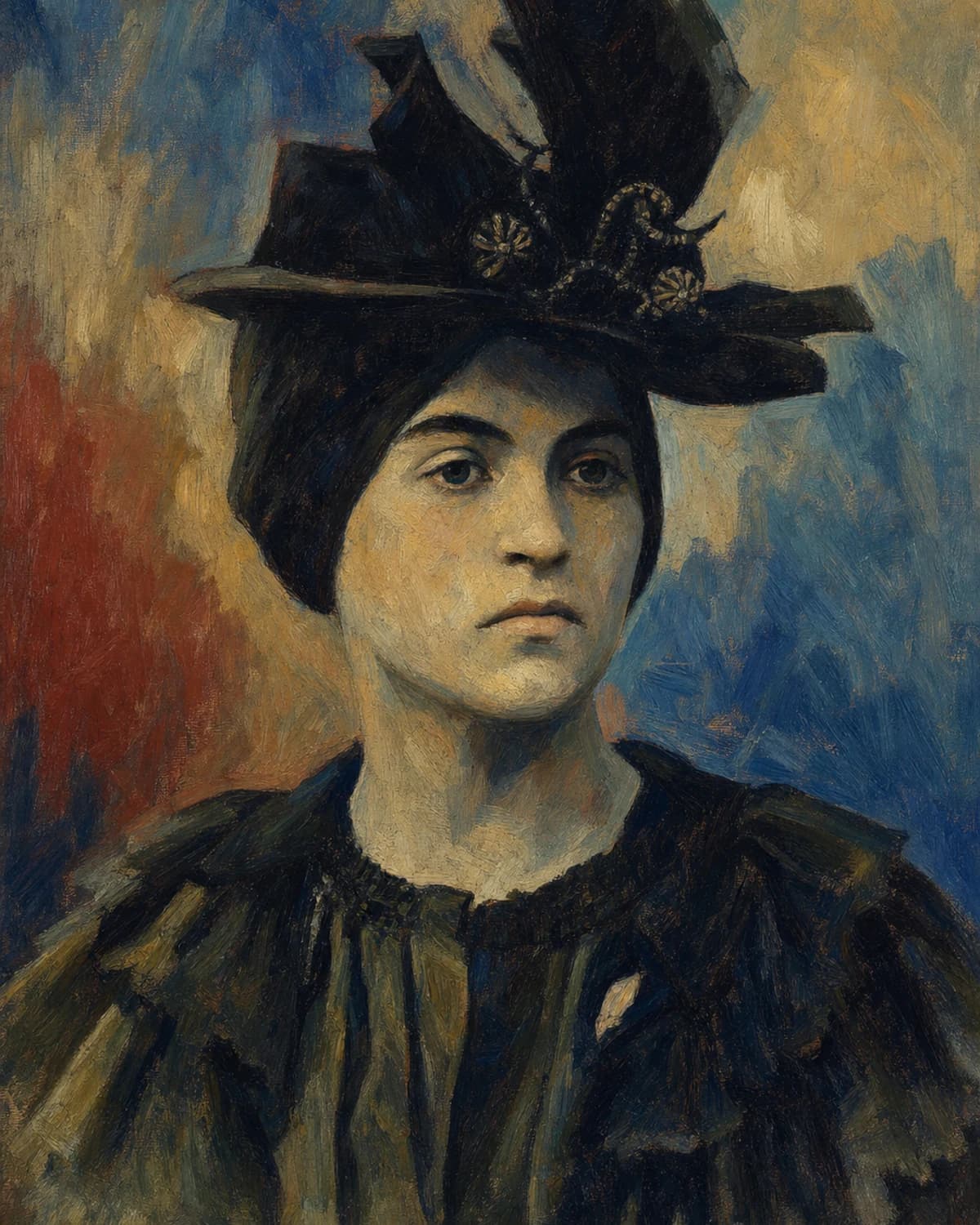
Suzanne Valadon grew up in the family of a Montmartre laundress, worked as a circus acrobat at fifteen, then modelled for Renoir, Puvis de Chavannes and Toulouse-Lautrec, learning to draw by watching them work. In 1894 she was admitted to the Société Nationale des Beaux-Arts, the first woman to be. She became known for nudes without idealisation; her son Maurice Utrillo also became a painter.
Biography
A drawing by Berthe Morisot from 1880, showing a young girl as a tightrope walker, is probably the earliest portrayal of Valadon by an artist. She was fifteen, and was still called Marie-Clémentine Valade.
She was born on 23 September 1865 in Bessines-sur-Gartempe, in Haute-Vienne. She never knew her father. She grew up in Montmartre with her mother, an unmarried laundress, attended primary school until she was eleven, and then went to work: in a milliner’s workshop, in a factory making funeral wreaths, selling vegetables, waiting tables. The circus job she wanted most she obtained in 1880, reportedly through two Symbolist painters who were decorating circus sets. A year later a fall from a trapeze, which injured her back, ended that career as well.
She began to draw, by tradition, at about nine, showing the drawings to no one. There was no money for lessons. Her school was modelling: for more than ten years, from 1880, she posed for Morisot, Puvis de Chavannes, Théophile Steinlen, Renoir, Jean-Jacques Henner and Toulouse-Lautrec, and watched how they worked. At first she posed under the name “Maria”; it was Toulouse-Lautrec who nicknamed her “Suzanne”, after the biblical Susanna and the Elders, because it seemed to him that she preferred posing for older artists. In 1883 she appears in Renoir’s “Dance at Bougival” and “Dance in the City”, and in 1885 in his “Girl Braiding Her Hair”, while Toulouse-Lautrec painted “The Hangover”. For two years she was Toulouse-Lautrec’s lover; in 1888 that relationship ended with her suicide attempt.
In 1883, at eighteen, she gave birth to a son, Maurice, the future painter Maurice Utrillo. Her mother mostly looked after him, while Valadon went back to modelling. Later a friend, Miquel Utrillo, signed papers recognising the boy as his son; the true paternity was never established.
The earliest surviving signed and dated work by Valadon is a self-portrait of 1883, in charcoal and pastel. Until 1893 she almost only drew; she turned to painting in 1892 and began to paint steadily in 1896, after marrying a well-to-do stockbroker, Paul Mousis. Her first models were family: her son, her mother, her niece. In the early 1890s Edgar Degas saw her drawings. He found them bold, bought them, introduced her to the collectors Paul Durand-Ruel and Ambroise Vollard, and taught her soft-ground etching. The friendship lasted until his death in 1917. In 1893 she had a brief affair with the composer Erik Satie, who wrote her passionate notes and called her his Biqui; after six months she left. Beside her portrait of Satie of 1893 I would put the very drawings that Degas supported: the line in them is firm and unsentimental.
In 1894 Valadon became the first woman admitted to the Société Nationale des Beaux-Arts, although the competition was fierce. In 1895 Durand-Ruel showed twelve of her etchings of women at their toilette. Later the Galerie Bernheim-Jeune regularly showed her work, and Berthe Weill, a Paris gallery owner, included it in nineteen exhibitions between 1913 and 1932, three of them solo shows. From 1909 Valadon exhibited at the Salon d’Automne, from 1911 at the Salon des Indépendants, and from 1933 to 1938 at the Salon des Femmes Artistes Modernes.
She painted her first large canvases for the Salon in 1909, moving from drawing to oil painting: “Adam and Eve” (1909), “Joy of Life” (1911), “Casting the Net” (1914). In them the man became the object of a woman’s desire, as women had been for male painters. The model for Adam was André Utter, a twenty-three-year-old friend of her son. In 1913 she divorced Mousis, and in 1914 she married Utter; they exhibited together until their divorce in 1934, though they did not break off the relationship.
Valadon never studied at an academy, and to my mind this shows in her nudes: she painted working-class women, heavily built, sometimes awkwardly posed, unidealised and self-possessed. She painted nude self-portraits all her life; the last shows her ageing body realistically. She did not trust ink or watercolour, finding them too fluid, and worked in oil, pencil, pastel and red chalk, with a firm black line around the figures. Some paintings she worked on for years. In later works, such as “Blue Room” (1923), the colour is brighter and the background becomes decorative, with patterned fabrics. By one count she left about 273 drawings, 478 paintings and 31 etchings, not counting those given away or destroyed.
Valadon died on 7 April 1938. André Derain, Pablo Picasso and Georges Braque were at the funeral. She was buried in the Saint-Ouen cemetery near Paris, where Utter was later laid beside her.
Related context
Associations
Works connected through artistic movements, cultural context and period. Priced works available in this market appear first.








Profile notes
Profile and sources
Image
Artist image
На основе открытого изображения: Unknown author Unknown author; Wikimedia Commons; CC0.
