
16.12.1863–13.12.1940
Stepan Aghajanian
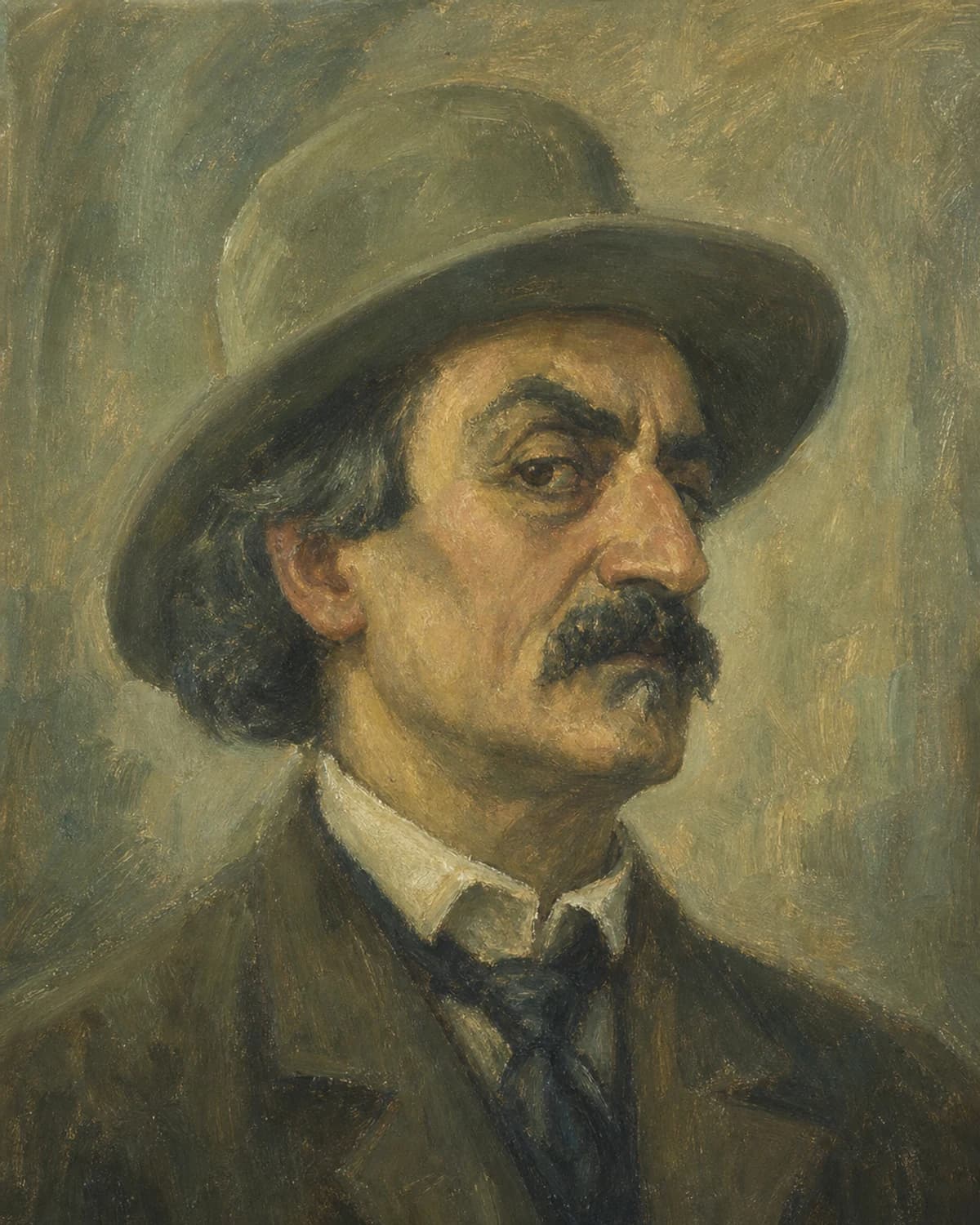
Stepan Aghajanian (1863–1940) was born in Shusha into a tailor’s family, studied in Marseille and at the Académie Julian in Paris, and for almost two decades taught drawing in Rostov-on-Don. In Yerevan, where he moved in 1922, he painted most of his best portraits: “Uncle Sedrak”, “The Street Child”, his self-portraits. The main collection of his work is in the National Gallery of Armenia.
Biography
He painted two companion portraits, of his father and his mother, in 1900, soon after returning to his native Shusha. He was thirty-six, and Marseille and Paris lay behind him. Those who describe these pictures speak of restrained colour and carefully rendered characters.
Stepan Meliksetovich Aghajanian was born on 28 December 1863 (16 December, Old Style) in Shusha, then part of the Baku Governorate. His father was a tailor. From 1872 to 1881 the boy studied at the diocesan school, then until 1884 at the Russian secondary school for science and modern subjects. In 1884 he left for Baku, and in 1886 he went to France. In Marseille he spent four years, until 1890, working in an art studio. What happened between 1890 and 1897 I cannot make out: there is no information about that period, and I will not try to fill it. The next securely known step is Paris, the Académie Julian, where from 1897 to 1900 he took lessons from Jean-Paul Laurens and Jean-Joseph Benjamin-Constant, painters of the academic establishment.
After his return to Shusha the sources differ in detail. According to some accounts, from 1903 to 1922 he lived in Rostov-on-Don and taught drawing in schools. According to other accounts, there was also an episode in Baku, from 1902 to 1904, and he left Rostov earlier, in 1921. I would leave these discrepancies open. One thing is beyond dispute: for almost two decades he taught schoolchildren to draw, rather than painting commissions in a capital.
In 1922 Aghajanian moved to Yerevan and until 1940 taught at the Yerevan art school (now the Panos Terlemezyan State College of Fine Arts). There, in his sixties, he painted most of his best pictures. These are the years of portrait types: “Uncle Sedrak” and “Vasil” (both 1926), “The Street Child” (1928). His works also include “The Artist’s Sister” (1926), “The Playwright Emin Ter-Grigoryan” (1927), “A Karabakh Woman” and a portrait of a composer named Ter-Ghevondyan. His realist portraits are generalised into types: a person from the street or the village becomes a representative of a milieu. The self-portraits of 1925 and 1926 stand apart; they are noted for their deep psychological insight.
In 1931 he was given the title of Honoured Artist of the Armenian SSR, and in 1938 that of People’s Artist. In November 1939 he received the Order of the Red Banner of Labour (a Soviet state decoration) “for outstanding services in developing Armenian theatrical and musical art”, a curious citation for a painter, and I cannot explain it.
Aghajanian died in Yerevan on 13 December 1940. A memorial plaque is mounted on the house at 42 Abovyan Street. Most of his works are kept in the National Gallery of Armenia.
Related context
Associations
Works connected through artistic movements, cultural context and period. Priced works available in this market appear first.








Profile notes
Profile and sources
Image
Artist image
На основе открытого изображения: Stepan Aghajanian; Wikimedia Commons; Public domain.
