
07.10.1928–21.04.1980
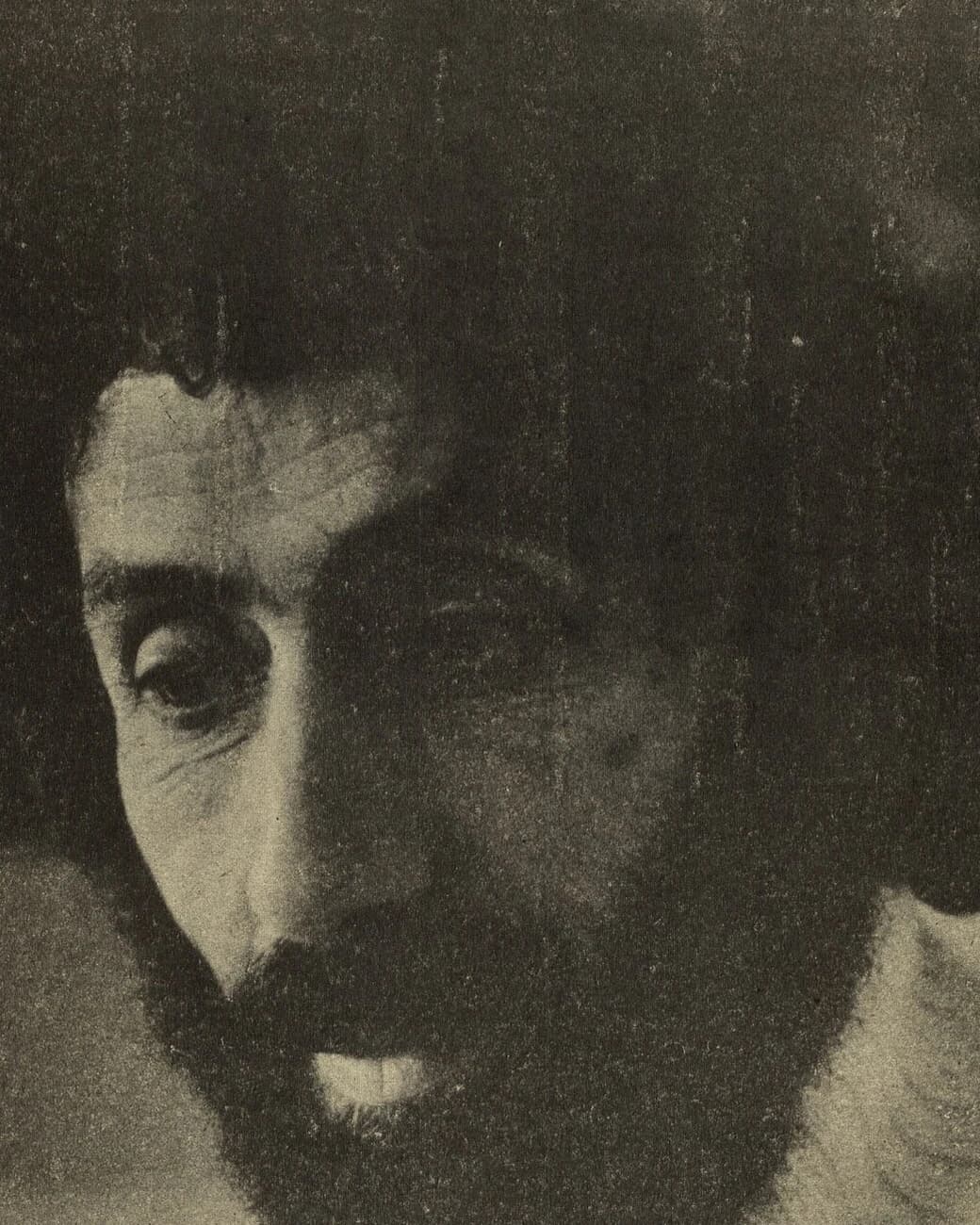
Sohrab Sepehri
In Iran, Sohrab Sepehri (1928–1980) is known above all for the poems of his collection “The Eight Books”, which are quoted in the press and included in school textbooks. Yet he graduated from the Faculty of Fine Arts at the University of Tehran, studied lithography in Paris and Tokyo, and from 1962 lived by selling his books and paintings, preparing between fifty and a hundred and fifty new works for each exhibition.
Biography
In August 1957 Sohrab Sepehri left Iran for Europe overland, through Turkey, Bulgaria and Yugoslavia, and in Paris enrolled as an auditing student in the lithography department of the École des Beaux-Arts. When his scholarship stopped, he had to earn his own keep: he washed apartment windows, hanging from tall buildings. This twenty-eight-year-old window cleaner already had an honours degree from the University of Tehran and three published collections of poetry behind him.
Oddly enough, it was Paris that turned him towards the East.
The Parisian school of painting at the time showed a marked interest in Asian art, and after the trip Sepehri took up Eastern philosophy in earnest, both in his poems and in his paintings. The collection “Downpour of Sunshine” was ready for the press as early as 1958 but did not appear until 1961, the same year as “East of Sorrow”.
He was born on 7 October 1928, in Qom according to some sources and in Kashan according to others; his childhood and school years were spent in Kashan. The family valued poetry and painting: his grandmother, Hamideh-Banou, wrote poems that were printed in periodicals at the end of the Qajar era, his father worked at the post office and loved art, and his mother loved poetry as well. His father died in 1941. Sohrab finished the Khayyam primary school in 1940 and the Pahlavi secondary school three years later, and in May 1943 he went to Tehran to study at a teachers’ college for young men. He then returned to Kashan for his teaching practice, worked in the local education department and passed the examinations for a full school certificate as an external candidate. His first collection, “At the Edge of the Meadow, or The Mausoleum of Love”, came out in 1947 and still follows the Romantics, with love lyrics and a longing for solitude. His first known painting dates from the same time: an idyllic pastoral landscape in the classical manner.
In the autumn of 1948 he entered the Faculty of Fine Arts at the University of Tehran and graduated with honours in 1953. As a student he was drawn to Cubism and published the collections “The Death of Color” (1951) and “The Life of Dreams” (1953); his Cubist experiments suited the second, with its surrealist visions, very well. In 1955 his translations of Japanese poems into Persian appeared in the magazine Sokhan. In these years, from 1948 to 1960, he made his living in salaried jobs: at the Anglo-Iranian Oil Company, which he left after eight months; as a designer for a public health organisation; in the museums department of the Ministry of Culture and Art; as a teacher at a higher school of decorative arts; and in the advertising department of the information directorate of the Ministry of Agriculture.
In 1960 he went to Tokyo to study lithography and woodcut, and on the way back, in 1961, he visited India and became acquainted with Buddhism. In March 1962, after returning from Japan, Sepehri left government service for good and began to live by selling his books and paintings. For each exhibition he made between fifty and a hundred and fifty new works, and they were bought by the Iranian intelligentsia and by connoisseurs. In 1964 he was in India again, and also in Pakistan and Afghanistan.
The mid-1960s are considered his most productive period, in poetry and in painting alike. It was then that he wrote “The Water’s Footfall” (1965), “The Traveller” (1966) and “The Green Volume” (1967 or 1968). In “The Water’s Footfall” he speaks about himself, his family and his way of thinking, so that the poem reads almost like an autobiography. His sentences are short, in place of the long periods that Persian poetry had favoured for centuries. He often worked far from people, in the village of Chenar and in the deserts around Kashan, and his canvases are mostly of nature.
In the 1970s he painted less: Sepehri travelled a great deal to exhibitions, biennials and festivals, and his works, sometimes without their author, went to Italy, Hong Kong, Israel, Brazil, the United States, Greece, Egypt and many other countries. He never stayed abroad longer than two months, because he would begin to miss Kashan and the villages of Chenar and Golestaneh. Of the ten years between “The Green Volume” and his last collection, “We Are Nothing, We Are a Gaze” (1977), scholars know little. Family and friends recalled that he sat in his room, painted and wrote poems, and read poetry, philosophy and the history of religions in Persian, French, English and a little Japanese, languages he had taught himself. There are almost no documents from that decade, and to my mind it is more honest to say so. In 1976 nearly all his poems were gathered in a single book, “Hasht Ketab”, that is, “The Eight Books”.
Sohrab Sepehri died on 21 April 1980 in Tehran. The next day he was buried in the village of Mashhad-e Ardahal near Kashan; the calligrapher Reza Mafi decorated the gravestone with lines from his poem “The Oasis of Now”. Sepehri’s paintings and drawings are held in museums around the world, and Abbas Kiarostami took the title of his poem “Where Is the Friend’s House?” for his 1987 film.
Profile notes
Profile and sources
Image
Artist image
ک. ا; Wikimedia Commons; Public domain.
