
1531–16.11.1625
Sofonisba Anguissola
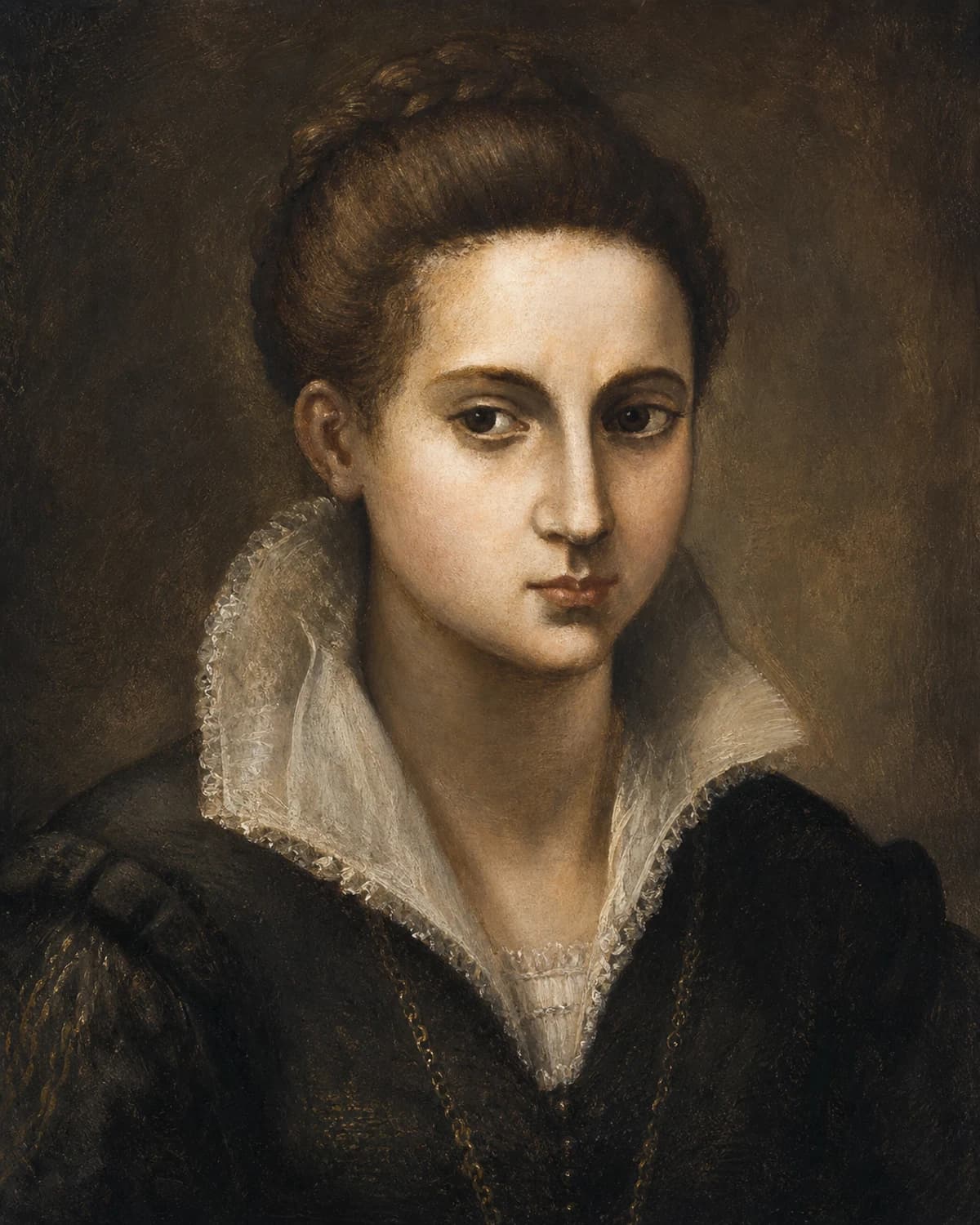
Sofonisba Anguissola (c. 1532 – 1625), from an impoverished noble family of Cremona, trained with local masters, showed her drawings to Michelangelo and in her early twenties became famous for portraits of her sisters and self-portraits. She spent about fourteen years at the Madrid court of Philip II as a lady-in-waiting and drawing teacher to the queen, then lived in Sicily, Genoa and Palermo.
Biography
On 12 July, in Palermo, the young Fleming Anthony van Dyck sketched a very old woman in his Italian sketchbook and noted that she was ninety-six, that her eyesight had weakened, and that her memory and mind were still clear. He was said to have claimed that their conversation taught him more about the “true principles” of painting than anything else. The year of this note was long read as 1624; the most recent examination of the document gives 1629.
The old woman was Sofonisba Anguissola. More than seventy years earlier, Michelangelo had looked over a drawing of hers.
She was born around 1532 in Cremona, the eldest of the seven children of Amilcare Anguissola and Bianca Ponzone, people of ancient lineage but little money. Six of the children were girls, and their father, a reader of Baldassare Castiglione’s “The Book of the Courtier”, gave them all a humanist upbringing with Latin, music and drawing. Sofonisba was named after a Carthaginian heroine: the family was fond of Carthaginian names generally, and the only son was called Asdrubale. Four of her sisters, Elena, Lucia, Europa and Anna Maria, also painted, but she became the best known of them and taught the younger ones; Elena entered a convent and Lucia died young. At about fourteen Sofonisba and Elena were sent to study with Bernardino Campi, a Cremonese portraitist, and when he moved to Milan around 1550 she went on to Bernardino Gatti, known as Il Sojaro, a pupil of Correggio. An unusual double portrait from this time survives: Campi painting a portrait of Sofonisba herself.
In 1554 she travelled to Rome, where she was introduced to Michelangelo. She showed him a drawing of a laughing girl; he replied that a weeping boy would be harder to draw. The result was “Child Bitten by a Crayfish”, and Michelangelo, impressed, gave her sheets from his notebooks to work from for at least two years and commented on the results. It has been suggested that Caravaggio remembered this drawing when he painted his “Boy Bitten by a Lizard”.
A well-born young woman was not expected to study anatomy from the nude, and large multi-figure scenes were closed to her. She painted the people around her, and herself. About sixteen of her self-portraits survive, more than from any other artist between Dürer and Rembrandt; in them she appears now at the easel, now at the spinet. Her father sent them out as letters of introduction, and his daughter’s fame grew with them. In “The Game of Chess” (1555, National Museum in Poznań) her sisters Lucia, Minerva and Europa sit at the board in formal dress but with quite informal, lively faces. Such a combination was unusual in Italian painting of the time. Around 1557–1558 she painted a group portrait of her father with Minerva and Asdrubale, now in Denmark, in the Nivaagaard Collection. To my mind, her best work is right here, in these family pieces painted before Spain.
In 1558, in Milan, she painted the Duke of Alba, who recommended her to Philip II. In the winter of 1559–1560 Sofonisba arrived in Madrid as a lady-in-waiting to the fourteen-year-old queen, Elisabeth of Valois, the king’s third wife, and began teaching her to draw. At court she painted official portraits: the king’s sister Joanna, the heir Don Carlos, the infantas Isabella Clara Eugenia and Catherine Michaela, and, after Elisabeth’s death in 1568, the new queen, Anne of Austria. She signed none of these portraits, and in time they came to be attributed to Alonso Sánchez Coello and Juan Pantoja de la Cruz. Only recently has the well-known portrait of a middle-aged Philip II been returned to her.
The king himself saw to her future: he provided a dowry of twelve thousand scudi and a pension. In the early 1570s she was married to a Sicilian nobleman, Fabrizio Moncada, and the couple are usually thought to have lived in Paternò, though some scholars believe they remained in Spain. For Paternò she painted the “Madonna dell’Itria”. Widowed in the late 1570s, she married again, in Pisa, the Genoese Orazio Lomellino, and lived in Genoa for several decades, remaining the city’s leading portraitist and receiving young artists who came to talk about art. She now also painted small religious pictures for private chapels; many of them are lost. Her last self-portrait is dated 1620. Then her eyesight failed, and she stopped painting.
By the traditional dating, Sofonisba Anguissola died in Palermo on 16 November 1625; under the new reading of van Dyck’s note her death is placed in 1629. Her husband, who called her small of frame yet “great among mortals”, buried her with honour in the Palermo church of San Giorgio dei Genovesi and later placed an inscription on her tomb.
Related context
Associations
Works connected through artistic movements, cultural context and period. Priced works available in this market appear first.
Profile notes
Profile and sources
Image
Artist image
На основе открытого изображения: Eugenio Camerini; Wikimedia Commons; Public domain.
