
07.12.1922–12.09.2008
Simon Hantaï
Simon Hantaï began in 1960 to paint on folded and crumpled canvas: the cloth was painted, then unfolded, and the untouched areas became part of the picture. Born in Hungary, he lived in France from 1948, was close to the Surrealists and broke with them in 1955. In 1982 he represented France at the Venice Biennale, and then withdrew from public life for almost a decade and a half.
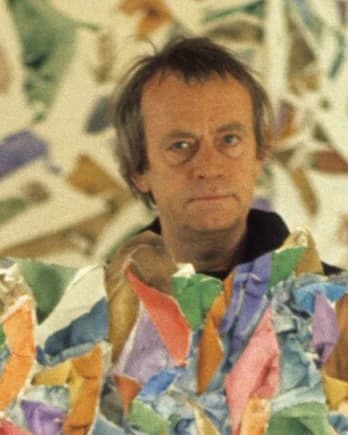
Biography
On 7 December 1952, his thirtieth birthday, Hantaï left a small unsigned picture-object at André Breton’s door on the rue Fontaine. Soon afterwards, passing the window of the gallery À l’étoile scellée (“The Sealed Star”), he saw his work on display there. That was how Breton came to know of him.
He was born on 7 December 1922 (by other accounts, 8 December) in Bia, now Biatorbágy, into a Catholic family of Swabian origin. German was spoken at home, and he learned Hungarian only at school. His father’s surname was Handl; in 1938 the family changed it to the more Hungarian-sounding Hantaï. He was meant to become an engineer, but he enrolled at the Budapest School of Fine Arts, where he studied from 1941; among his teachers is named Vilmos Aba-Novák. His early Hungarian works are figurative, with traces of Matisse and the Nabis. On 15 March 1944, for an anti-German speech at the school, he was arrested by the Arrow Cross, the Hungarian fascist movement, but escaped; this story is hard to check against other documents.
In 1948, with his wife, the painter Zsuzsa Biró, he was preparing to go to Paris on a promised scholarship. While the visa failed to arrive, the couple went to Rome and travelled on foot through Italy, where Hantaï discovered Piero della Francesca, Masaccio and Giotto’s Madonna in the Uffizi. In Paris that autumn they learned that the scholarship had been refused. They decided to stay: first they lived in a hotel room on the Île Saint-Louis, then on the rue Servandoni, then at the Cité des Fleurs in the 17th arrondissement. In 1950, after meeting Joan Mitchell, he took part in a group show at the Galerie Huit alongside American painters; this was his first appearance in Paris. His first solo exhibition took place in early 1953, with a catalogue preface by Breton. Hantaï illustrated the first issue of the Surrealist journal Médium. But already in 1954 he wrote, with Jean Schuster, the critical essay “Une démolition au platane” (“A Demolition by Plane Tree”), published in 1955. In March 1955 he told Breton in a letter that he was leaving the group: Breton refused to admit any link between automatic writing and Jackson Pollock’s action painting. Hantaï’s last exhibition under the Surrealist banner was “Alice in Wonderland” (1955).
Gestural canvases came next. He covered the canvas with bright colours, laid a dark, greasy layer over them and scraped it with a razor blade or a part from an alarm clock, so that colour showed through from beneath. The 1956 exhibition “Sexe-Prime. Hommage à Jean-Pierre Brisset” at the Galerie Kléber began his work with Jean Fournier, which lasted until Fournier’s death in 2006. In 1958–59 Hantaï spent a whole year copying out in ink the texts of the liturgical calendar along with philosophers and mystics, and in the afternoons made “À Galla Placidia”, in which thousands of tiny strokes recall the mosaics of the mausoleum in Ravenna. He showed the first work only in 1976, and gave the second to the state only in 1998.
In 1960 he made folding (pliage) his method. The canvas was crumpled or folded, the visible parts were painted, and it was unfolded; the colour lay in fragments, while the untouched areas remained as an equal part of the picture. He explained it this way: one had to put oneself in the place of someone who had seen nothing yet, “in the canvas itself”. The first series, the “Mariales” (“Cloaks of the Virgin”, 1960–62), numbers 27 works. It was followed by the “Catamurons” (1963–64) and the “Panses” (“Bellies”, 1964–65), in which the canvas was knotted into a sack. The folds have also been linked to his mother’s apron, but this is hard to confirm from documents.
In 1966 Hantaï took French nationality, and the family settled at Meun, in the Forest of Fontainebleau. For a year he did not paint at all. The “Meuns” series (1967–68) is named after that village; in it the white, unpainted canvas shows plainly for the first time. To my mind, it is here that his painting first enters into conversation with Matisse’s cut-outs. In 1967 he received the Fondation Maeght prize, and in 1968–69 the Fondation gave him a solo exhibition. Then came the “Études” (1969–71), “Aquarelles” (1971), “Blancs” (1972–74) and “Tabulas” (from 1972), in which knots produce a grid of squares with “stars” of white at the intersections. In 1973 a large exhibition was held in Saint-Étienne, and for a school in Trappes he made a wall 3 × 14 metres. In 1976 a retrospective at the Musée National d’Art Moderne in Paris brought him full recognition. After it he did not paint for more than three years, questioning the place of art in society and the art market. In 1980 he received the Grand Prix National des Arts Plastiques. From August 1979 he lived in Paris near the Parc Montsouris, with Meun remaining a country house.
In 1982 Hantaï represented France at the Venice Biennale with eighteen “Tabulas” from 1974–81, but he himself considered the show a failure: some canvases were shown without stretchers, and the central space was given to Toni Grand. Soon afterwards he announced that he was giving up public activity. He declined exhibitions, among them Dominique Bozo’s proposal at the Centre Pompidou in 1986. Until 1985 he still painted, then buried some works in his garden and destroyed or cut up others; from this grew the “Laissées” (“Leftovers”, from 1989). His interlocutors were philosophers, among them Hélène Cixous, Gilles Deleuze, Jacques Derrida, Georges Didi-Huberman and Jean-Luc Nancy.
Hantaï died on 12 September 2008 in Paris, in the 14th arrondissement. A posthumous retrospective at the Centre Pompidou opened on 22 May 2013: more than 130 works from 1949 to 1990.
Profile notes
Profile and sources
Image
Artist image
Archives Simon Hantaï; Wikimedia Commons; CC BY-SA 4.0.