
1707–1769
Sim Sajŏng
Sim Sajŏng (1707–1769) came from a distinguished family, but because of his grandfather’s case he could not enter government service and earned his living by painting all his life. He studied under Jeong Seon and painted flowers, insects, birds and landscapes. In 1748 he was appointed to supervise the copying of a royal portrait, but was soon dismissed.
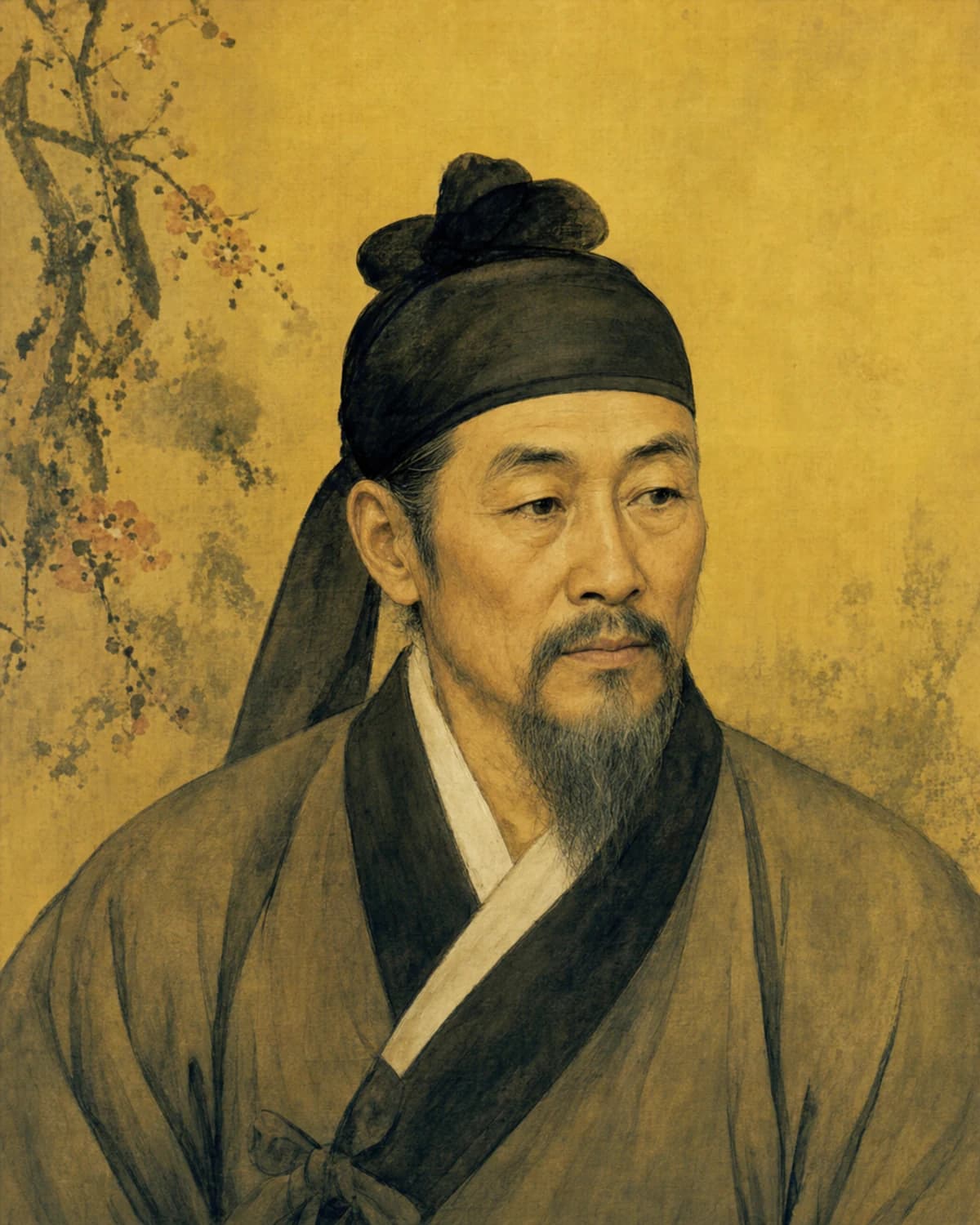
Biography
In 1748, under King Yeongjo, Sim Sajŏng was appointed a supervisor in the office that copied and restored portraits of the king. The post was taken away from him very soon. For an artist with no other road to court, it was a rare chance, and it did not last.
The reason lay in his family.
Sim Sajŏng was born in 1707 into the Cheongsong Sim clan, one of the distinguished families. His great-grandfather Sim Jiwon had been chief state councillor, his father Sim Jeongju was known as a master of ink painting of grapes, and his mother came from the Hadong Jeong clan: her father, an official of the Office of the Inspector-General, was also considered a good painter. His elder brother was called Sim Sasun. It seemed that the road to government service was open. But his grandfather, Sim Ikchang, had been drawn into an affair after which his descendants were regarded as kin of a disgraced man, and the doors to an official career were closed to the grandson. I do not give the details of the affair: I have no documentary evidence about it at hand, and the painter’s own fate shows what came of it. All his life he did nothing but paint.
He began to study painting early, probably before the age of fifteen, under Jeong Seon, the best-known landscape painter of the time. The lessons broke off in 1721, when Jeong Seon was appointed district magistrate at Hayang and left. After that Sim Sajŏng developed on his own. He studied Chinese painting and combined the methods of the Southern and Northern schools in a manner of his own. Together with Jeong Seon and Jo Yeongseok, he came to be counted among the leading painters of the second half of the Joseon period. Korean tradition places him among the literati painters, who worked in the spirit of “scholars’ painting” (muninhwa).
His range of subjects is wide: landscapes, flowers and grasses with insects, birds and animals, figures. The painter and connoisseur Kang Sehwang, his contemporary, ranked his flowers and insects highest, then birds and animals, and only after that landscapes. The order is curious: today Sim is more often remembered as a landscape painter, next to Jeong Seon.
His experience of the world was narrow. When the scholar Yi Deokmu asked him about his travels, the painter answered that he had been to the Geumgang Mountains and to the fortress of Daeheungsanseong, but had never reached nearby Bukhansan. He gave as the reason the stigma of being the descendant of a man charged with an offence against the state. Apparently for that reason many of his mountain views were built on Chinese models and imagination rather than on nature. To my mind, this is worth remembering when one looks at “The Road Through the Shu Mountains” or “Night Mooring on the River”.
Works by Sim are held in major Korean collections. The National Museum of Korea has “Night Mooring on the River” (Gangsang yabakdo), “Searching for Plum Blossoms on the Bridge at Bayqiao”, “Fierce Tiger”, “Flowering Trees and Insects” and “Immortal Crossing the Sea”. The Deoksugung branch of the National Museum of Modern and Contemporary Art shows “Autumn Vegetable Garden”, “Watching Fish in a Flowering Harbour”, “Living in the Mountains by a Stream” and “Dragon in the Clouds”. The Gansong Art Museum holds “The Road Through the Shu Mountains” and “The Immortal with a Toad”. A number of landscapes, among them “Summer Landscape” and “Moonlight at the Wicker Gate”, are in private collections.
He used the art names Hyeonjae and Mukseon, the second meaning roughly “Chan monk of ink”. Sim Sajŏng died in 1769.
Related context
Associations
Works connected through artistic movements, cultural context and period. Priced works available in this market appear first.








Profile notes
Profile and sources
Image
Artist image
На основе открытого изображения: Sim Sa-jeong; Wikimedia Commons; Public domain.
