
21.03.1938–16.05.2026
Silvio Benedetto
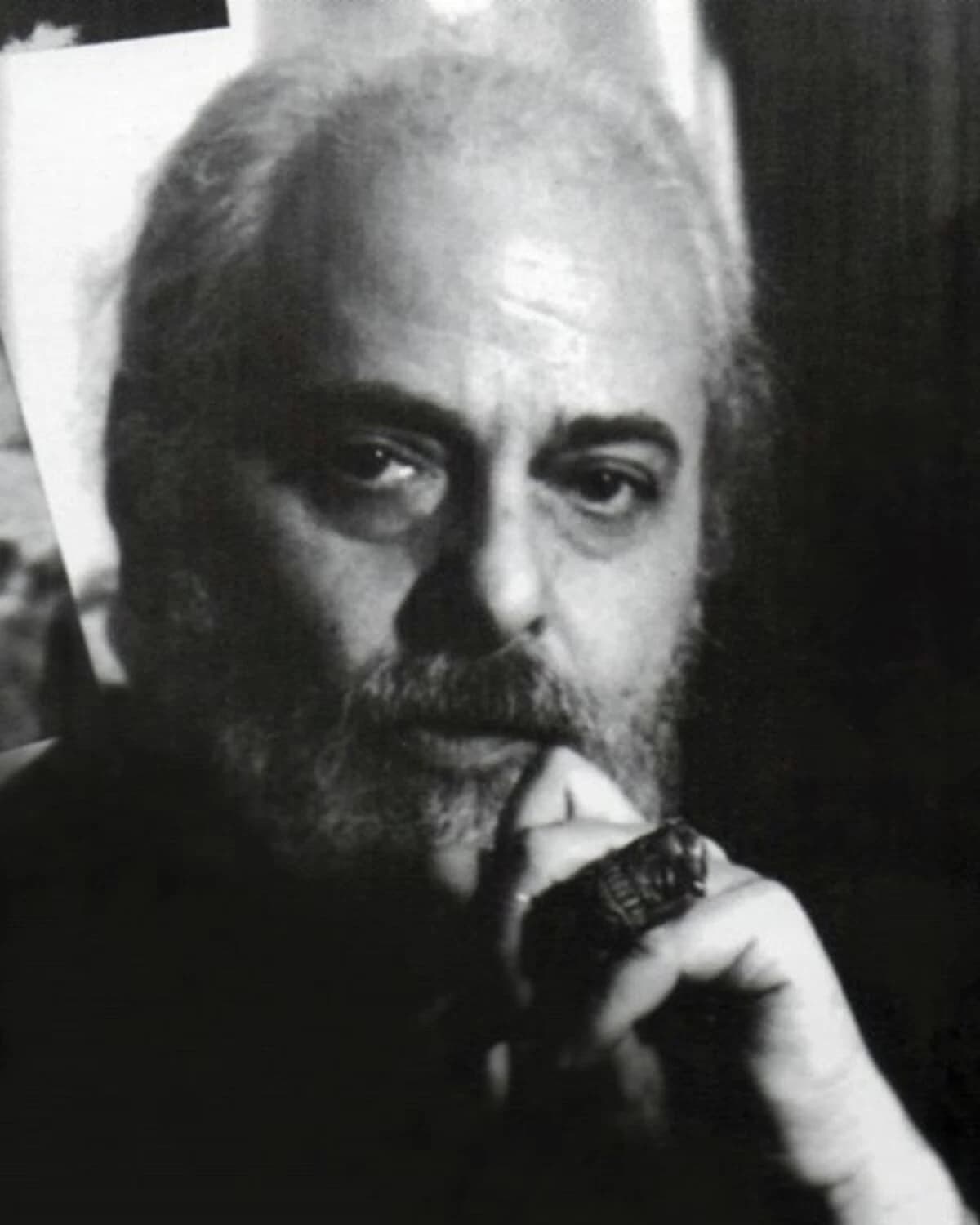
At eighteen Silvio Benedetto (1938–2026) won first prize at the Pan-American Biennial of Sacred Art in Buenos Aires, and in 1961 he moved to Italy. He painted murals in Mexico and Sicily, in 1974 showed in Palermo a 33-metre structure, “Man-Christ”, that was taken down after a few days, and decorated the stations of the Cinque Terre National Park.
Biography
In December 1974 a polyhedral structure 33 metres high, which its author called “Man-Christ”, stood in the streets of Palermo. The city administration dismantled it after a few days: in its words, this was a Christ unsuited to Christmas. The dispute that followed was a long one. Silvio Benedetto’s manifesto “Art as Action in the Urban Context” was signed by the architect Bruno Zevi, the composer Luigi Nono, the critic Enrico Crispolti, Leonardo Benevolo and Cesare Zavattini.
By then he had long been living in Italy.
Benedetto was born on 21 March 1938 in Buenos Aires, into a family of Italian origin in which almost everyone was connected with the arts. His grandfather Benito Caldarella was a portrait photographer, his mother Adela Caldarella a painter, ceramist and stage actress, and his father Juan Valente Benedetto an actor and journalist who founded the first association of journalists in Buenos Aires. In 1956, at eighteen, the son won first prize at the Second Biennial of Pan-American Sacred Art. Between 1957 and 1961 he had several solo exhibitions, including one at the Provincial Museum of Fine Arts in Tucumán.
In 1961 he left for Italy and settled in Rome. He had solo shows at the Penelope, Zanini and New Weight galleries in Rome, the Compass in Turin, the De’ Foscherari in Bologna and the Gianferrari in Milan. Together with the photographer David Racanelli he took part in founding the Due Mondi gallery and managed it in its first years. Between the mid-1960s and the early 1990s he made many engravings and lithographs at the Roman print workshops Il Torcoliere and Il Feltro, and exhibited in various European cities.
From 1967 he travelled and worked in Latin America. He took part in making the mural “La Marcha de la Humanidad” in the World Trade Center complex in Mexico City. The Colombian critic Marta Traba wrote in the catalogue of the Gallery of Modern Art of Colombia that he had become the “scandalous case” of Latin American painting: a rival of Guayasamín, a challenger of Siqueiros and the winner in Mexico of an “abnormal” mural. She meant the mural at the Casino de la Selva in Cuernavaca, “Progreso y Violencia”, 30 by 50 metres, which has been destroyed. About seventy of his works remain in Cuernavaca, gathered in a museum named after him; among them are the “Dialogues”: “Great Deposition with Christ by Mantegna”, “The Shooting of Goya in the Studio” and “The Flood by Paolo Uccello”. In Ecuador he also made a mural, at the university of Guerrero.
Not everything survived in Italy either. In the fire at the Palace Hotel in Mondello in 1973 his painting “Ratto di Santa Teresa – dialogo con Bernini” was destroyed; on that theme only a folder of engravings with a preface by Leonardo Sciascia remains. In 1977 he was invited to the 10th Rome Quadrennial, in the section for foreign artists working in Italy, where he showed a triptych: “Flood”, “Procession” and “Greek Tragedy”. In Normandy the Museum of Fine Arts in Fécamp mounted a solo exhibition of his work. In 1992 the Norman Palace in Palermo hosted the first exhibition of his sculpture, “The Metaphor of the Mountain”.
In Campobello di Licata, together with Olga Macaluso, he began the Valley of the Painted Stones: 110 polychrome travertine boulders, two metres by three, painted on several sides after Dante’s “Divine Comedy”. At the exhibition “Raum!” at the Künstlerhaus in Vienna in 1998 he showed the installation “Via Scialoja 6 at the Künstlerhaus” and a performance inspired by Goethe’s “Faust”. From 1996 he also worked as a theatre director, staging “Lo specchio di Mefistofele”, “Faust opera ultimo” and “Faust” for the Radicondoli festival.
From 1999 the Cinque Terre National Park commissioned him to carry out the project “Artistic Itineraries”. He painted large murals in the park’s five railway stations, Riomaggiore, Manarola, Corniglia, Vernazza and Monterosso, linking them by a common manner and theme into a cultural trail for visitors. In Manarola he designed the decoration of Piazza Capellini: the terracotta tiles were made by Silvia Lotti, and the circular pattern at the centre by his daughter Flavia Benedetto. A monument to Fabrizio De André was also unveiled there. Along the whole wall of the pedestrian tunnel in Riomaggiore, which leads from the station to the town centre, he made “The Sequence of Memory”, 157 metres long: a mosaic of shaped tiles, glazed majolica, stones, pebbles, red and green Levanto marble, crystals, mirrors, shells and pottery, depicting the coast of the Cinque Terre. In 2000, at the Military Maritime Arsenal in La Spezia, he created the mural “Tradizione Tecnologia Arte”, several assemblage sculptures and a performance. In 2001 he began “L’Iliade in terra e fuoco”, a ceramic mural 7.3 by 3.1 metres made of majolica pieces of various shapes; in the same year he also made a graphic “Iliad”.
Benedetto died on 16 May 2026 in Campobello di Licata, in Sicily, at the age of 88.
Profile notes
Profile and sources
Image
Artist image
Painter , Luisa Racanelli; Wikimedia Commons; CC BY-SA 3.0.
