
22.04.1917–28.11.1992
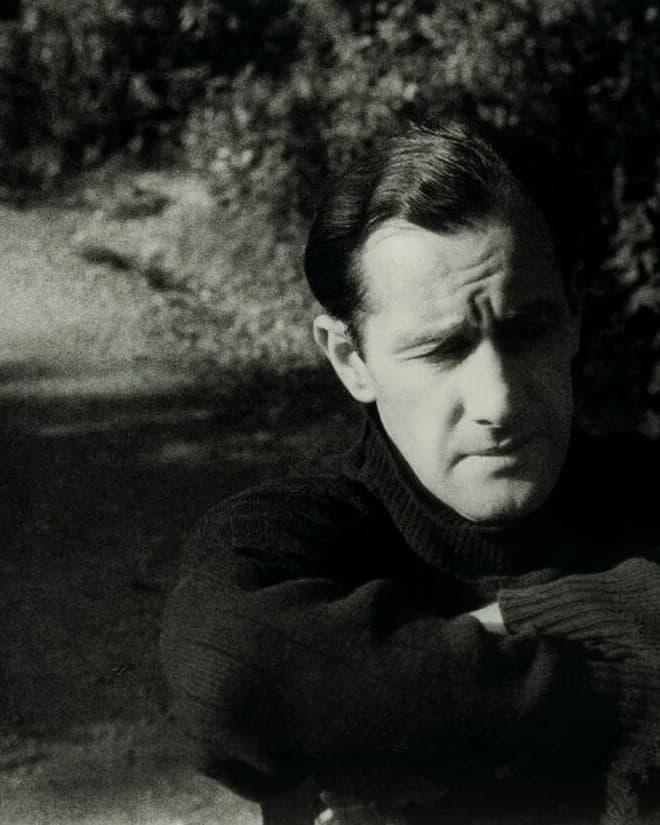
Sidney Nolan
Sidney Nolan (1917–1992) turned the steel helmet of the bushranger Ned Kelly into an emblem of Australian art: a black square with a slit for the eyes in the middle of the bush. He started out in the Melbourne circle of the Reeds, patrons of the arts, lived in England from the early 1950s, designed ballets and operas in London, and made more than 250 works about Auschwitz and a copper-and-enamel “Eureka” mural for the Reserve Bank of Australia.
Biography
In most of the paintings in the first Ned Kelly series the main subject is a black square. It is the outlaw’s steel helmet, and in its slit Nolan paints nothing but a pair of eyes. Around it is the bush, and in almost every painting the bush is different. Nolan knew that the black square had long since become an emblem of modernism; what was new was to set that emblem down in the middle of an Australian landscape and let it look.
The twenty-seven paintings of the series were made in 1946–1947 at Heide, the country house of the Melbourne patrons John and Sunday Reed. By some accounts, Sunday had a hand in the work.
Nolan was born on 22 April 1917 in Carlton, then a working-class suburb of Melbourne, the eldest of four children. His father drove a tram, and both parents came from Irish families that had settled in Australia five generations earlier. He left school at fourteen, took design courses at a technical college, and in 1933, aged sixteen, went to work at the Fayrefield hat factory in Abbotsford, where for six years he made advertising display stands with a spray gun and dyes. From 1934 he attended evening classes at the National Gallery of Victoria Art School, on and off. Among painters he responded to Cézanne, Picasso, Matisse, Henri Rousseau and children’s drawings, and in Melbourne also to the Russian artist Danila Vassilieff, who had arrived in the mid-1930s. Nolan’s early works were sometimes abstract, and in 1939 one of them was seen by chance by Serge Lifar, then on tour with the Original Ballet Russe. Lifar commissioned the young artist to design his new version of “Icare”; it premiered on 16 February 1940 at the Theatre Royal in Sydney.
Around the Reeds a group took shape that would later be called the Heide Circle: Albert Tucker, Joy Hester, Arthur Boyd, John Perceval. Nolan became one of its centres. During the war he served in the army, for a time near Dimboola, and his landscapes of that country are now in the National Gallery of Victoria. In July 1944, when it looked likely that he would be sent to the front in Papua New Guinea, he went absent without leave and lived under the name Robin Murray, which Sunday Reed had made up for him. In the same months Nolan edited the magazine Angry Penguins and drew the cover of the issue in which, in June 1944, the poems of a non-existent poet, Ern Malley, were printed, a literary hoax. He came back to those poems all his life, made hundreds of works on their themes, and in 1975 said that it was the Malley affair that had pushed him towards Kelly: to take the risk of setting a completely alien object against the Australian bush. I think the personal undercurrent of the series is plain enough too. A fugitive from the law was painting a fugitive from the law.
In 1948 Nolan married Cynthia, John Reed’s sister, and fell out with the Reeds; after an unhappy visit by the newlyweds in March 1948 he never saw them again. Later he demanded the return of the works he had left at Heide. Sunday handed back 284 paintings and drawings but kept twenty-five of the Kellys, which she regarded as the core of a future museum at Heide, and in 1977 gave them to the National Gallery of Australia. Which of the two was in the right is hard to decide from the evidence that survives.
In 1949 the series was shown at the Musée National d’Art Moderne in Paris, and its director, Jean Cassou, wrote that something new was being born in these paintings. The second Kelly series, from the mid-1950s, was bought by the Museum of Modern Art in New York and by the Tate in London. Nolan painted other figures from Australian history as well: the explorers Burke and Wills, Eliza Fraser.
From the early 1950s he lived in England. He spent one year, 1956, in Greece, painting subjects from Greek myth; in Paris he studied engraving and lithography with Stanley William Hayter at Atelier 17. He illustrated books by his friend the poet Robert Lowell and designed covers for more than seventy publications. His first solo exhibition in London was held at the Whitechapel Gallery in the summer of 1957, and in 1959 his work was taken for documenta II in Kassel.
In 1961, after the capture of Adolf Eichmann, Nolan made more than 250 works about Auschwitz. On 29 January 1962, at the invitation of the journalist Al Alvarez and The Observer, he went there himself to illustrate an article about the camps, but on his return he turned the commission down. These paintings were first shown in public only in August 2021, at the Sidney Nolan Trust in Presteigne.
Once he had done “Icare”, the theatre never let him go. For Kenneth MacMillan at the Royal Ballet he designed “The Rite of Spring” (1962), and for Robert Helpmann the ballet “The Display” (1964), set at a picnic in the bush, where blue-green gauze panels let the light through as in a rainforest. At the Royal Opera, with the director Elijah Moshinsky, came “Samson et Dalila” (1981) and “Die Entführung aus dem Serail” (1987).
In 1965 his panel on the Eureka Stockade rebellion of 1854 went up in the Melbourne office of the Reserve Bank of Australia on Collins Street: twenty metres long, jewellery enamel on one and a half tonnes of copper. He drew it in the manner of Aboriginal sand painters, with thumb and forefinger. In 1968–1970 he made “Paradise Garden” from 1,320 flower sheets drawn in crayon and dyes.
For the deserter of 1944, the list of honours turned out to be a long one: Commander of the Order of the British Empire in 1963, a knighthood in 1981, the Order of Merit in 1983, and in 1988 Companion of the Order of Australia (AC), after he had turned down a lower grade of the same order in 1975. In 1983 Nolan settled in Herefordshire, and in 1985 his trust for supporting artists and musicians began its work there, at The Rodd, an estate near Kington. He travelled through Africa, China and Australia, and went to Antarctica.
Nolan died in London on 28 November 1992. He is buried in the eastern part of Highgate Cemetery.
Profile notes
Profile and sources
Image
Artist image
Albert Tucker; Wikimedia Commons; Public domain.
