
26.03.1957–present
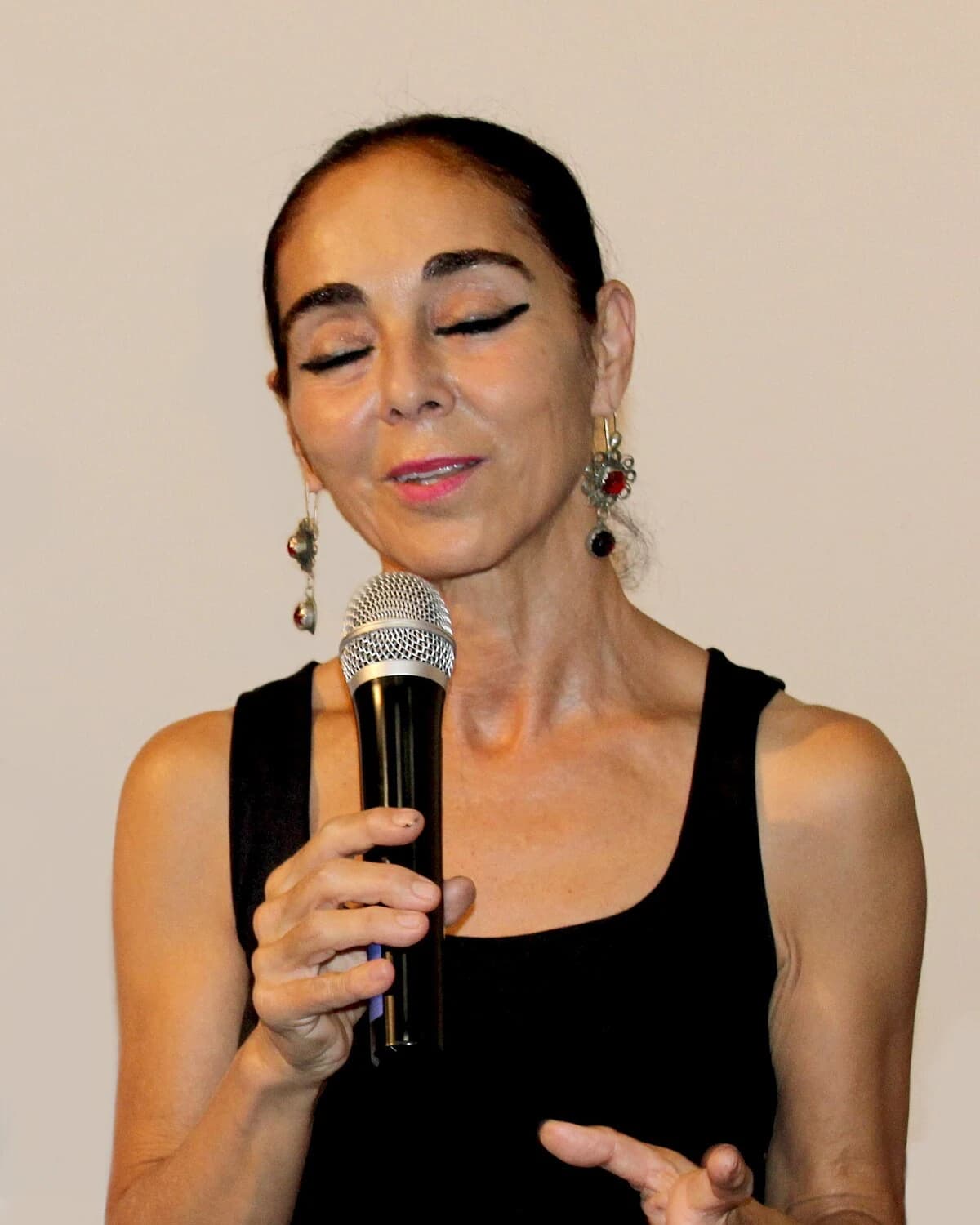
Shirin Neshat
Shirin Neshat left Iran to study at Berkeley in 1975 and did not see her homeland again until 1990. That shock gave rise to the photographic series “Women of Allah”, portraits covered in Persian calligraphy. In 1999 her video installations won the International Prize at the Venice Biennale, and in 2009 her film “Women Without Men” earned her the Silver Lion for best director.
Biography
In 1990, a year after the death of Ayatollah Khomeini, Shirin Neshat went to Iran for the first time since the revolution. She later called the trip probably the most shocking experience of her life. The country she remembered and the country she saw barely coincided. What struck her most were the changes in how people looked and how they behaved in the street; she had never before been in so ideological a country. The changes, she said, both frightened and fascinated her.
Neshat was born on 26 March 1957 in Qazvin, a religious city in north-western Iran, and went to a Catholic boarding school in Tehran. In 1975 she left for the University of California, Berkeley, to study art, worked with Harold Paris and Sylvia Lark and took, one after another, a BA, an MA and an MFA. After graduating in 1983 she moved to New York.
There, she has said, she soon realised that art was not yet her profession. For ten years Neshat worked at the Storefront for Art and Architecture, a non-profit space in Manhattan that functioned as a cultural laboratory: artists, architects and philosophers gathered there. She made almost no work of her own in those years; the New York scene intimidated her, and the little she did produce she disliked and in the end destroyed.
In 1993 she came back to art in earnest, starting with photography. Her first solo exhibition was held that same year at Franklin Furnace in New York.
Her first mature works were the series “Unveiling” (1993) and “Women of Allah” (1993–1997). The portraits of women in this series are covered entirely in Persian script. In this way Neshat tried to come to terms with the gap between the pre-revolutionary Iran of her childhood and what she had seen in 1990; the themes of the series concern how femininity is understood in the context of Islamic fundamentalism and militancy. Later Persian poetry and calligraphy came into play, along with martyrdom, exile and identity. She resists stereotyped images of Islam but avoids poster-style polemic: what interests her are the complex intellectual and religious forces that shape a Muslim woman. She says herself that since the revolution she has been drawn to art about tyranny, dictatorship, oppression and political injustice. She does not consider herself an activist, yet, in her words, every work she makes turns out to be a protest. I think this is an honest distinction: the artist turns down the slogan, though not the subject.
When Neshat took up film and video, her point of reference was Abbas Kiarostami, whom she valued for an aesthetic that knows how to work within constraints. The video installations “Shadow Under the Web” (1997), “Turbulent” (1998), “Rapture” (1999) and “Soliloquy” (1999) are projected onto two facing walls, and the viewer stands between the screens. The contrasts are built on light and darkness, black and white, male and female. “Rapture” needed almost 250 extras; its world premiere took place in May 1999 at the Art Institute of Chicago. That same year “Turbulent” and “Rapture” won her the International Prize at the 48th Venice Biennale, and her name became known far beyond New York.
She regards music as the soul of her work, the thing that softens its socio-political side. In 2001–2002, with the singer Sussan Deyhim, she created the multimedia performance “Logic of the Birds”; it premiered in 2002 at the Lincoln Center summer festival and was then shown in Minneapolis and London. With Philip Glass she made “Passage” (2001).
For several years Neshat worked with Shahrnush Parsipur’s novel “Women Without Men”. First came the video installations “Tooba” (2002), “Munis” and “Faezeh” (2008), and in 2009 her feature-length directorial debut of the same title was released, its story bound up with the 1953 coup in Iran. At the 66th Venice Film Festival the film won the Silver Lion for best director. Neshat called her work on it a six-year labour of love. In July of that year she took part in a three-day hunger strike outside United Nations headquarters in New York in protest against the outcome of the presidential election in Iran.
Then came films made together with Shoja Azari: “Looking for Oum Kulthum” (2017) and “Land of Dreams” (2021), from a screenplay by Jean-Claude Carrière. In 2017, at the Salzburg Festival, she directed Verdi’s “Aida” with Riccardo Muti conducting and Anna Netrebko in the title role, and admitted that the line between Aida and herself sometimes blurred. Her awards include the Dorothy and Lillian Gish Prize (2006), the Praemium Imperiale (2017) and an honorary professorship at the Berlin University of the Arts (2004).
In 2013 the Detroit Institute of Arts mounted a Neshat retrospective. Her largest exhibition was the thirty-year retrospective “I Will Greet the Sun Again” at the Broad in Los Angeles (2019–2020), later shown in Fort Worth. In 2022, after the death of Mahsa Amini, her work “Woman, Life, Freedom” was shown on the screens of Piccadilly Circus in London. The two-channel video installation “Fury” (2022) was exhibited at Fotografiska in Stockholm in 2023 and in Berlin in 2024.
Profile notes
Profile and sources
Image
Artist image
Colling-architektur; Wikimedia Commons; CC BY-SA 3.0.
