
29.10.1504–17.05.1551
Shin Saimdang
Shin Saimdang (1504–1551), a painter, calligrapher and poet of the Joseon period from Gangneung, painted grasses, insects, grapes, fish and landscapes in ink and mineral colours; about forty of her works are known. Her son Yi I became a celebrated Confucian scholar, and in Korea she has long been honoured as the “Wise Mother”. In 2009 she became the first woman to appear on a South Korean banknote.
Biography
In 1537 a young woman with a baby in her arms climbed to the Daegwallyeong pass and looked back at the village she had just left behind. She was returning from her parents’ home in Gangneung to the capital, Hanseong, and leaving her mother there. On the pass she composed a poem about her mother; under the title “Looking Back at My Parents’ Home while Going Over Daegwallyeong Pass” it is still known in Korea. The baby was her third son, Yi I, the future scholar more often called by his literary name, Yulgok.
The painter’s mother had spent her married life in her own parents’ house, and that, perhaps, explains everything.
Shin In-seon, who later took the literary name Saimdang, was born in Gangneung, in Gangwon Province, on the 29th day of the tenth lunar month of 1504 (by the European calendar, in December). Her mother’s family home, Ojukheon, survives to this day. Her father, Shin Myeong-hwa of the Pyongsan Shin clan, was an official and a friend of the scholar Cho Kwang-jo, but kept out of politics; for sixteen years he lived apart, in Hanseong, preparing for the state examinations with money from his wife’s family and coming home a few times a year. He never rose above the lowest scholarly degree, and after the purge of scholars in 1519 he gave up the examinations altogether and returned to Gangneung. Her mother, Lady Yi of the Yongin Yi clan, lived with her own parents and decided for herself how her daughters were to be taught. There were no sons in the family, only five daughters, and their maternal grandfather, Yi Sa-on, taught In-seon as he would have taught a grandson. Her father took the girls through the Thousand Character Classic and other elementary Confucian books. His visitors were surprised at how much she knew of Neo-Confucianism, history and letters. Besides literature and poetry, she was skilled at calligraphy, embroidery and painting.
On the 20th day of the eighth lunar month of 1522 Saimdang, then seventeen, was married to Yi Won-su, who was twenty-two. Many thought the choice a poor one: the groom’s ancestors included chief state councillors, but the family had become poor, his father was dead, and he himself held no post. Her father, however, was looking for a son-in-law who would allow his wife to paint, and Yi Won-su raised no objection. With his consent Saimdang spent long periods in Gangneung. Her father died in the year of the wedding, and she travelled between Gangneung and Paju, where her husband’s house was, in order to look after her mother. Later she went with her husband to his posts: to Hanseong, to Pyeongchang. They had seven children. At thirty-eight she ran a new household in Hanseong and lived there with her mother.
About forty of her paintings in ink and mineral colours survive, though more are believed to exist. Her favourite subjects were insects, flowers, butterflies, orchids, grapes, fish, landscapes, grasses with insects. Little of her calligraphy has come down to us, but in her lifetime high officials and connoisseurs praised her hand, and it was they who left records of it. The scholar Eo Suk-kwon, in his miscellany “Paegwan Japgi”, compared her grapes and landscapes with those of the celebrated Ahn Gyeon. Three centuries later, in 1868, the governor of Gangneung found her writing full of “nobility and elegance, serenity and purity”. Her poems are almost all about her parents’ home and her mother.
To my mind, her children speak best for her teaching. It was said of her son Yi U that chickens took the insects he drew in ink for real ones and chased after them; Yi I said that if his brother had given himself to scholarship, he would have surpassed him. Her eldest daughter, Yi Mae-chang, who wrote poetry, was known as “Little Shin Saimdang”.
In the summer of 1551 her husband left on official business for Pyongan province, taking their eldest son and Yi I with him. Shin Saimdang died on the 17th day of the fifth lunar month of 1551, aged forty-six, before they returned. She was buried in Paju.
Together with Queen Munjeong, Jeong Nan-jeong and Hwang Jini she is counted among the most notable women of her age. In February 2009 the Bank of Korea unveiled the design of a new 50,000 won note, and in June it went into circulation: on the front are a portrait of Shin Saimdang, her ink painting of grapes and a screen with grasses and insects that is listed as a National Treasure. Feminist critics objected that the choice reinforced the old stereotype of woman as model wife and mother.
Related context
Associations
Works connected through artistic movements, cultural context and period. Priced works available in this market appear first.
Profile notes
Profile and sources
Image
Artist image
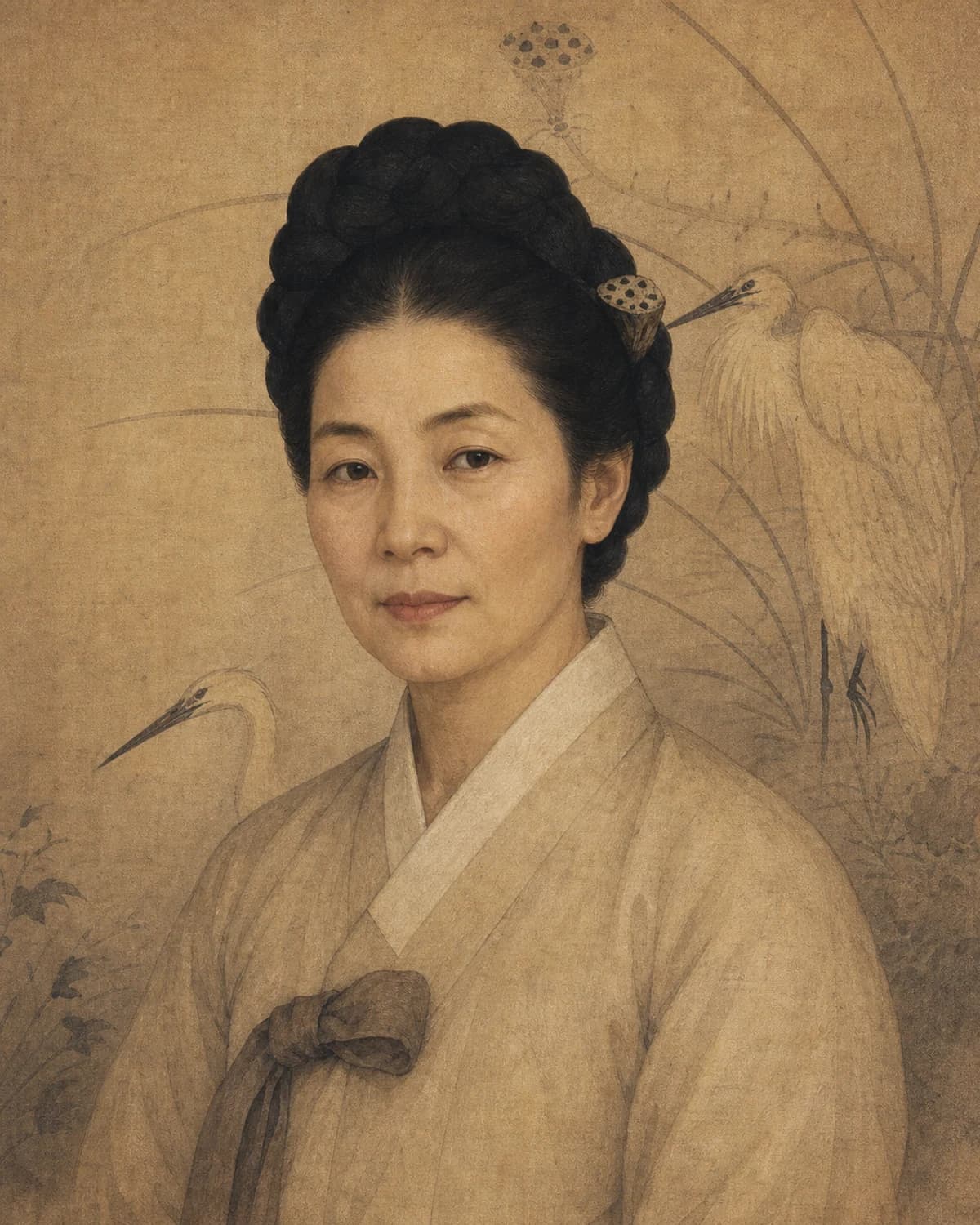
На основе открытого изображения: Shin Saimdang; 傳 申師任堂; Korean, 1504-1551); Wikimedia Commons; Public domain.
