
1427–1509
Shen Zhou
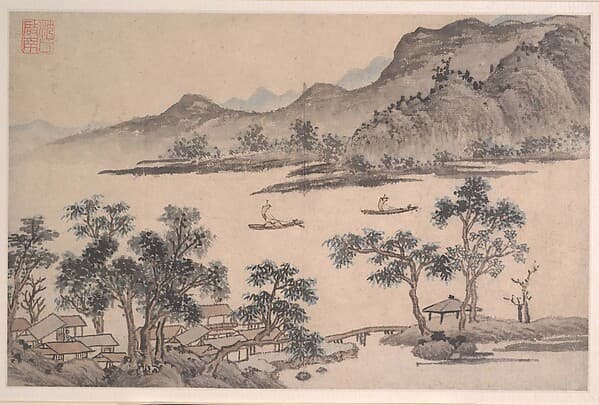
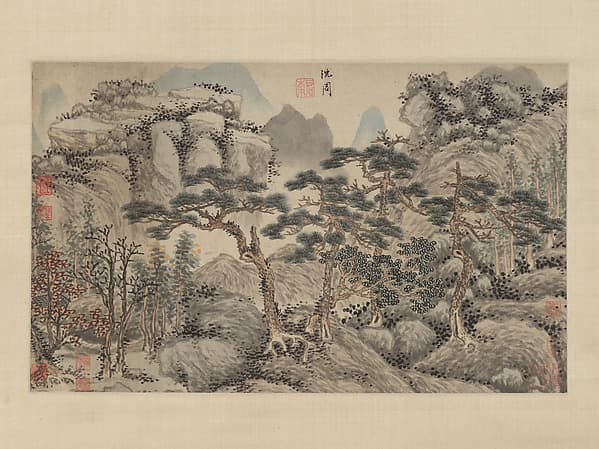
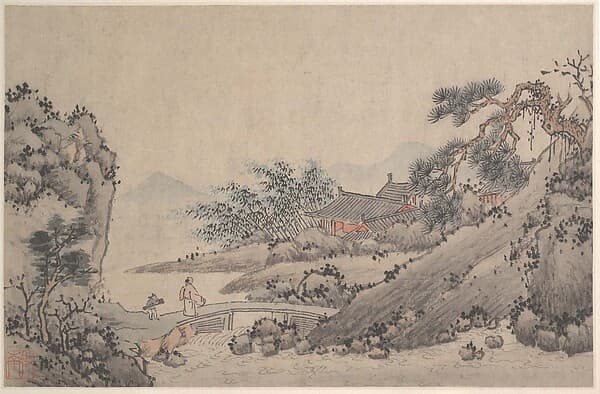
Shen Zhou (1427–1509) spent his life as a wealthy scholar-recluse near Suzhou: he refused office, cared for his mother, and wrote poetry, practiced calligraphy and painted. He brought the manner of the four Yuan masters back into Ming painting and is regarded as the founder of the Wu School. His best-known work, “Lofty Mount Lu” (1467), is in Taipei.
Biography
In 1467 Shen Zhou painted a birthday present for his teacher Chen Kuan: a scroll showing Mount Lu, to which he attached a long poem. Mount Lu stands in the north of Jiangxi province, and the Yangtze can be seen from its summit, but the artist himself had never been there. The huge wooded masses of rock are painted with unusual care, and at the very bottom a tiny man stands looking at the view that has opened before him. Like any painted gift in China, the picture speaks in allegory: the teacher’s firmness and dignity are compared to the mountain. It is painted in the manner of the Yuan master Wang Meng and is considered perhaps Shen Zhou’s best-known work.
Such fine attention to detail is rare in his other works.
He was born in 1427 near Suzhou, into a wealthy family of hereditary scholars. The family had made its fortune at the end of the Yuan dynasty, when the artist’s great-grandfather (by other accounts, his grandfather) became a large landowner. Under the Ming the head of the family was appointed tax collector; this increased the family’s wealth still further and freed its men from obligatory careers as officials. His father, Shen Heng, and his uncle, Shen Zhen, painted in their leisure hours and became the boy’s first teachers, and after them he studied with the Suzhou scholars Chen Kuan, Liu Jue and Zhao Tonglu. His courtesy name was Qinan, and his literary name Shitian, “stone field”.
Why he never entered official service was explained in different ways. According to one version, his grandfather had laid down a family rule to keep away from the pursuit of office. According to another, when offered a post Shen Zhou politely declined, citing the need to care for his sick mother, and Confucian officials could not fail to respect such filial piety. According to a third, he consulted the “Book of Changes” and received a negative answer. Most likely he never meant to serve, but did not show it while his father was alive, and after his father’s death he gave up the examinations and devoted himself to his widowed mother. I think these explanations do not contradict one another. He stayed at home with a good library and the family collection of paintings, traveled, wrote plain poems free of ardent outpourings in the spirit of the Tang and Northern Song poets, and by the age of thirty was known in Suzhou as a man of letters and a calligrapher. Stories were told of his kindness: in winter, it was said, he would notice the houses with no smoke rising from the hearth and send a servant there with money. His mother, according to the same stories, lived to a hundred.
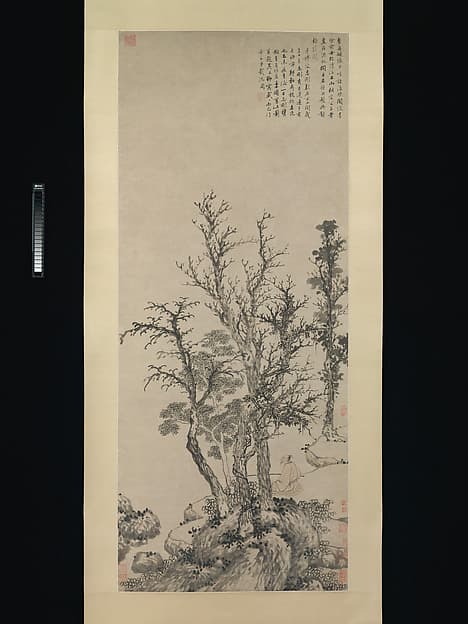
Distance from the court played its part. The first Ming emperor gathered painters in Nanjing and trained them in the manner of the Song masters, and the Zhe School dominated at court. When the capital was moved to Beijing under the Yongle emperor, Suzhou found itself far from court taste. Shen Zhou, who had begun with his father and uncle, was drawn to scholars’ painting, above all to the four masters of the Yuan: Huang Gongwang, Ni Zan, Wang Meng and Wu Zhen. By forty he had repeated their brushwork until he achieved ease; in “Traveler with a Staff”, in Taipei, the composition and trees come from Ni Zan and the structure of the mountains from Dong Yuan. He also turned to Mi Fu and his son, and to Juran. His own collection of late Yuan and early Ming painting served as models for him and his friends, and they often worked together, combining painting, poetry and calligraphy at friendly gatherings. This is how the Wu School took shape, with its poetic inscriptions on paintings.
Between forty and sixty he imitated his favorite masters, each time adding something of his own; after sixty he turned what he had mastered into a style of his own. “Landscape in the Manner of Ni Zan” (1479) and his copy of Huang Gongwang’s “Dwelling in the Fuchun Mountains” (1487) show how old devices became independent variations in his hands. In the scroll “Rainy Thoughts” (1487) rain fills the whole picture, and a small house almost dissolves into the mountains looming over it. In one of his last works, a scroll nearly nine meters long, “Landscapes of Cangzhou”, he combined the techniques of all four Yuan masters, and in the inscription he rebuked those contemporaries who learn from Dong Yuan and Juran yet shy away from depicting nature truthfully.
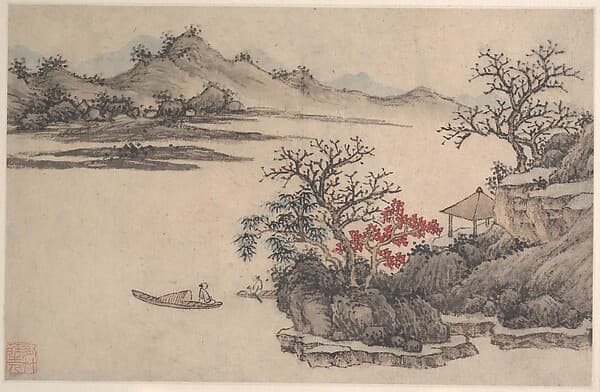
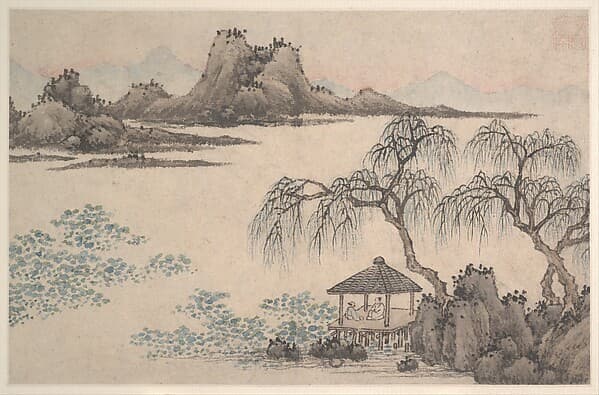
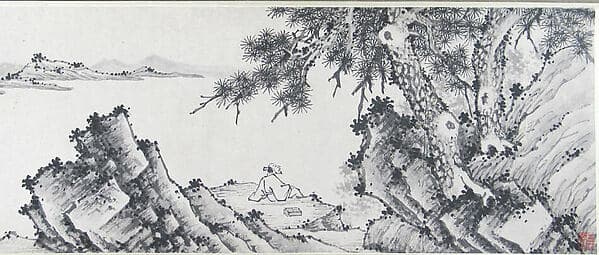
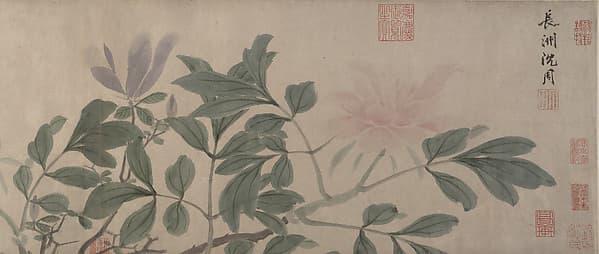
He liked to paint the poet alone with nature. In the album leaf “Reading amid Autumn Nature”, in the Palace Museum in Beijing, he showed himself with a book, and in “Playing the Qin”, in a museum in Osaka, a small figure is set into the landscape on equal terms with the trees and rocks. He worked a great deal in the “flowers and birds” genre, often without outlines, laying on color in several layers. In the leaf “Pomegranate and Luffa” in the Detroit Institute of Arts, the pomegranate branches are painted in austere strokes of ink and the luffa leaves in bluish washes, while the poem on it was written by the scholar and statesman Wang Ao; the leaf was meant for their mutual friend Wu Chunhong, and the burst pomegranate with its seeds wished him a long-awaited son.
At eighty he painted a self-portrait: an old man with a kind, intelligent face, executed according to the rules of physiognomy and close to the memorial portrait. In the inscription he agrees in advance that the eyes have come out small and the forehead narrow, doubts that likeness is worth revering, and admits that he fears only one thing: failing to bring out the truth in full.
Shen Zhou died in 1509, at the age of eighty-two. Wen Zhengming is regarded as the most gifted of his followers. Between two hundred and four hundred and sixty surviving works are associated with his name, depending on the count, and his poetry and prose are collected in the “Shitian ji”, the “Collection of the Stone Field”.
Artist works
Works by the artist
Works by Shen Zhou available in this edition of NEOARCA.
Related context
Associations
Works connected through artistic movements, cultural context and period. Priced works available in this market appear first.
Profile notes
Profile and sources
Image
Artist image
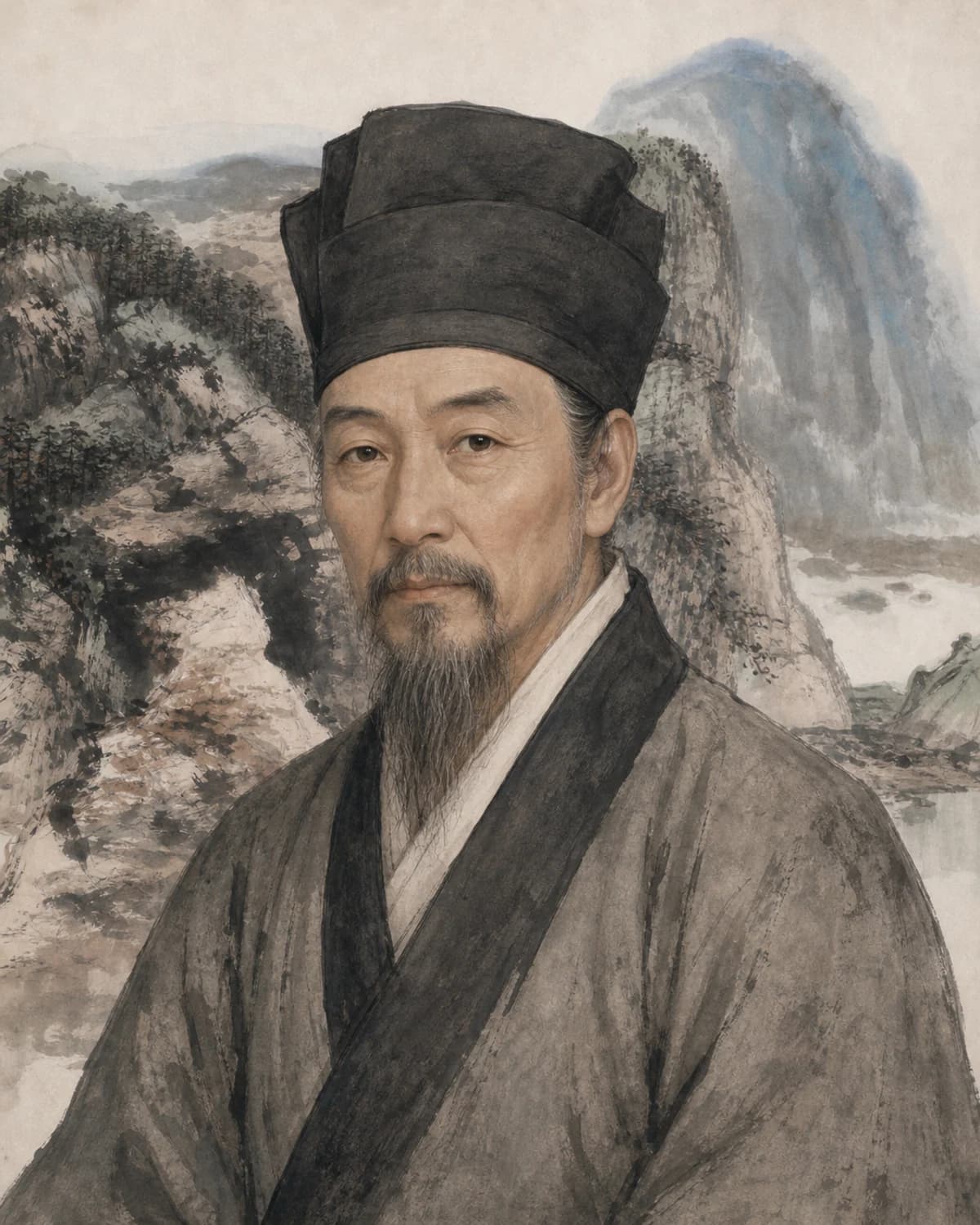
На основе открытого изображения: Globegroup1; Wikimedia Commons; CC BY-SA 4.0.
