
1420–26.08.1506
Sesshū Tōyō
Sesshū Tōyō (1420–1506), a Zen monk trained at the Shōkoku-ji monastery in Kyoto, spent most of his life painting in ink in the provinces, under the patronage of the Ōuchi clan in Yamaguchi. In the late 1460s he travelled to Ming China and got as far as Beijing. Several schools later claimed him as their founder, and six works securely attributed to him are designated National Treasures of Japan.
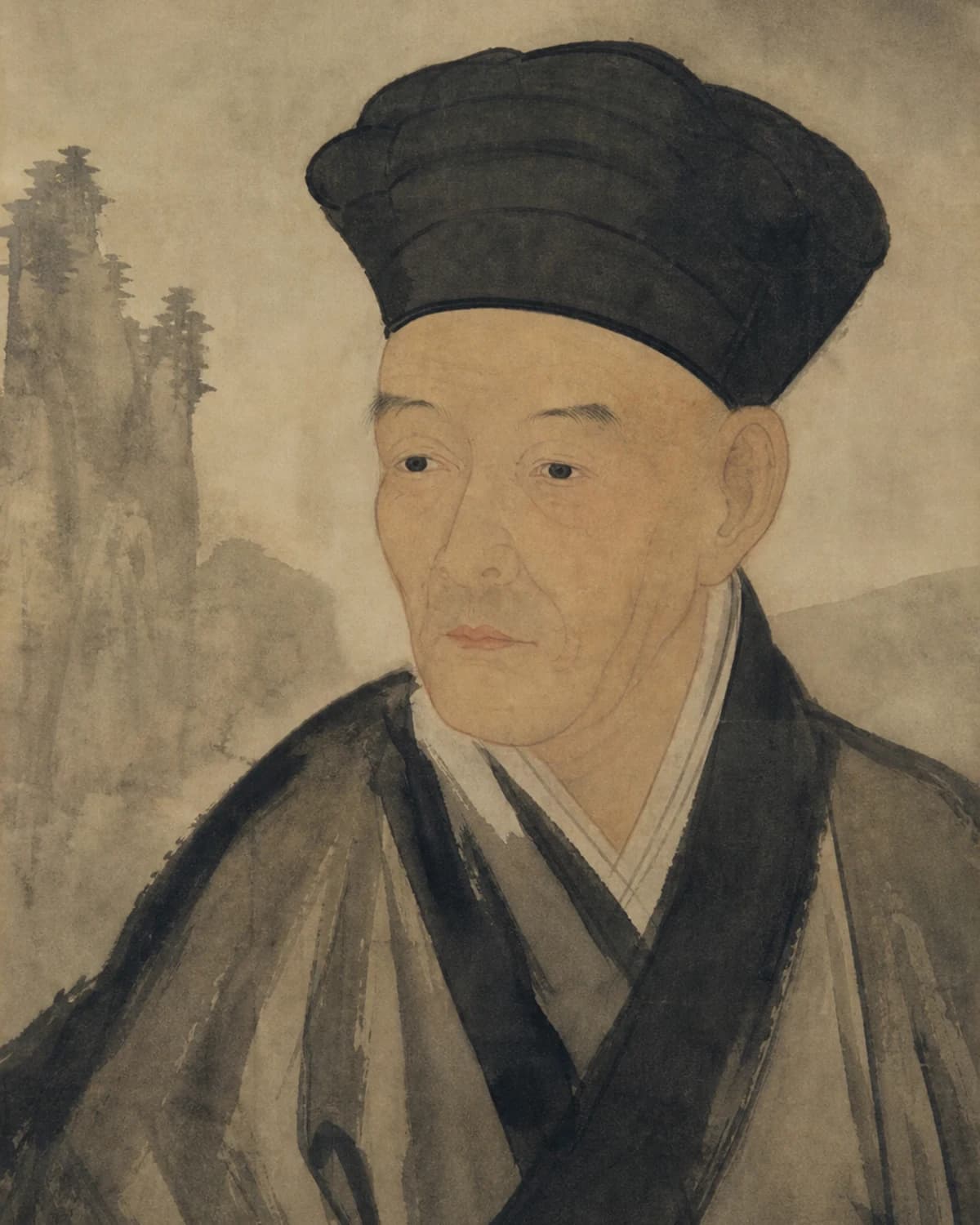
Biography
The best-known story about Sesshū most likely took shape after his death. The boy, sent as a novice to the monastery of Hōfuku-ji, was tied to a pillar by his teacher as punishment for some misdeed. Several hours passed, and he drew a mouse on the wooden floor, using his own tears for ink. The mouse, so the story goes, came to life and gnawed through the ropes.
The tale carries no dates and there is no way to check it. Even the name the boy was given at birth has not survived.
He was born in 1420 in the village of Akahama in Bitchū Province, near the present-day city of Sōja in Okayama Prefecture. The “History of Japanese Painting” (“Honchō gashi”), compiled in 1691, places him in the samurai Oda family. Around 1431, at the age of twelve or thirteen, he came to Kyoto, to Shōkoku-ji, one of the monasteries of the “Five Mountains” system; the monastery’s chief patrons were the ruling Ashikaga shoguns. The abbot, Shunrin Shuto, gave him the monastic name Tōyō. He studied painting under Tenshō Shūbun, generally regarded as the first major Japanese master of ink landscape, and at first painted in his manner. He spent nearly thirty years in the capital.
Around 1460 Tōyō left Shōkoku-ji and entered the service of the Ōuchi clan in Yamaguchi, in Suō Province in western Honshu. The Ōuchi built him a temple studio, the Unkoku-an. Here he was free of monastic and political duties and could give himself to painting. For a time he signed himself Unkoku, and then he chose the art name Sesshū, “snow boat”.
The Ōuchi traded with China, and with their funding Sesshū set off there in 1467 as a member of a Japanese embassy. He travelled from Ningbo to Beijing, visited monasteries of the Chan school and looked above all at the work of professional painters rather than scholar-literati. In Beijing the Ministry of Rites commissioned wall paintings from him. There too, from the work of Ruofen Yujian and Muqi, he learned the technique of “splashed ink” (hatsuboku) and was the first to bring it into Japanese ink painting.
He returned in 1469, but the Ōnin War was raging in the central provinces, and until 1479 Sesshū lived in Bungo Province, today’s Ōita Prefecture. Then he settled again at the Unkoku-an and worked under Ōuchi patronage. His best-known works were painted after he had turned sixty. The screens “Flowers and Birds of the Four Seasons” are dated 1483, the “Long Scroll of Landscapes” is placed around 1486, and the “Landscape in the Haboku Manner” bears the date 1495. The scroll “Huike Offering His Arm to Bodhidharma”, of 1496, shows the disciple holding out his severed arm to Bodhidharma as proof of his resolve. There is a portrait too, the “Portrait of Masuda Kanetaka”, painted in the late 1470s. The “View of Ama-no-Hashidate” dates from the 1500s. Sesshū also painted Buddhist and Chinese subjects: “Shakyamuni Descending the Mountain”, Daruma, Kanzan and Jittoku, “Du Fu Riding a Donkey”, Jurōjin, the god of longevity.
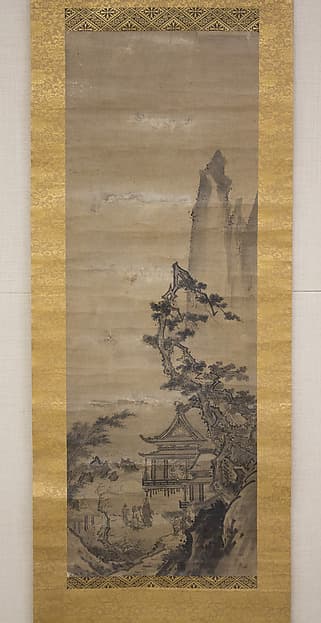
“Winter Landscape” (dated variously, from the 1470s to 1486) is painted in black ink alone, diluted to shades of grey. Flat mountains overlap one another, and a small figure of a traveller climbs a steep path towards a deserted temple. The rocks and trees in the foreground are outlined in heavy dark lines; the distant mountains on the left are set down in a single stroke against a grey sky. Down the middle runs a sharp, jagged line like a bolt of lightning: it outlines a cliff and breaks off in the mist. To my mind, this angular stroke shows better than anything how much he took from China and how far he moved from the manner in which he had painted under Shūbun.
In the cycle “Landscapes of the Four Seasons”, the autumn scroll stands apart from the rest: the Chinese training shows most clearly in it.
His manner was carried on by Sesson Shūkei, Hasegawa Tōhaku and Unkoku Tōgan, and in the sixteenth century his methods were widely used by artists trained in schools that traced their lineage to him. Six works whose authorship is not in doubt have been designated National Treasures of Japan. His transformation into a classic of the national art began in the late nineteenth and early twentieth centuries, with officials, scholars and collectors all taking part. In 1956 the World Peace Council included Sesshū, together with Leonardo da Vinci, among ten figures of world culture whose memory was to be honoured that year, and postage stamps dedicated to him were issued in the USSR.
Accounts of his last years differ. According to one version, he moved to Masuda in Iwami Province, lived at the temple of Daiki-an, practised Zen, painted and laid out gardens now known as Sesshū’s gardens. According to another, he stayed in Yamaguchi, at the temple of Chōgen-ji. He died on 26 August 1506; the temple of Tokoji is named as the place, from where his body was taken to the temple of Ikoji, later nicknamed the Sesshū temple, and cremated there. The Unkoku-an studio passed to his pupil Shutoku.
Artist works
Works by the artist
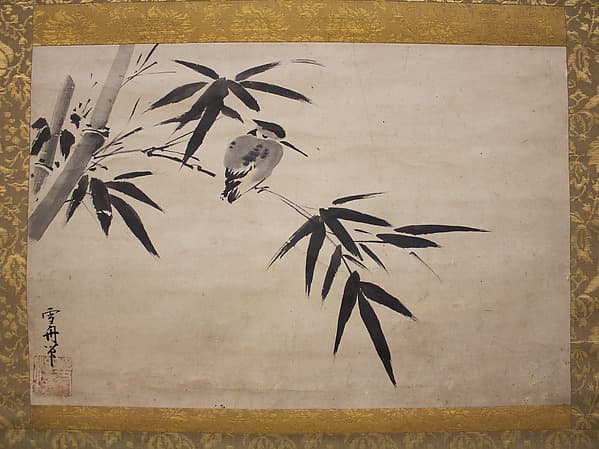
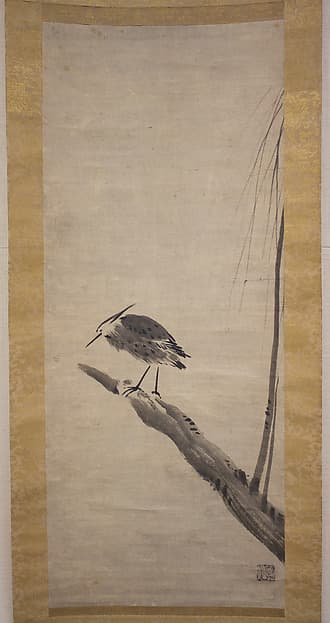
Works by Sesshū Tōyō available in this edition of NEOARCA.
Related context
Associations
Works connected through artistic movements, cultural context and period. Priced works available in this market appear first.
Profile notes
Profile and sources
Image
Artist image
На основе открытого изображения: 不詳 unknown; Wikimedia Commons; Public domain.
