
24.09.1857–19.09.1931
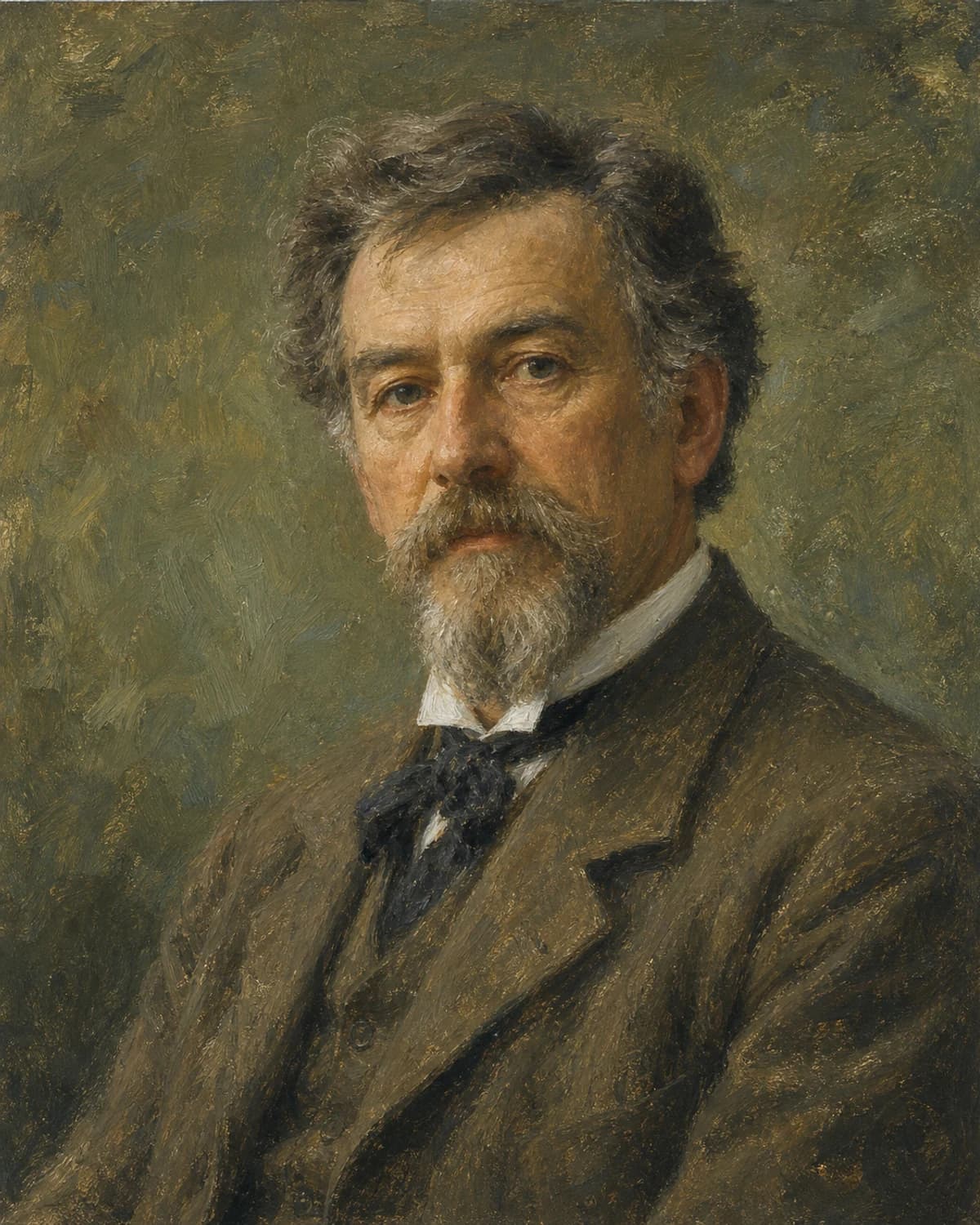
Serhiy Svetoslavsky
Serhiy Svetoslavsky (1857–1931) studied at the Moscow School of Painting under Alexei Savrasov and Vasily Perov, spent ten years in the Wanderers (Peredvizhniki), and in 1900 won a bronze medal at the Paris World’s Fair for his painting “The Courtyard”. He painted Kyiv, the Dnieper and the Ukrainian countryside, and published caricatures in the journal Shershen. From the 1920s an eye disease kept him from painting almost entirely.
Biography
Svetoslavsky’s first picture, so the story goes, was painted at the school itself: a view from a window. Pavel Tretyakov, the Moscow collector who later founded the Tretyakov Gallery, bought it. The purchase is hard to date: by one account it was 1879, by another the picture was simply his first independent work. From the windows of Moscow and Kyiv houses he later painted a whole series of views.
He was born in Kyiv in 1857, into an official’s family. The sources give the date differently: 24 September, 1 December, 6 October; it is safer to keep to the year. When the boy was about five, the family moved to Moscow. In 1875 he entered the Moscow School of Painting, Sculpture and Architecture and studied there under Alexei Savrasov, Vasily Perov, Evgraf Sorokin, Illarion Pryanishnikov and Vasily Polenov. He finished in 1883; by one account he was expelled for lateness, by another he simply completed the course, so I would leave the circumstances of his departure open. From 1884 he exhibited with the Wanderers, that is, with the Association of Travelling Art Exhibitions, a realist group opposed to academic art, and in 1891 he joined it and remained a member until 1900. By one account, he quarrelled with the organisers and took no further part in their exhibitions. His early landscapes, mostly of cities, are painted in the grey-brown range usual for the Wanderers. After his return to Ukraine there is more light in his colour. He lived in Moscow in 1870–1883 and 1890–1894, and in Kyiv in 1884–1890 and again from 1895.
What became central for him were the Dnieper, the outskirts of Kyiv, country roads and ox teams on ploughland. He painted quiet Kyiv lanes with low houses, the slopes near the Church of St Cyril, fairs, an abandoned park. He loved sunlight on white snow (“First Snow”, 1893), early spring (“The Beginning of Spring”, 1896) and autumn colours (“Autumn”, 1898). With the large painting “The Dnieper Rapids” (1885; in another list 1887) he announced himself as a lyrical painter. Journeys to Central Asia gave him new subjects: the steppe, flocks in the mountains, caravans of camels.
In 1900 “The Courtyard” won a bronze medal in Paris. In the same years he showed work at the exhibitions of the World of Art (1901–1902), at the Kyiv Society of Art Exhibitions, and in Nizhny Novgorod in 1896. He also drew satirical sheets: in 1906 his caricatures were printed in the Kyiv journal Shershen. For the merchant Mogilevtsev he made ten metal panels for a mansion on Lypky, which now houses a branch of the Kyiv National Picture Gallery.
In 1905–1907 Svetoslavsky organised a studio for former students of the Kyiv Art School who had been expelled for taking part in student unrest. By some accounts there were more than forty of them; among his pupils the painter Sonia Delaunay-Terk, also known as Sonia Lewitska, is named.
There is a record of another of his passions: by some accounts he supported the Kyiv Zoo and in 1910, having sold his estate, went himself on an expedition to Central Asia to collect animals. I would check this against other sources. What is certain is that in 1914 he sat on the jury of the competition for a monument to Taras Shevchenko in Kyiv, and that from 1904 to 1917 he took part in charity exhibitions, among them ones for the deaf and mute and for the victims of the war.
From the early 1920s his eyes troubled him so much that he almost gave up painting. Kazimir Malevich recalled that in Soviet years Svetoslavsky lived in poverty and sold horseradish on Khreshchatyk. This is hard to confirm from other documents. He died in Kyiv on 19 September 1931 and was buried in the Lukianivka Cemetery. In 2023 a street in the Darnytskyi District of Kyiv was named after him.
Related context
Associations
Works connected through artistic movements, cultural context and period. Priced works available in this market appear first.








Profile notes
Profile and sources
Image
Artist image
На основе открытого изображения: Serhiy Svetoslavsky; Wikimedia Commons; Public domain.
