
25.07.1938–present
Sérgio Ferro
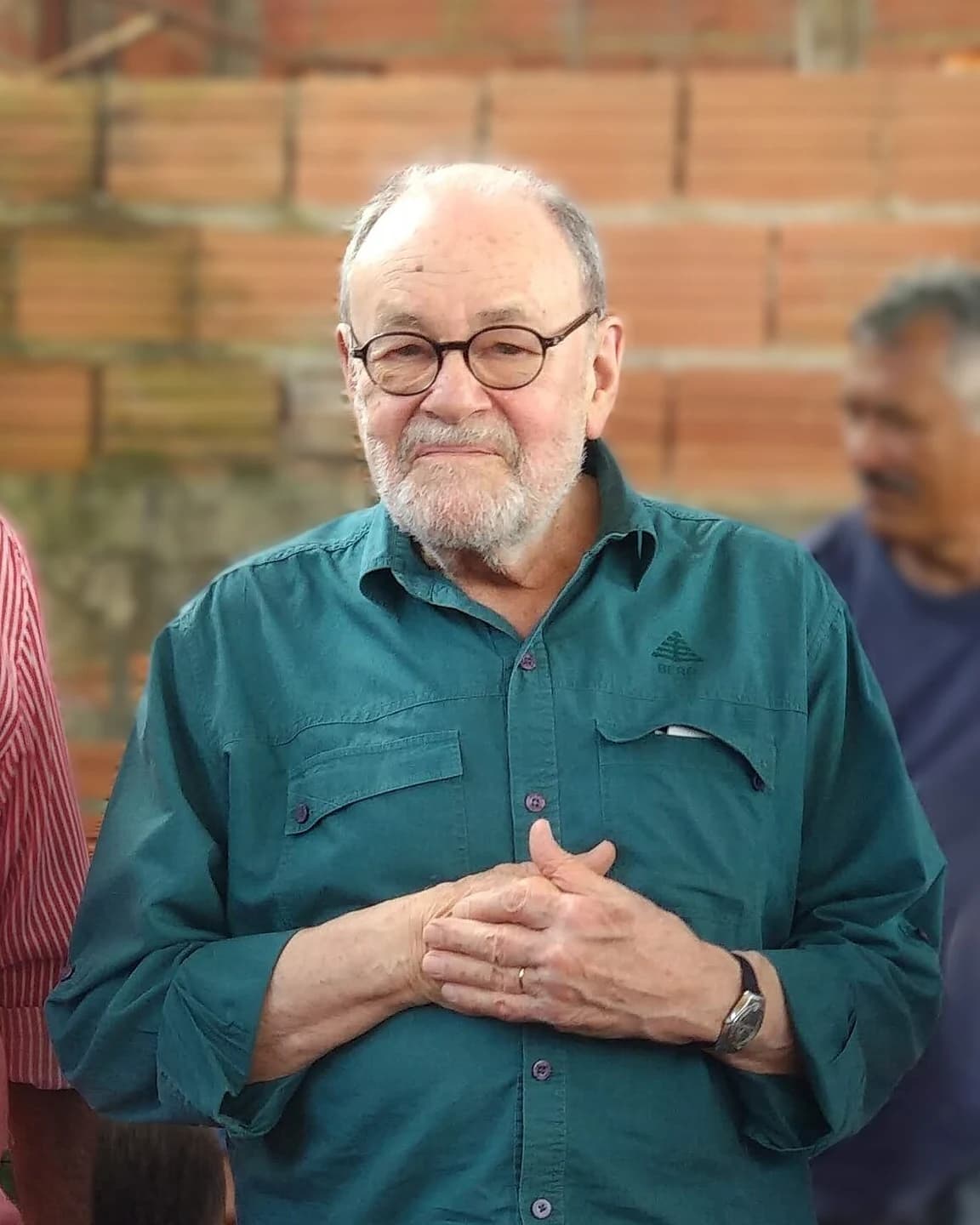
Sérgio Ferro (born 1938) graduated in architecture from the University of São Paulo, co-founded the group Arquitetura Nova with Rodrigo Lefèvre and Flávio Império, and wrote “Design and the Building Site”. After a year in prison under the military dictatorship, he has lived in Grenoble since 1972, where he taught and painted frescoes for schools. His painting is built on unfinished images and references to Michelangelo.
Biography
In 1972 Sérgio Ferro settled in Grenoble, in France. He could not work as an architect there and turned to painting and teaching.
He was born on 25 July 1938 in Curitiba. In 1962 he graduated in architecture and urbanism from the Faculty of Architecture and Urbanism at the University of São Paulo (FAUUSP). Soon afterwards Professor João Batista Vilanova Artigas invited him to join the faculty as a teaching assistant in the art history course. Until 1970 Ferro taught plastic composition, art history and aesthetics at schools and colleges in Santos, São Paulo and Brasília; among his posts were the Escola de Formação Superior de Desenho (1962–1968) and the architecture course at the University of Brasília (1969–1970). He later also earned a degree in semiotics at Mackenzie University and did postgraduate studies in museology and urban development. In the 1960s, together with Rodrigo Lefèvre and Flávio Império, he founded the group Arquitetura Nova (New Architecture). Its members treated architecture as a chain of production: the social role of the architect, the relations between people on the building site. They proposed social housing projects and called their approach the “poetics of the economy”: simple solutions and streamlined procedures meant to make housing more accessible. They based their critique of institutional architecture in Brazil on the Marxist notion of surplus value and set it against the work and school of their former mentor, Artigas. Issue 319 of the magazine Acrópole in 1965 was devoted entirely to the group.
Painting ran alongside. Ferro’s first solo exhibition took place in 1963 at the Galeria Teatro de Arena in São Paulo. He took part in “Pintores de Vanguarda” in Porto Alegre (1965), in the exhibitions “Opinião 65” and “Propostas 65”, and in “Nova Objetividade Brasileira” (1967) at the Museum of Modern Art in Rio de Janeiro. In 1970 he represented the São Paulo Biennial Foundation in Venice as a special commissioner.
During the military dictatorship Ferro and his colleagues in the group made contact with the Brazilian Communist Party, which opposed armed struggle. He later broke with it and joined the Aliança Libertadora Nacional (National Liberation Alliance) of Carlos Marighella. Because of his political activity and persecution by the regime he spent a year in prison, was dismissed from the university, and in 1972 left for France.
In Grenoble he taught: from 1972 to 1989 at the university, and from 1972 to 2003 at the École Nationale Supérieure d’Architecture. In 1982 he founded the laboratory Dessin/Chantier (Drawing/Construction) and directed it until 1997. In those same years he painted frescoes at Villeneuve (1975) and at the schools École Buttes (1981) and École Joseph Vallier (1983). His paintings consist of unfinished images and clear references to Michelangelo and Leonardo, mixed with sketches and handwritten texts. To my mind, this is the painting of a man who never stopped thinking like an architect: for him drawing remains a stage of the work, not its result. Exhibitions in France followed almost without a break: the Musée de Grenoble (1975), Paris, Le Touquet, Barbizon, Brussels, Rouen; in 1981 and 1989 he showed work at the São Paulo Museum of Art (MASP), and in 1991 he took part in the exhibition “Mémoires de la liberté” at the Centre Pompidou. In 1987 the São Paulo Association of Art Critics gave him its Best Painter award.
His book “O canteiro e o desenho” (Design and the Building Site, 1979) became Ferro’s main theoretical text: he describes the architect’s drawing as a means of organizing fragmented labour. It was followed by works on Michelangelo (1981, 1998, 2020), “Arquitetura e trabalho livre” (2006), “A história da arquitetura vista do canteiro” (2010), the two volumes of “Artes plásticas e trabalho livre” (2021, 2022) and the anthology “Architecture from Below” (2024).
In 2012 the Legislative Assembly of Paraná granted him the title of Honorary Citizen of Paraná. In 2020–2024 a British-Brazilian project funded by FAPESP and AHRC translated his texts into English; Ferro donated part of his archive to the Institute of Architecture and Urbanism of the University of São Paulo in São Carlos. In 2021 the Escola Livre Espaço Sérgio Ferro of the Cooperativa Braço Forte was named after him.
Profile notes
Profile and sources
Image
Artist image
Lalita.mt; Wikimedia Commons; CC BY-SA 4.0.
