
19.08.1858–26.10.1908
Sergei Korovin
Sergei Korovin (1858–1908), the elder brother of Konstantin Korovin, studied under Perov, Savrasov and Pryanishnikov and himself taught for almost twenty years at the Moscow School of Painting, Sculpture and Architecture. His main picture, “At the Village Assembly” (1893), shows a village meeting after the peasant reform. Later he turned to lyrical landscape and illustrated Gogol’s “The Overcoat”.
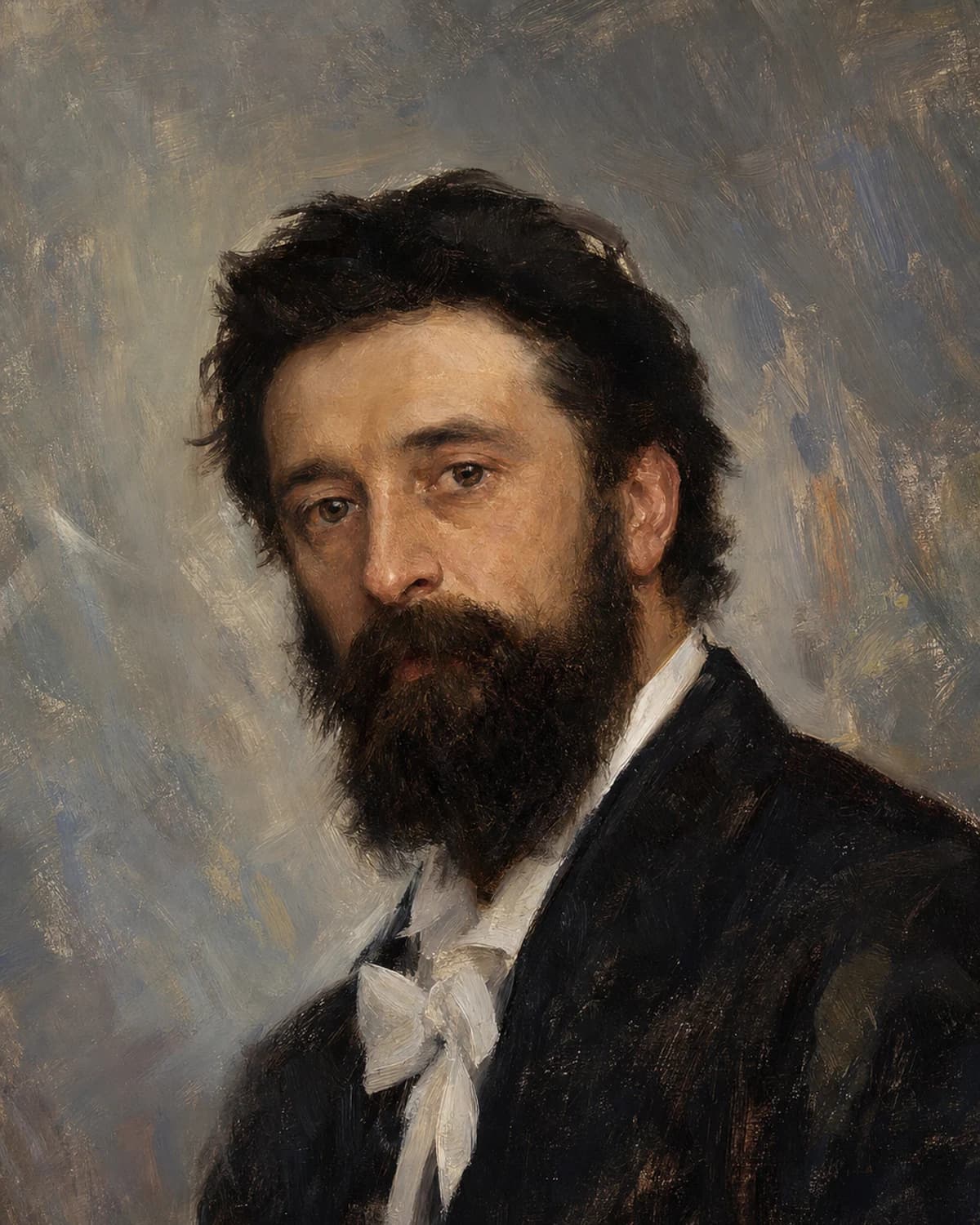
Biography
In the painting “At the Village Assembly” (1893) a village meeting is trying to settle a dispute between a poor peasant and a rich one. The subject grew out of the life of the post-reform village, after the abolition of serfdom in 1861. Mikhail Nesterov, who called the picture “The Gathering”, considered it one of the most significant genre paintings in Russian art. It is now in the Tretyakov Gallery.
I am afraid that today its author is more often known simply as the elder brother of Konstantin Korovin.
Sergei Alexeyevich Korovin was born on 7 (19) August 1858 in Moscow, into a wealthy merchant family. According to some accounts, the family were Old Believers, his mother came from the nobility, and officially the Korovins were registered as peasants of Vladimir Governorate. Until 1886 he studied at the Moscow School of Painting, Sculpture and Architecture under Vasily Perov, Alexei Savrasov and Illarion Pryanishnikov, who, it is said, was a distant relative. His early works continued the line of the Peredvizhniki, as did the painting “Before the Punishment” (1884), now in the Museum of Contemporary History of Russia.
From 1888 he taught at the school himself and remained there until 1907, with a break in 1894–1898. Among those who studied with him was Elizaveta Kruglikova. Korovin was a member of the Union of Russian Artists and of the Moscow Society of Art Lovers.
In the second half of the 1890s his painting changed. Where he had once worked up every detail with care, he now painted more lightly, in the manner of a study, closer to Impressionism, valuing mood above particulars, and he turned more and more to landscape. An example of this manner is “To the Trinity” (1902), also in the Tretyakov Gallery. From 1900 to 1908 he drew illustrations for Gogol’s “The Overcoat”; these sheets, full of sympathy for the hero, are in the Tretyakov Gallery and the Russian Museum. According to some sources, he also worked with his brother on decorative panels, among them one of the Battle of Kulikovo for the Historical Museum (1908).
Contemporaries constantly compared the brothers. Alexander Golovin wrote that Sergei Korovin “had something to say, but lacked painterly power”, while Konstantin had enough talent for three. Konstantin himself, according to the memoirs of Nadezhda Komarovskaya, said more than once that Seryozha was more talented than he was, but that his muse was a sad one. Sergei Miloradovich saw the difference in this: for Sergei art was the aim of life, for Konstantin a means, and he believed the elder brother had been formed under the influence of Sorokin and Perov. Nesterov called him the opposite of his younger brother in everything. Pavel Ettinger found more that was opposed than shared in their talents. Sergei Korovin’s own remarks on the subject are not to be found in the available sources.
He died in Moscow on 13 (26) October 1908, a year after he had given up teaching. He was buried in the cemetery of the Pokrovsky Monastery. The obituary “In Memory of S. A. Korovin” was published in Russkiye Vedomosti by the same Ettinger.
Related context
Associations
Works connected through artistic movements, cultural context and period. Priced works available in this market appear first.








Profile notes
Profile and sources
Image
Artist image
На основе открытого изображения: Vladimir Makovsky; Wikimedia Commons; Public domain.
