
08.01.1900–12.10.1969
Serge Poliakoff
Serge Poliakoff (1900–1969), born Sergei Georgievich Polyakov, left Russia in 1918, earned his living for years by playing the guitar in Russian cabarets, and only in Paris, after meeting Kandinsky and the Delaunays, came to non-figurative painting. He is counted among the post-war School of Paris. In 1962 he was given a room at the Venice Biennale.
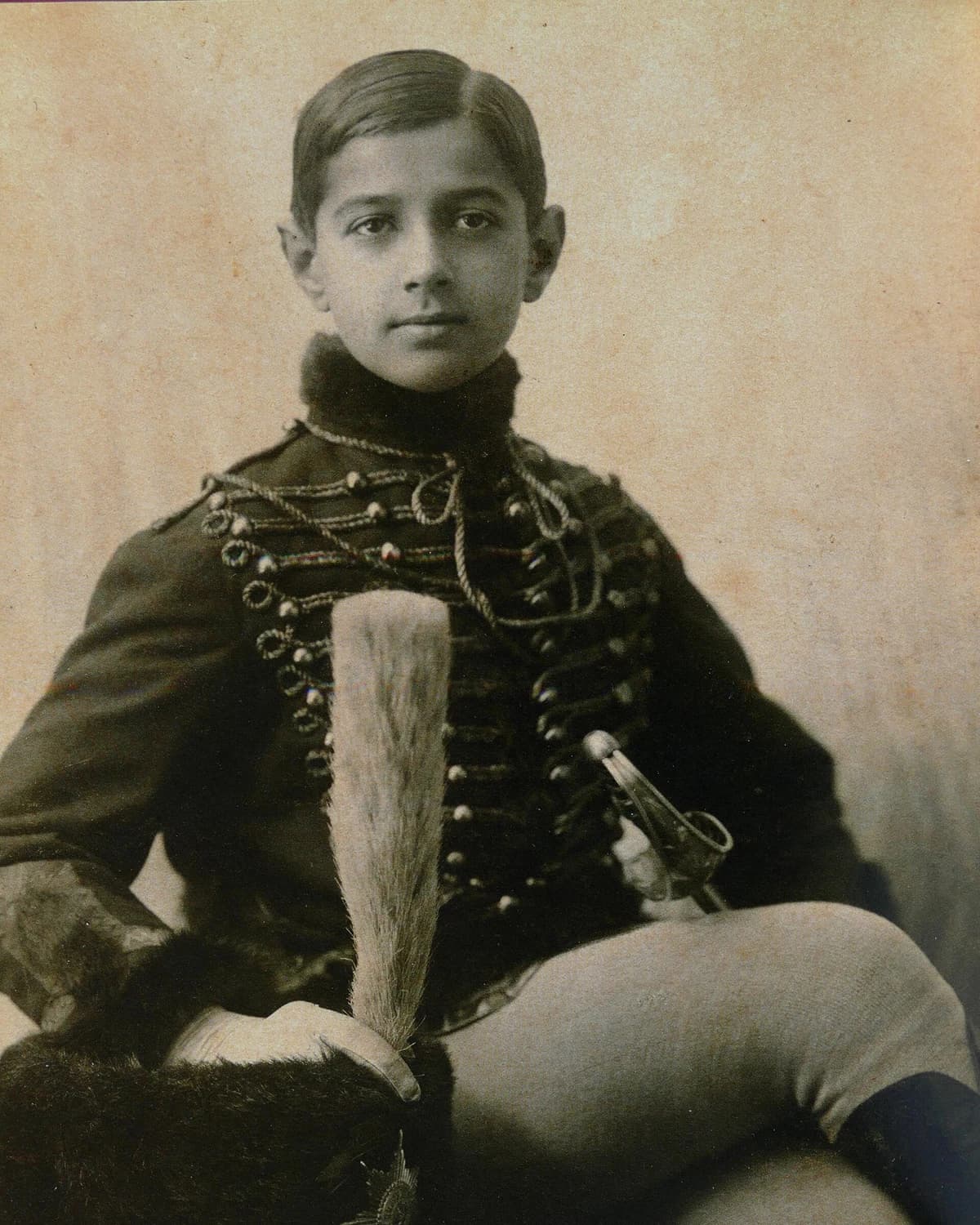
Biography
In the early 1950s Serge Poliakoff, who was already regarded as one of the most powerful painters of his generation, was still living at the Old Dovecote hotel near Saint-Germain-des-Prés. His neighbours there were the painters Louis Nallard and Maria Manton. His most reliable income still came from playing the balalaika. Stability came later, when he got a contract.
Music had kept him since 1920.
He was born in Moscow on 8 January 1900; some sources give 1906. Sergei Georgievich Polyakov was the thirteenth of fourteen children. His father, a Kyrgyz by origin, bred horses, supplied them to the army and kept a racing stable. His mother was deeply devout, and the church icons fascinated the boy. He studied at the Moscow School of Painting, Sculpture and Architecture, but in 1918 he left Russia. In 1920 he reached Constantinople and lived there by playing the guitar. Then came Sofia, Belgrade, Vienna and Berlin, and in 1923 he settled in Paris, still playing in Russian cabarets.
In 1929 he enrolled at the Académie de la Grande Chaumière, but his painting remained thoroughly academic. The turning point came in London, where in 1935–1937 he studied at the Slade School of Fine Art: there he discovered abstract art and the luminous colours of Egyptian sarcophagi. To my mind, this combination explains a good deal about his painting: it was his contemporaries who later pushed him towards non-figuration, but light and colour he found in antiquity. Soon afterwards he met Wassily Kandinsky, Sonia and Robert Delaunay and Otto Freundlich, and under their influence he came to non-figurative painting.
His first solo exhibition in Paris was held in 1945. In 1947 he worked with Jean Deyrolle at Gordes, in the Vaucluse, alongside Gérard Schneider, Émile Gilioli, Victor Vasarely and Jean Dewasne, and that same year he received the Kandinsky Prize. In 1962 the Venice Biennale gave his work a room of its own, and in the same year he became a French citizen. He also worked in ceramics, at the Sèvres manufactory. His painting influenced Arman.
Serge Poliakoff died in Paris on 12 October 1969. His pictures are in many museums in Europe and in New York. In 2006 the Musée du Luxembourg included his work in an exhibition on lyrical abstraction in Paris in 1945–1956, among them “Composition in Brown” (1947) from the Ny Carlsberg Glyptotek in Copenhagen and “Red Composition with a Line” (1952) from Cologne. And in 2013 the Musée d’Art Moderne de la Ville de Paris mounted a large retrospective, “The Dream of Forms”, with a hundred and fifty works of 1946–1969: the first significant exhibition of Poliakoff in his own city since 1970.
Related context
Associations
Works connected through artistic movements, cultural context and period. Priced works available in this market appear first.








Profile notes
Profile and sources
Image
Artist image
Unknown author Unknown author; Wikimedia Commons; Public domain.
