
1750–1837
Sengai
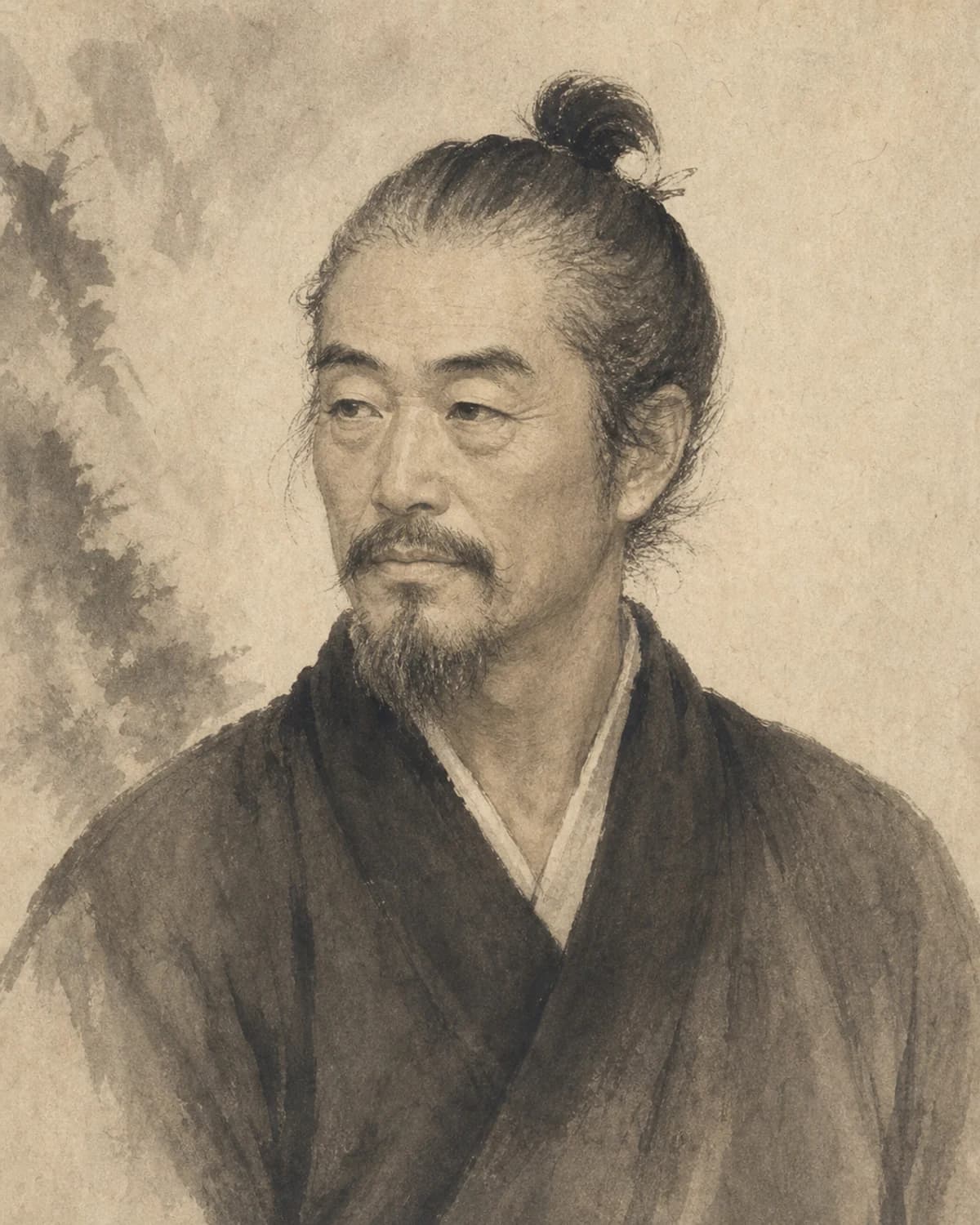
Sengai Gibon (1750–1837), a Zen monk of the Rinzai school, headed Shōfuku-ji in Hakata, the oldest Zen temple in Japan, for twenty-three years and took up painting in earnest only after forty-five. His ink pictures with joking inscriptions explained Zen to townspeople, who kept coming to him for “a single stroke” until his death; the sheet with a circle, a triangle and a square became, in the twentieth century, the best-known image of Zen in the West.
Biography
One New Year an official of the Kuroda domain came to Shōfuku-ji and asked for something auspicious in writing. Sengai nodded, took up the brush and wrote: “Grandfather dies, father dies, son dies, grandson dies.” The visitor was outraged, and the monk explained: if they die in that order, nobody in the house dies young, and what could be happier than that.
He was born in the fourth month of 1750 in Mino province, in the Mugi district (now the city of Seki in Gifu Prefecture), the son of a farmer, Itō Jinpachi. At eleven he was ordained at Seitai-ji, a temple near his home; his master was Kūin Enkyo of the Kogetsu line of the Rinzai school. At nineteen he went to Tōki-an, a hermitage at Nagata in Musashi province, in present-day Yokohama, to the master Gessen Zen’e, and received from him the inka, the certificate of attainment. When Gessen died, in 1781, the thirty-two-year-old Sengai left the hermitage and wandered for several years. At thirty-nine he became the successor of Bankoku Shōteki at Shōfuku-ji in Hakata, on Kyushu, the temple regarded as the first Zen temple in Japan, headed it for twenty-three years, and then retired to Kyohaku-in, a small subtemple of the same monastery. In Hakata he spent the rest of his life.
He began to paint in earnest, judging by what survives, in his late forties.
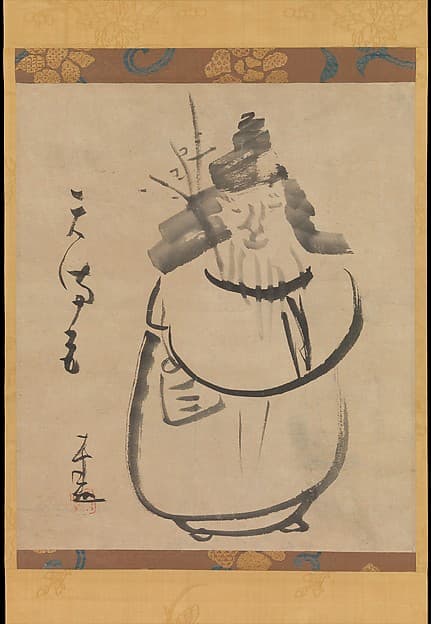
He painted in ink, quickly, and at first glance his brush looks clumsy, almost childish; the inscriptions on the pictures, on the other hand, are funny and exact, and they were made for ordinary people to whom the difficult doctrine of Rinzai was otherwise closed. Contemporaries paired him with Hakuin and said: “in the East, Hakuin of Hara; in the West, Sengai of Hakata”. He himself joked that his play with brush and ink was “not calligraphy nor painting”; the uninformed took it for one or the other. So many people wanted “a single stroke” that at eighty-three he set up a “stele of the last brush” in his garden and announced that he would paint no more; he could not keep to it, and works survive right up to the year of his death. In comic kyōka verses he compared his cell to a privy: whoever comes leaves paper behind. There is also a story of verses against a new chief councillor in his native Mino, for which he was banished from the province. Among his works are “Hotei Pointing at the Moon” and the sheet with the circle, triangle and square, both in the Idemitsu Museum in Tokyo; a pair of six-panel screens of 1822 with Bukan, Kanzan and Jittoku at the temple Genjū-an; and scrolls of the same Kanzan and Jittoku, the eccentric monks of Chinese legend, in the Eisei Bunko collection of the Hosokawa family.
The sheet with the circle, triangle and square carries no title and no inscription, only a signature. In Japan it is called simply “Maru sankaku shikaku”, and Daisetz Suzuki, who in the twentieth century translated Sengai’s inscriptions into English and opened him to the West, christened the picture “The Universe”. What the author meant cannot be checked; to my mind, that is the point.
Sengai died on 4 November 1837 (the seventh day of the tenth month of the eighth year of Tenpō) in Hakata, aged eighty-eight by the Japanese count. His last words, according to tradition, were “I don’t want to die”; the same thing, however, is told of Ikkyū, so it is hard to believe. In 1841 Emperor Ninkō granted him the posthumous name Fumon-in Entsū Zenji.
In the early Shōwa era, in the 1930s, people began to search for Sengai all over the country: new sheets turned up, anecdotes and articles multiplied, and this was called the “Sengai boom”. The chief collector was the industrialist Idemitsu Sazō; his collection is now in the Idemitsu Museum, and in 2022 the Eisei Bunko showed Sengai’s sheets in an exhibition subtitled “Come again and laugh!”.
Artist works
Works by the artist
Works by Sengai available in this edition of NEOARCA.
Related context
Associations
Works connected through artistic movements, cultural context and period. Priced works available in this market appear first.








Profile notes
Profile and sources
Image
Artist image
На основе открытого изображения: Sengai; Wikimedia Commons; Public domain.
