
1906–1954
Santiago Martínez Delgado
Santiago Martínez Delgado (1906–1954) studied in Chicago for five years, went to Frank Lloyd Wright at Taliesin and in 1933 won the Logan Medal for a mural at the World’s Fair. In Colombia he painted the Elliptical Room of the Capitol in Bogotá, edited the magazine “Vida” and published books on the iconography of Bolívar. He died at forty-seven, leaving unfinished a huge canvas for a bank.
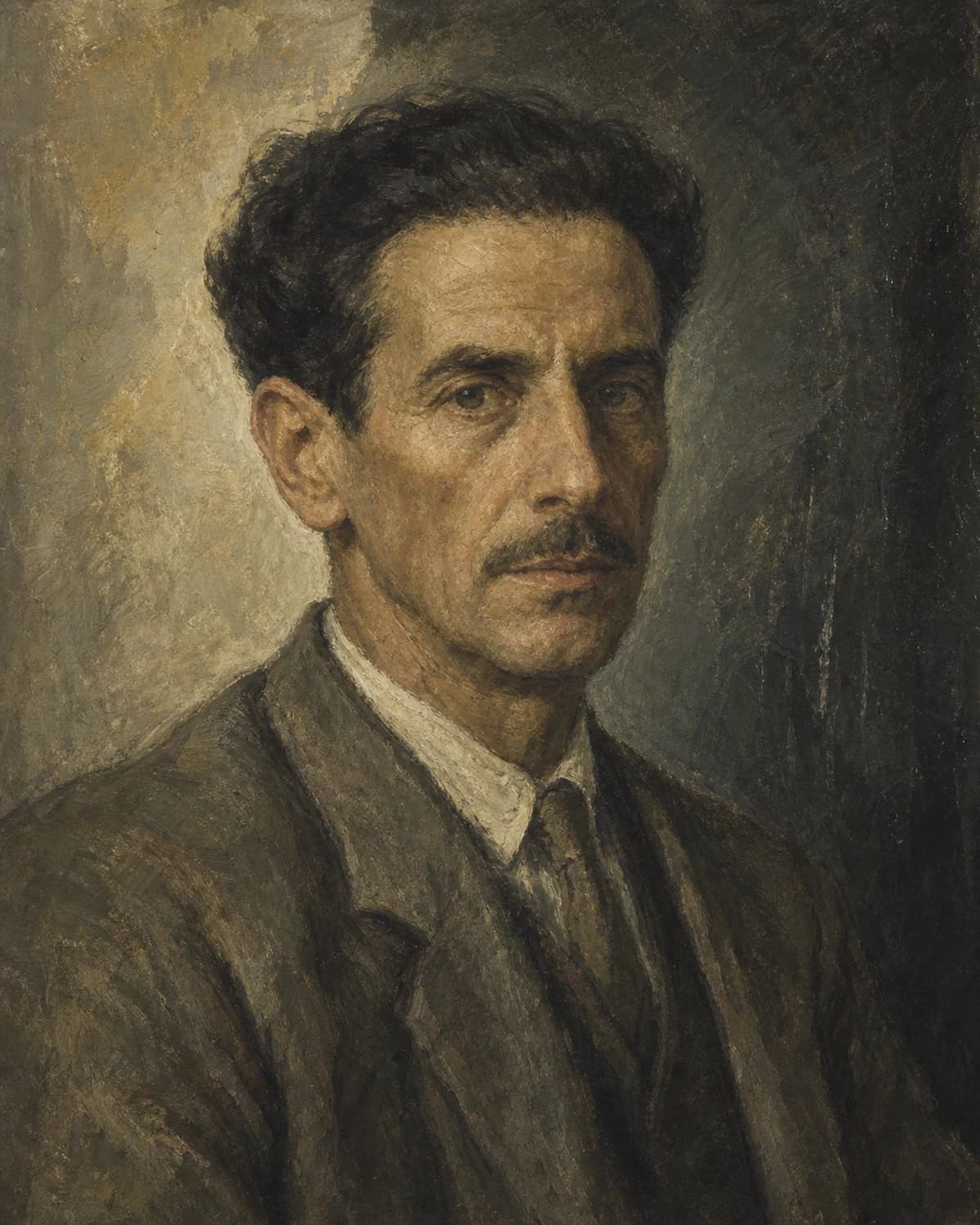
Biography
In 1939 Martínez Delgado brought to New York, to the World’s Fair, a painting he believed to be by Raphael. He had first examined it by X-ray, and now specialists from the Metropolitan Museum, the Art Institute of Chicago and the Louvre looked at it. They confirmed his attribution, and in Colombia the dispute over it became known as “the Madonna affair”.
It had all begun in Bogotá.
He was born in 1906 (on 19 April, if some biographical accounts are to be trusted) into an aristocratic family. His father, Luis Martínez Silva, was a Conservative Party leader who was exiled from the country on a charge of involvement in an attempted coup; Santiago grew up without him. His mother, Mercedes Delgado Mallarino, painted in her spare time and gave her son his first drawing lessons. From the age of eleven he studied with Roberto Pizano, then attended the School of Fine Arts in Bogotá. In 1925 he went to Cartagena and ran a page in the newspaper “La Patria”, signing it with the pseudonym Sanmardel.
In 1926 he left for Chicago and for about five years studied at the academy of fine arts under Ruth VanSickle Ford. Among his acquaintances in Chicago are named Edward Hopper, Isamu Noguchi and Willem de Kooning. He worked for Wright at Taliesin: according to some accounts, he made paintings, wood carvings and stained glass for him. It was there that he began to try out the language of Art Deco. Wright said of his drawing: “Young Santiago’s brush lines are elegant.” He made illustrations for Esquire magazine, and in 1929 won a prize from the US Federation of Commercial Artists for the best advertising illustration. In 1933, at the Chicago World’s Fair, his mural on the development of Colombia won him the Logan Medal; at the same fair he helped paint murals in the General Motors pavilion.
He returned to Colombia in 1934. His first solo exhibition in Bogotá, in Art Deco, caused controversy. In 1935 he painted the curtain of the Teatro Municipal, which has not survived, and in 1936 he founded a course in art and decoration at the women’s Universidad Javeriana. From 1937 to 1940 he ran the magazine “Vida” and illustrated it himself; it printed interviews with Joan Miró and Gabriela Mistral. He also painted murals for the café El Molino.
In 1940, at the first Salón de Artistas Colombianos, he won the gold medal for the oil painting “El que volvió” (“The One Who Returned”), and in 1941 first prize for “Interludio” (now in the National Museum of Colombia). He finished his first fresco in the country, in the chapel of the Presentación school in Chapinero, in 1943. In 1945 he began the Stations of the Cross for the cathedral of Cúcuta: of the fourteen planned he managed to finish five, each three metres by two. In the same year he became a member of the Academy of History in Bogotá and illustrated a book about Sucre.
His main work of these years is the fresco of the Elliptical Room of the Capitol, commissioned in 1947 for the Pan-American Conference. For it he studied the iconography of Bolívar and Santander, corresponded with specialists, toured museums and collected uniforms and swords. For it he received the Cross of Boyacá.
Commercial work followed: in 1948 he founded a commercial art studio and wrote and directed radio dramas, of which “El Virrey Solís” broke the year’s listening records. In 1951 his murals in Medellín, at the Banco Comercial Antioqueño and the Banco de Colombia, set off a controversy in the press: local artists, among them Eladio Vélez, objected that commissions were being given to a painter from the capital.
In 1953 he began a canvas of eight by four metres for a bank in Bogotá, commissioned by the Rockefeller family. He worked on it until his last day. He died on 12 January 1954 at the El Molino estate in Cajicá and was buried in the Central Cemetery of Bogotá. In August of that year the National Museum held an exhibition of his work. The canvas was hung in the bank in the place intended for it.
Related context
Associations
Works connected through artistic movements, cultural context and period. Priced works available in this market appear first.








Profile notes
Profile and sources
Image
Artist image
На основе открытого изображения: Santiago Martinez Delgado; Wikimedia Commons; CC BY-SA 3.0.
