
1445–1510
Sandro Botticelli
Sandro Botticelli, a pupil of Fra Filippo Lippi, spent almost his whole life in one Florentine neighbourhood near the church of Ognissanti and went away for a long stretch only once, to paint in the Sistine Chapel. He worked for the Medici and their allies. “Primavera” and “The Birth of Venus” in the Uffizi brought him fame later; in his lifetime he painted mostly altarpieces and round Madonnas.
Biography
In 1480 the Vespucci family commissioned from Botticelli a fresco of Saint Augustine for their parish church, Ognissanti. Facing it, Domenico Ghirlandaio painted Saint Jerome, and both saints sit in their studies, crowded with objects. Above Augustine’s head lies an open book. Almost all the “text” in it is scribble, but one line can be read: “Where is Brother Martino? He went out. And where did he go? He is outside Porta al Prato.” Most likely this is a conversation overheard among the Umiliati friars who ran the church; Vasari wrote that Botticelli was fond of jokes of this kind.
Ognissanti was his parish too: he was baptised there, and he was buried there.
When he was born is not known for certain. In his father’s tax returns the son is two years old in 1447 and thirteen in 1458, so he was born between 1444 and 1446. The painter’s real name was Alessandro di Mariano di Vanni Filipepi; his father was a tanner, and Sandro was the youngest of four sons who survived. The nickname “Botticelli”, meaning “little barrel”, was first borne by his brother Giovanni, and the sources explain it in different ways. Another brother, Antonio, was a gold-beater, and Vasari reports that Sandro began as a goldsmith’s apprentice. The family’s neighbours were the Vespucci, among them Amerigo, after whom America would later be named.
Around 1461–1462 he entered the workshop of Fra Filippo Lippi and worked with him in Prato, where his master was painting the cathedral. From Lippi he took the clear contour, the soft modelling and the pensive, beautiful faces. The influence of the Pollaiuolo brothers and of Andrea del Verrocchio is evident, but whether he trained in their workshops is unclear. By 1469, when Lippi died in Spoleto, Botticelli already had a workshop of his own. His earliest securely dated painting, “Fortitude” (1470), completed for the Merchants’ Court a series of Virtues begun by Piero del Pollaiuolo. In 1472 Filippino, Lippi’s son, became his apprentice.
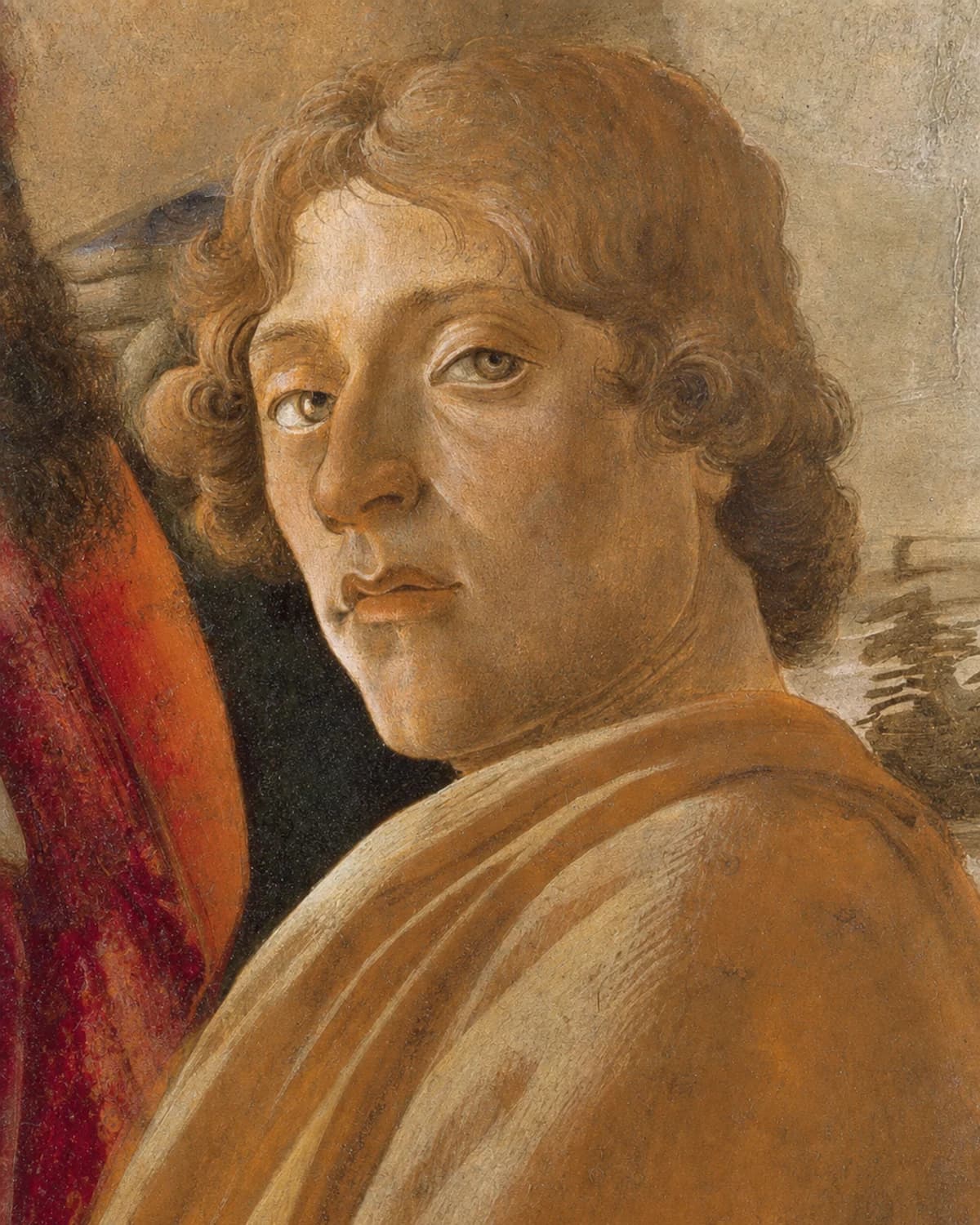
His fame grew quickly. In 1474 he was invited to Pisa to paint in the Camposanto, but nothing of that work survives. The “Saint Sebastian” of the same year was painted for a pier in the Florentine church of Santa Maria Maggiore, hence its narrow format, and its winter landscape recalls the saint’s January feast. In the “Adoration of the Magi” for Santa Maria Novella (c. 1475) he included portraits of the Medici and, in the view of most scholars, himself at the right edge.
In 1481 Pope Sixtus IV summoned him to Rome, together with Perugino, Ghirlandaio, Cosimo Rosselli and other masters, to paint the walls of the new Sistine Chapel. Botticelli was given the “Temptations of Christ”, the “Youth of Moses” and the “Punishment of the Sons of Korah”, as well as some of the imagined portraits of the early popes. Each scene measures about 3.5 by 5.7 metres, and the whole was done in a few months, with assistants. In the “Youth of Moses” the hero appears seven times. In 1482 Botticelli returned to Florence and never again left it for long.
The eighties were his finest decade. “Primavera” (c. 1482) was apparently painted for the town house of Lorenzo di Pierfrancesco de’ Medici, together with “Pallas and the Centaur”, and “The Birth of Venus” (c. 1485) for another patron; Vasari saw both pictures at the Villa di Castello in the mid-sixteenth century, and both are now in the Uffizi. European art had hardly known such large paintings of classical subjects since antiquity itself. Their meaning is traced to the poetry and Neoplatonic philosophy of the circle of Lorenzo the Magnificent, but neither illustrates a particular text. In the small “Venus and Mars” in the National Gallery in London, Mars sleeps while little satyrs play with his armour, one blows a conch into his ear, and wasps buzz around his head. The Italian for wasps is “vespe”, hence the guess that the picture was commissioned by the neighbouring Vespucci, whose coat of arms bore wasps. In 1483 Antonio Pucci commissioned, for his son’s wedding, four panels with the story of Nastagio degli Onesti from the “Decameron”.
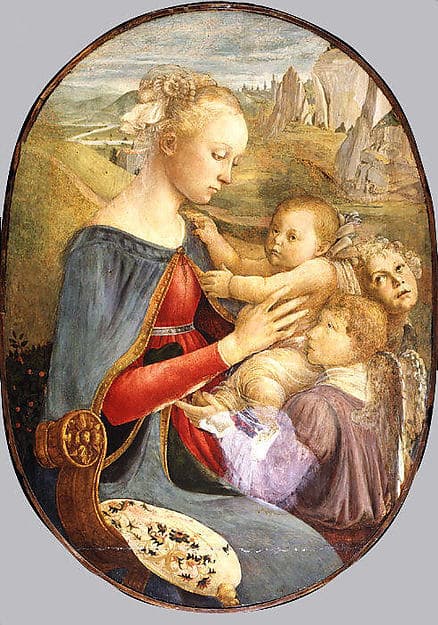
At the same time he painted altarpieces and Madonnas, often round tondos more than a metre across. In the “Madonna of the Magnificat” (c. 1483) Mary writes down her song of praise, and the wingless angels look like fashionably dressed young Florentines. In the Bardi Altarpiece (1485) the bench is seen from above and the vases of lilies on it from below, and such freedom with perspective is typical of him. All his life he was occupied with Dante: Baccio Baldini engraved illustrations after his drawings for the printed “Divine Comedy” of 1481, and later he began a luxurious manuscript on parchment, of which 93 sheets survive, mostly underdrawings.
In the nineties Savonarola was preaching in Florence. Vasari writes that Botticelli became his follower, gave up painting and in old age nearly starved. I would not take his word for it: the “Mystic Nativity”, the artist’s only dated work, was painted at the end of 1500, after Savonarola’s execution, and in 1502 an agent of Isabella d’Este informed her that Botticelli was free and ready to take on a commission at once. The story that he burned his own secular paintings on the “bonfire of the vanities” is not in Vasari. His manner did indeed grow severe towards the end of the century: the dark “Lamentations”, the “Calumny of Apelles” (c. 1494–1495), figures of differing scale and the devils hiding in the rocks of the “Mystic Nativity”. In the Greek inscription on it the painter names himself Alessandro and mentions “the troubles of Italy”. In 1504 he sat on the committee that decided where Michelangelo’s “David” should stand.
He paid his dues to the Confraternity of Saint Luke until at least October 1505. According to Vasari, in his last years he walked on crutches. Sandro Botticelli died on 17 May 1510 and was buried at the church of Ognissanti. Tradition has it that he asked to be laid at the feet of Simonetta Vespucci, who had died in 1476 and in whom many have wished to see the model for his beauties.
Artist works
Works by the artist
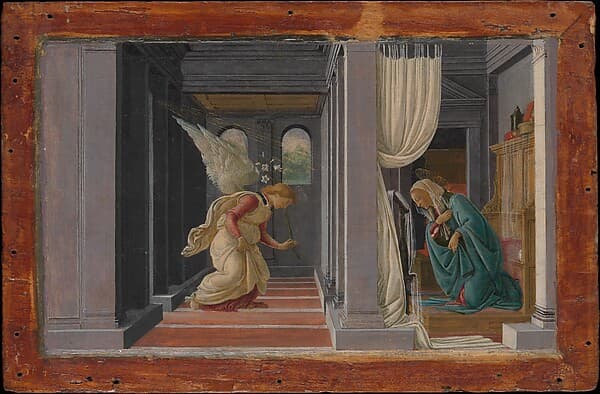
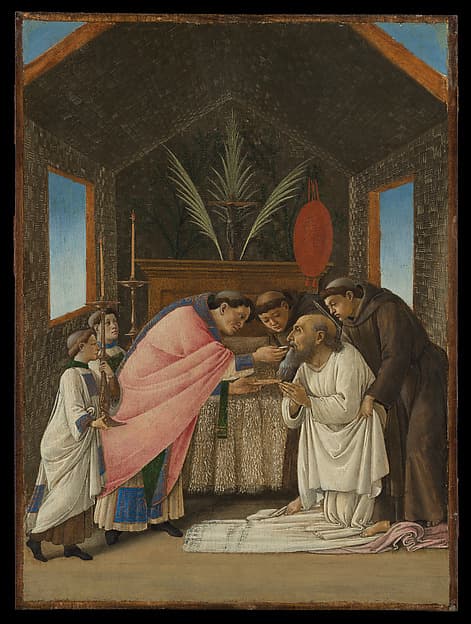
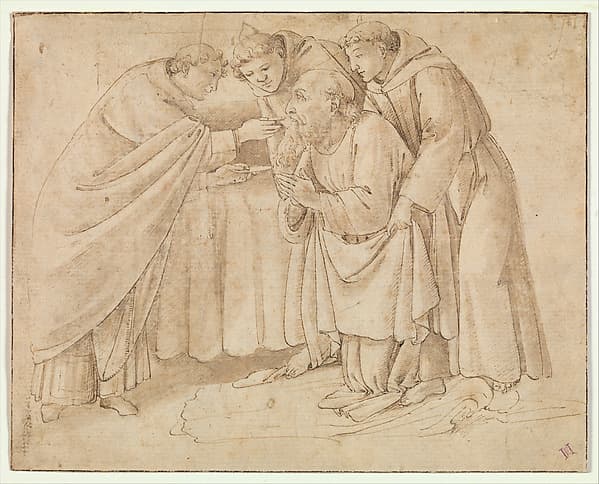
Works by Sandro Botticelli available in this edition of NEOARCA.
Related context
Associations
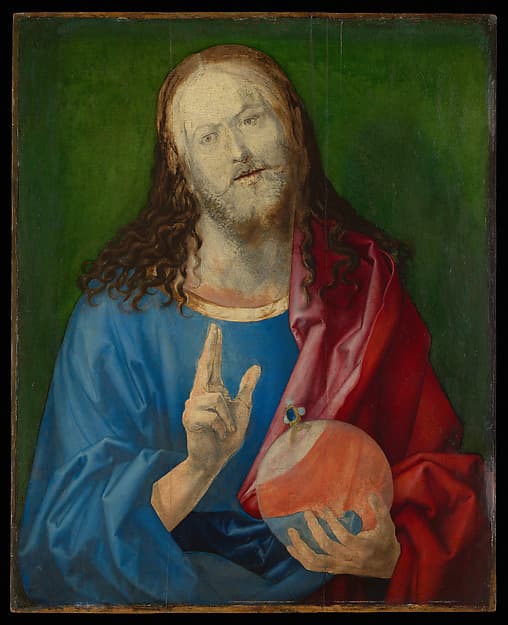
Works connected through artistic movements, cultural context and period. Priced works available in this market appear first.
Profile notes
Profile and sources
Image
Artist image
На основе открытого изображения: Sandro Botticelli; Wikimedia Commons; Public domain.
