
11.05.1904–23.01.1989
Salvador Dalí
Salvador Dalí (1904–1989), from Figueres in Catalonia, joined the Surrealist group in 1929, painted “The Persistence of Memory” with its soft watches and became one of the movement's leading artists until Breton expelled him. He made objects, jewellery and stage designs, worked with Buñuel, Hitchcock and Disney, and in 1974 opened his own Theatre-Museum in his home town.
Biography
In 1938 Stefan Zweig arranged for Salvador Dalí to meet Sigmund Freud. While Dalí was drawing his portrait, Freud whispered that the young man looked like a fanatic, and Dalí, when he heard of it, was delighted. The next day Freud wrote to Zweig that he had until then regarded the Surrealists, who had chosen him as their patron saint, as complete fools, but that the young Spaniard, with his candid fanatical eyes and undeniable technical mastery, had made him change his mind.
In December 1936, at thirty-two, Dalí had already appeared on the cover of Time magazine.
He was born on 11 May 1904 in Figueres, in the Catalan district of the Empordà, not far from the French border. His father, a notary and a convinced atheist, kept his son on a strict rein; his mother, Felipa Domènech, encouraged his drawing. An older brother, also called Salvador, had died on 1 August 1903, nine months before he was born. Dalí said that they resembled each other like two drops of water but had different reflections, and in 1963 he painted “Portrait of My Dead Brother”.
In 1916 the boy started at the municipal drawing school, and that summer in Cadaqués, on holiday with the family of the painter Ramon Pichot, he saw modern painting for the first time. In 1918 his work was shown at the Municipal Theatre in Figueres; he would return to that site several decades later. On 6 February 1921 his mother died, and Dalí, then sixteen, later called it the hardest blow of his life.
In 1922 he moved into the Residencia de Estudiantes in Madrid and enrolled at the San Fernando Academy. Long hair, sideburns and knee-breeches in the manner of the English aesthetes made him conspicuous at once. There he grew close to Luis Buñuel and Federico García Lorca, spent Sunday mornings in the Prado taking the old masters apart pencil in hand, and read Freud. His first solo exhibition was held in November 1925 at the Galeries Dalmau in Barcelona. In April 1926 he went to Paris for the first time and met Picasso, and shortly before his final examinations he left the academy; by some accounts he was expelled for insolence towards his teachers. The realistic “Basket of Bread” of the same year shows how well trained he was.
From 1927 his work turned Surrealist: rotting donkeys, dismembered bodies, the light and landscapes of Catalonia. In 1929 he wrote the screenplay of “Un Chien Andalou” with Buñuel, and in August he met Gala, born Elena Diakonova, a Russian émigrée ten years his senior and at the time the wife of the poet Paul Éluard. In November came his first Paris exhibition, with a catalogue preface by André Breton, and Dalí joined the Surrealist group. On a drawing of the Sacred Heart of Jesus he wrote: “Sometimes I spit for fun on my mother's portrait.” His father demanded a public retraction, was refused, and on 28 December 1929 threw his son out of the house. The following summer Dalí and Gala rented a fisherman's hut in the bay of Port Lligat, then bought it and gradually turned it into a villa. In 1931 came “The Persistence of Memory”; the idea of the soft watches, Dalí insisted, had come to him while looking at a Camembert. On 30 January 1934 he and Gala were married at a civil ceremony in Paris, and they were not married in church until 8 August 1958. Gala managed all his affairs.
Dalí refused to condemn fascism outright; in 1934 he went through an internal Surrealist “trial” and replied that the difference between them was that he was the Surrealist. In 1936, at the London exhibition, he gave a lecture in a diving suit and nearly suffocated. That same year he painted “Soft Construction with Boiled Beans”, and for the patron Edward James he made the “Lobster Telephone” and a sofa in the shape of Mae West's lips. In 1936 the Nationalists shot Lorca; publicly, Dalí spoke neither for nor against the Republic throughout the war. After Franco's victory he wrote Buñuel a letter praising Catholicism and the Falange, and Buñuel broke with him; in May 1939 Breton announced Dalí's expulsion from the group.
In 1940 the Portuguese consul in Bordeaux, Aristides de Sousa Mendes, issued visas to Dalí and Gala, and in August they sailed from Lisbon to New York. In America, where they lived for eight years, “The Secret Life of Salvador Dalí” was published (1942), there was a retrospective at the Museum of Modern Art, and there followed designs for ballets, the dream sequence in Hitchcock's “Spellbound” (1945) and “Destino” for Disney.
In 1948 they returned to Port Lligat. Living in Spain under Franco and publicly supporting the regime provoked the outrage of many artists, and Picasso never spoke his name again for the rest of his life. Dalí announced his return to the Catholic faith, showed Pope Pius XII a study for “The Madonna of Port Lligat” and called his new style “nuclear mysticism”: Christian iconography combined with the disintegration of matter taken from atomic physics. This is how “Christ of Saint John of the Cross” (1951) and “The Disintegration of the Persistence of Memory” were painted; his “Sacrament of the Last Supper” also belongs among the religious works. In 1958 he named the physicist Heisenberg as his new father in place of Freud. To my mind, this is the best key to the late Dalí.
He was one of the first artists to take up holography, and he made thirty-nine pieces of jewellery. From 1960 he built his Theatre-Museum in Figueres, which opened in 1974. In 1968 he bought the castle of Púbol for Gala, and he himself went there only with her written permission. Gala died on 10 June 1982 and was buried at Púbol; Dalí moved there, and that same year King Juan Carlos granted him the title of Marquess of Dalí de Púbol. After a fire in his bedroom in August 1984 he moved to the Torre Galatea, part of the museum. He gave his last drawing, “Head of Europa”, to the King on 5 December 1988.
Salvador Dalí died in Figueres on 23 January 1989. He was buried in the crypt beneath the stage of the Theatre-Museum, across the street from the church of Sant Pere, where he had been baptised, and four hundred and fifty metres from the house where he was born.
Related context
Associations
Works connected through artistic movements, cultural context and period. Priced works available in this market appear first.








Profile notes
Profile and sources
Image
Artist image
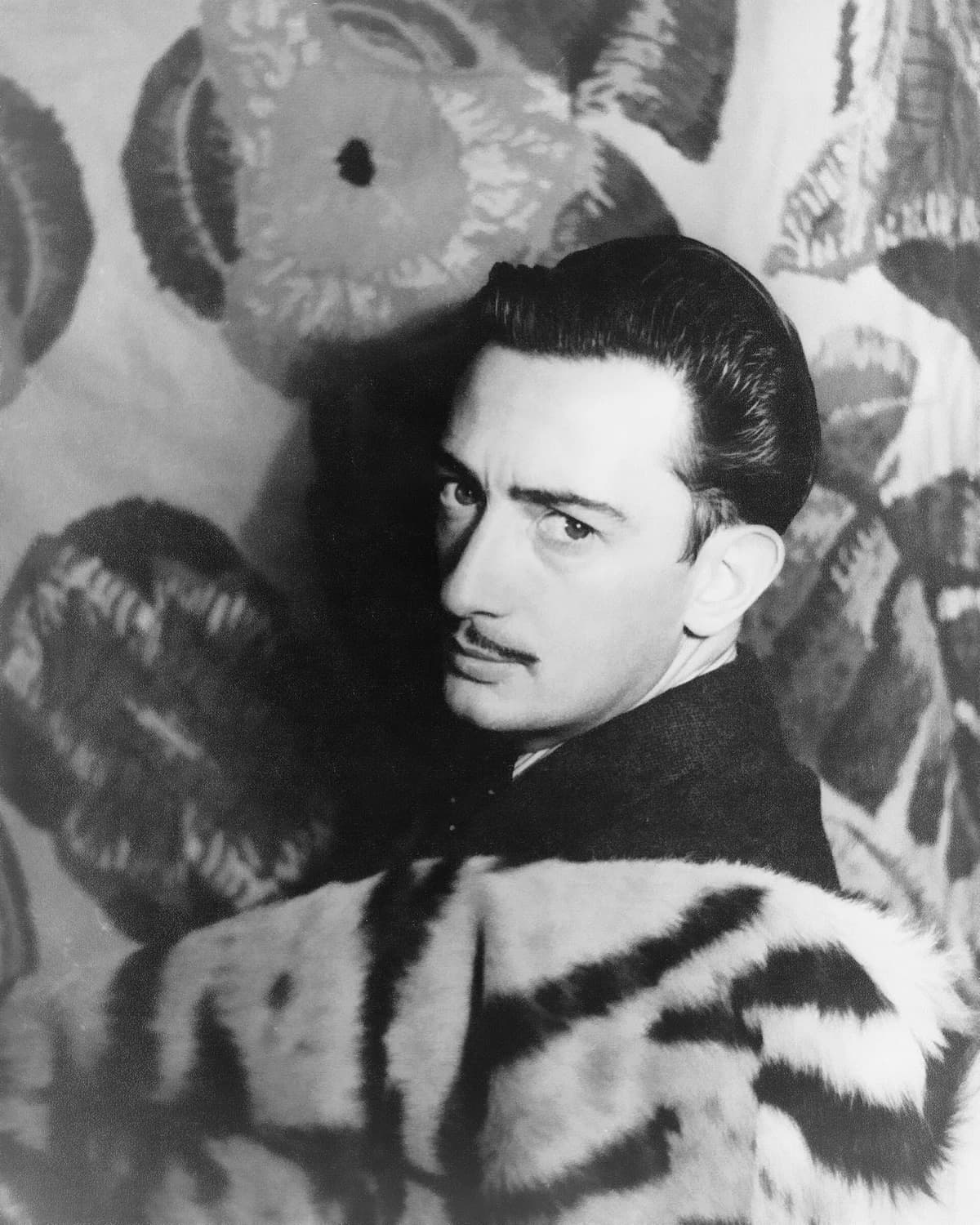
Van Vechten, Carl, 1880-1964.; Wikimedia Commons; Public domain.
