
22.02.1922–23.07.2016
S. H. Raza
Sayed Haider Raza (1922–2016) founded the Progressive Artists’ Group in Bombay in 1947 together with F. N. Souza and K. H. Ara, and from 1950 lived and worked in France. He began with watercolour landscapes, and from 1980 built abstract canvases around the bindu, a black central dot. In 1956 he became the first foreigner to receive the Prix de la Critique in Paris.
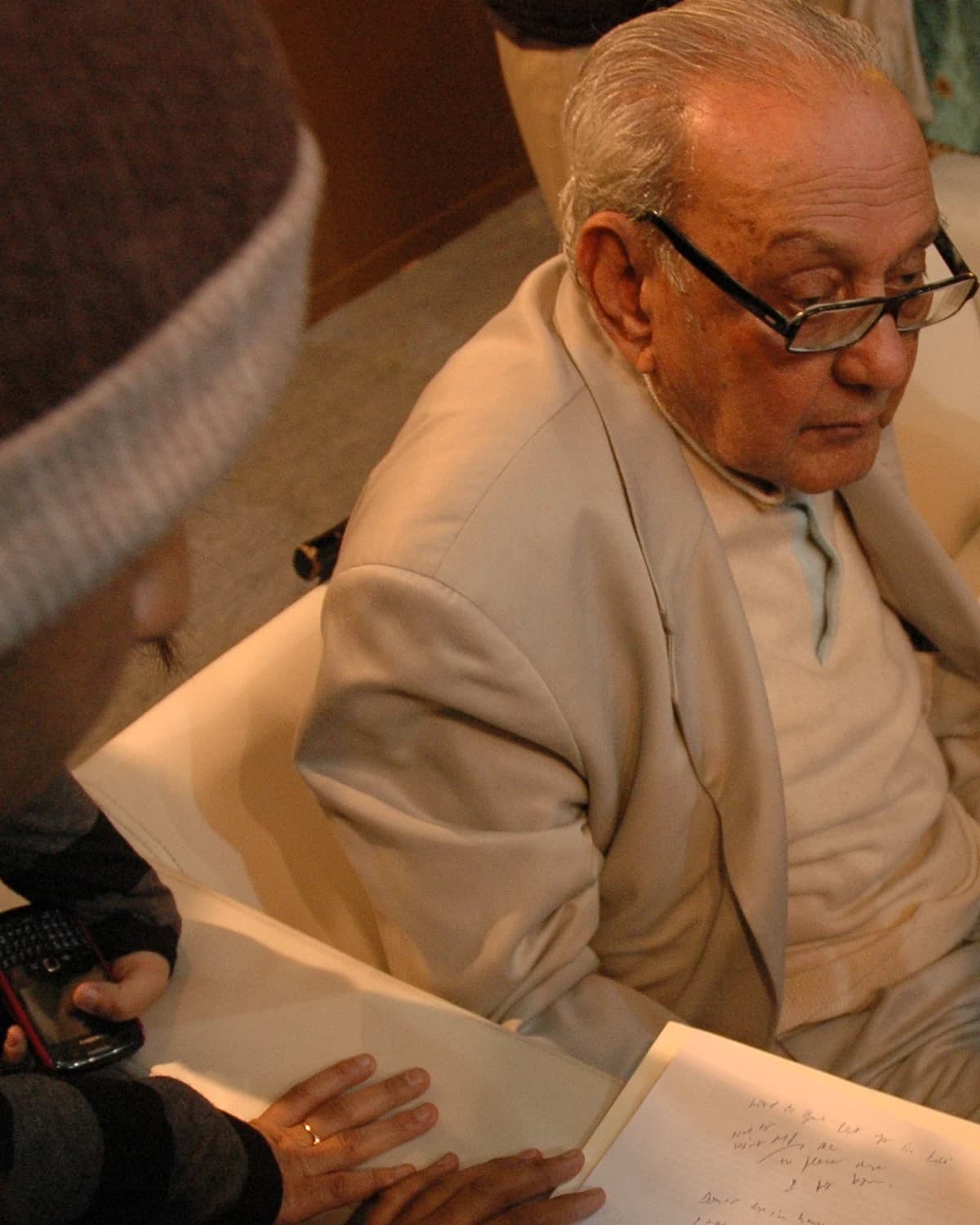
Biography
A primary school teacher, noticing that the boy simply could not concentrate, drew a dot on the blackboard and told him to look at it. That, by Raza’s own account, was how the bindu came about, the dot around which almost all his painting was built from 1980 onwards. In Indian philosophy the bindu is held to be the point from which creation begins. In 2010, already in his eighties, he put it briefly: it is the centre of my life.
Sayed Haider Raza was born on 22 February 1922 in the village of Kakkaiya in Mandla district (British India, now the state of Madhya Pradesh). His father, Sayed Mohammed Razi, was the district’s deputy forest ranger; his mother was called Tahira Begum. He started drawing at about twelve, at thirteen moved to Damoh and finished secondary school there. Then came the art school in Nagpur (1939–1943) and the Sir Jamsetjee Jeejebhoy School of Art in Bombay (1943–1947). His first solo exhibition, at the salon of the Bombay Art Society in 1946, earned a silver medal; two years later the society gave him its gold.
The year 1947 proved both hard and decisive for him. His mother and his father died, and most of his brothers and his sister moved to Pakistan after Partition. That same year Raza, with F. N. Souza and K. H. Ara, founded the Bombay Progressive Artists’ Group. They wanted to free Indian painting from European realism and bring back into it an inner vision, “antar gyan”. Raza himself was painting loose watercolours at the time, landscapes and townscapes, and in September 1948 he showed a hundred pictures of Kashmir in New Delhi.
In October 1950 he went to France to study at the École Nationale Supérieure des Beaux-Arts on a French government scholarship (1950–1953) and stayed there for sixty years. The artist Krishen Khanna recalled a joint Paris exhibition of Raza, Akbar Padamsee and Souza at the Gallery Cruz: the other two painted in a half-modernist manner, while Raza produced watercolours that looked like jewels, rubbing the pigment in with a shell, as in Mughal miniatures. In France his landscapes grew more and more expressive. In the “Église” series a village church sinks into an inky-blue night sky, the paint lies thick, the brushwork is sharp. In 1956 Raza received the Prix de la Critique, the first non-French artist to do so, and in the same year took part in the Venice Biennale. In 1959 he married the French artist Janine Mongillat, and in 1962 he lectured at the University of California, Berkeley.
By the 1970s his own painting no longer satisfied him. He travelled to the caves of Ajanta and Ellora, to Varanasi, Gujarat and Rajasthan, and called his earlier work “plastic art”, something he wanted to leave behind. The result was the bindu. After 1980 the expressive landscape gave way to geometry: the dot, the triangle (tribhuj), the paired concepts of prakriti and purusha, matter and spirit. He himself saw the bindu as a centre from which form and colour, energy, sound, space and time spread outwards. I think that is why his late canvases cannot be read as pure geometry. From 2000 the Kundalini, nagas and subjects from the “Mahabharata” appeared in his work.
In 1991 the Palais Carnolès in Menton held the retrospective “Raza 1952–1991”. India gave him the Padma Shri (1981), the Padma Bhushan (2007) and the Padma Vibhushan (2013), and on 14 July 2015 France made him a Commander of the Legion of Honour. The Raza Foundation in India presents an annual award to young artists, and a French foundation in the village of Gorbio looks after his estate.
Janine died in 2002. Some years later Raza moved back to New Delhi, and until his last days he worked several hours a day.
He died in New Delhi on 23 July 2016, at the age of 94. He was buried, as he had asked, in Mandla, beside his father’s grave.
Profile notes
Profile and sources
Image
Artist image
Chetan Nikam; Wikimedia Commons; CC BY-SA 4.0.
