
07.02.1912–29.06.1981
Russell Drysdale
Russell Drysdale (1912–1981), also known as Tass, made the Australian outback his main subject: red, parched earth, abandoned goldfields, lone figures under heavy skies. He won the 1947 Wynne Prize for “Sofala”, his London exhibition of 1950 opened British critics’ eyes to Australian painting, and in 1954 he represented Australia at the Venice Biennale.
Biography
In 1944 the Sydney Morning Herald sent Russell Drysdale to the far west of New South Wales to draw the effects of the drought that was then ruining the region. The trip produced a series of paintings of the scorched land of the state’s west. The art historian Ron Radford would later say that by the end of the war Drysdale had set off “a general reddening” of the Australian landscape.
He himself was born far from those places.
George Russell Drysdale came into the world on 7 February 1912 at Bognor Regis, in Sussex, England, into an Anglo-Australian pastoralist family that settled in Melbourne in 1923. He was educated at Geelong Grammar School. His eyesight was poor all his life, and from the age of seventeen, after a detached retina, he was almost blind in his left eye; later this kept him out of the army. At first he worked on his uncle’s property in Queensland and as a jackaroo in Victoria. In 1932 he was operated on by the Melbourne surgeon and photographer Julian Smith, who showed his patient’s drawings to the artist and critic Daryl Lindsay; Lindsay advised him to take up art seriously and introduced him to George Bell, a modernist and the founder of the Contemporary Art Society. Drysdale studied with Bell in Melbourne from 1935 to 1938. In 1938 his first solo exhibition was held, also in Melbourne.
He trained in Europe as well: in 1938–1939 he attended the Grosvenor School in London and the Académie de la Grande Chaumière in Paris. When he came back from the third of these trips in June 1939, he was already regarded in Australia as a notable young talent, but he did not yet have a vision of his own.
A move gave him one. In 1940 Drysdale left Melbourne for Albury and then Sydney, and found his lifelong subject: the Australian outback and its people. Much was suggested by his friend, the painter Peter Purves Smith: from him come the desolate landscapes with a few figures under a threatening sky. His Sydney exhibition of 1942 was a critical success and placed Drysdale alongside William Dobell, Elaine Haxton and Donald Friend, the leading Sydney modernists of the day. After the drought series of 1944 came a series on the derelict gold-mining town of Hill End. “Sofala”, a view of a nearby town, won the Wynne Prize for landscape in 1947. The National Gallery of Australia describes “The Cricketers” (1948) as one of the most original and haunting images in Australian art. “The Drover’s Wife”, according to scholars, sits in the Australian mind beside Sidney Nolan’s “Carcass” paintings. The earth in his canvases is red, burning hot and hostile to man, and the figures on it look utterly estranged. He also worked with colour photography, using his snapshots as a notebook; in 1987 the National Gallery of Victoria devoted an exhibition to this method.
In 1950, at the invitation of Kenneth Clark, the Leicester Galleries in London showed his paintings. Until then Australian painting had been seen in Britain as a provincial offshoot of British art; after this exhibition critics began to speak of a distinct Australian vision. International recognition for Dobell, Nolan, Arthur Boyd and Clifton Pugh followed.
In 1954 Drysdale represented Australia at the Venice Biennale together with Nolan and Dobell, and in 1960 he became the first Australian artist to be given a retrospective by the Art Gallery of New South Wales. In 1962 he wrote a travel book, “Journey Among Men”, with Jock Marshall. From 1963 he sat on a small committee of the Reserve Bank of Australia that oversaw the designs of the banknotes for the new decimal currency, introduced in 1966. In 1969 he was knighted for services to art, and in 1980 he was made a Companion of the Order of Australia. In his later years he painted noticeably less, though he had never been prolific.
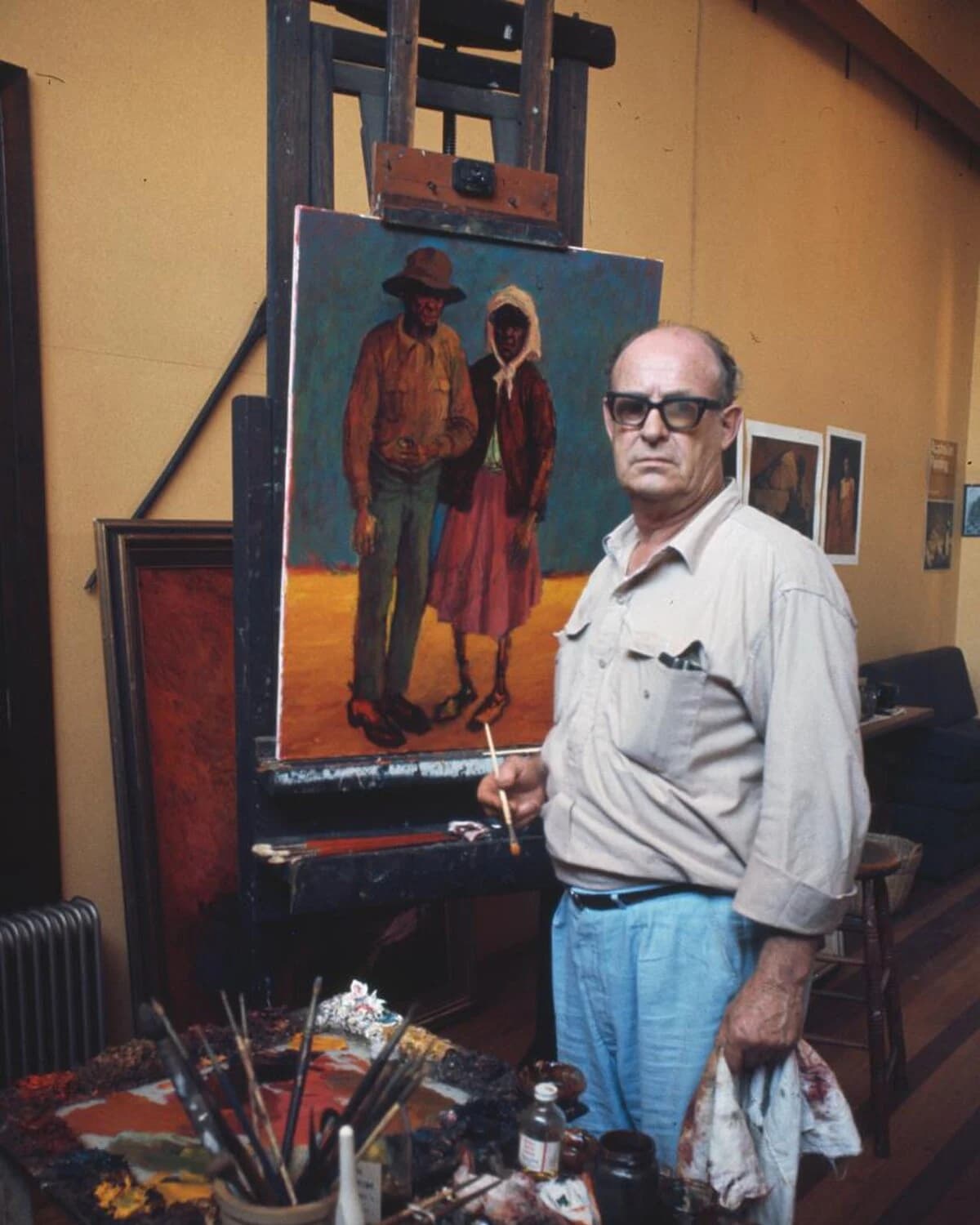
The composer Peter Sculthorpe, who became a close friend, recalled that Drysdale was reproached for painting the same picture over and over. He would reply that he was no different from a Renaissance master trying again and again to paint the perfect Madonna and Child. I think this is the best key to his late works, right up to “Grandma’s Sunday Walk” (1972), one of his last. Sculthorpe admitted that from then on he, too, stopped worrying about returning to his own material.
The scholar Lou Klepac observed that viewers see loneliness and isolation in these paintings, whereas for Drysdale himself the outback was a liberation from the anxieties of the civilised world.
Sir Russell Drysdale died on 29 June 1981 in Sydney. At his request his ashes were placed in the shade of a tree by St Paul’s Church at Kincumber, in the old churchyard.
Related context
Associations
Works connected through artistic movements, cultural context and period. Priced works available in this market appear first.








Profile notes
Profile and sources
Image
Artist image
Australian Information Service; Wikimedia Commons; Public domain.
