
27.10.1923–15.09.1997
Roy Lichtenstein
In 1961 Roy Lichtenstein (1923–1997) transferred a picture from a Mickey Mouse comic onto canvas, printing dots and all, and became one of the leading figures of American Pop Art. Then came enlarged panels of war and romance, brushstrokes drawn as if they were printed reproductions, mirrors, entablatures, interiors, sculpture and more than three hundred prints.
Biography
In 1961 one of Roy Lichtenstein’s sons showed him a Mickey Mouse comic and declared that his father could not draw like that. His father did. “Look Mickey” became his first work in which hard outlines and the big Ben-Day dots used to print cheap comics took over the whole canvas. According to another account, the son was being teased at school about his abstractionist father, who supposedly could not draw.
Before that, Lichtenstein had spent several years painting Abstract Expressionist canvases, hiding Mickey Mouse and Bugs Bunny inside them.
He was born on 27 October 1923 in New York, into a well-off German-Jewish family. He drew for his own pleasure: he loved jazz, went to concerts at the Apollo Theater in Harlem and drew the musicians. In the summer of 1939 he enrolled in classes at the Art Students League under Reginald Marsh, and after school he went to study at Ohio State University. From 1943 to 1946 the army interrupted his studies: he served as an orderly, a draftsman and an artist. Back in Ohio, he came under Hoyt Sherman, who is regarded as his chief teacher. In 1949 he took his Master of Fine Arts degree there and taught, on and off, for about ten years.
His first solo exhibition was held in 1951 at the Carlebach Gallery in New York. That same year he moved to Cleveland and lived there for six years, working now as a draftsman, now as a window decorator, and painting in between, wavering between Cubism and Expressionism. From 1957 he taught again in upstate New York, from 1958 at Oswego, and in 1960 he moved to Rutgers University. Allan Kaprow taught there alongside him, and that milieu turned him back towards the images of mass culture.
From 1961 Leo Castelli showed his work, and in 1962 his first solo exhibition was held at the gallery. Lichtenstein painted single objects from advertising (sneakers, hot dogs, golf balls), and then took up war and romance comics: he wanted a subject charged with strong feeling to set against a cool, calculated technique. “Drowning Girl” (1963, Museum of Modern Art, New York) is taken from a romance comic drawn by Tony Abruzzo. The diptych “Whaam!” of the same year, four metres wide, shows a fighter plane whose rocket blows an enemy aircraft apart in a red-and-yellow explosion; the Tate bought it in 1966. He reproduced the printing dots by hand, in oil and Magna, an early acrylic paint. He called Pop Art industrial painting. Critics greeted these works as vulgar and empty, and in 1964 Life magazine ran a headline asking whether he was the worst artist in the United States. That same year he left the university and became the first American to exhibit at the Tate in London. Around 1964 he took up sculpture as well: on ceramic heads, the dots and outlines were applied in glaze.
The original panels were drawn by Jack Kirby, Russ Heath, Tony Abruzzo, Irv Novick and Jerry Grandenetti, whose names were hardly ever mentioned. The comics artist Dave Gibbons later called him a copycat, and Art Spiegelman remarked that Lichtenstein did as much for comics as Warhol did for soup. Lichtenstein himself said that he was only nominally copying and was really restating the borrowed image by other means: dots, flat colour, unyielding line. I would not brush aside either side: the difference from the originals is visible, but the debt to the anonymous draughtsmen is real too.
In 1965 he all but abandoned comics and began the “Brushstrokes” series, in which the sweeping gesture of the abstract painter is turned into a flat printed image, and in 1966 the “Modern Paintings”, with Art Deco motifs. He had begun repainting other artists’ pictures even earlier, starting with Cézanne, Mondrian and Picasso and later reaching van Gogh. In 1967 came his first museum retrospective, in Pasadena, and his first solo exhibition in Europe; in 1969, a retrospective at the Guggenheim. In 1970, commissioned by the Los Angeles County Museum of Art, he made a three-screen film, “Three Landscapes”, his only venture into cinema, and set up a studio in Southampton on Long Island. Then came the “Mirrors”, the “Entablatures”, the “Artist’s Studios” with his own earlier paintings on the walls, works after the German Expressionists, still lifes, the “Interiors” based on furniture advertisements from telephone directories, and the “Landscapes in the Chinese Style”, after an exhibition of monochrome prints by Degas in 1994. He made more than three hundred prints, mostly screenprints.
From the late 1970s he was increasingly asked to work for streets and buildings. In 1977 he painted a racing car for the BMW Art Car series; then came “Mermaid” in Miami Beach (1979), “Brushstrokes in Flight” for the Columbus airport (1984), the five-storey “Mural with Blue Brushstroke” at the Equitable Center in New York, “El Cap de Barcelona” (1992) and, in 1994, an enamel mural some sixteen metres long in the Times Square subway station. His last completed work was the logo of the record company DreamWorks.
In 1979 he was elected to the American Academy of Arts and Letters; in 1987 he became the first living artist to have a solo exhibition of drawings at the Museum of Modern Art in New York; in 1995 he received the Kyoto Prize and the National Medal of Arts. In 1996 he gave the National Gallery of Art in Washington 154 prints and two books.
Roy Lichtenstein died on 29 September 1997 in New York. His “Electric Cord” of 1961 was sent to a restorer for cleaning in January 1970, and the painting vanished. In 2006 the foundation bearing his name put its image on a holiday card asking for help in the search, and in 2012 the painting, found in a New York warehouse, was returned to Leo Castelli’s widow.
Profile notes
Profile and sources
Image
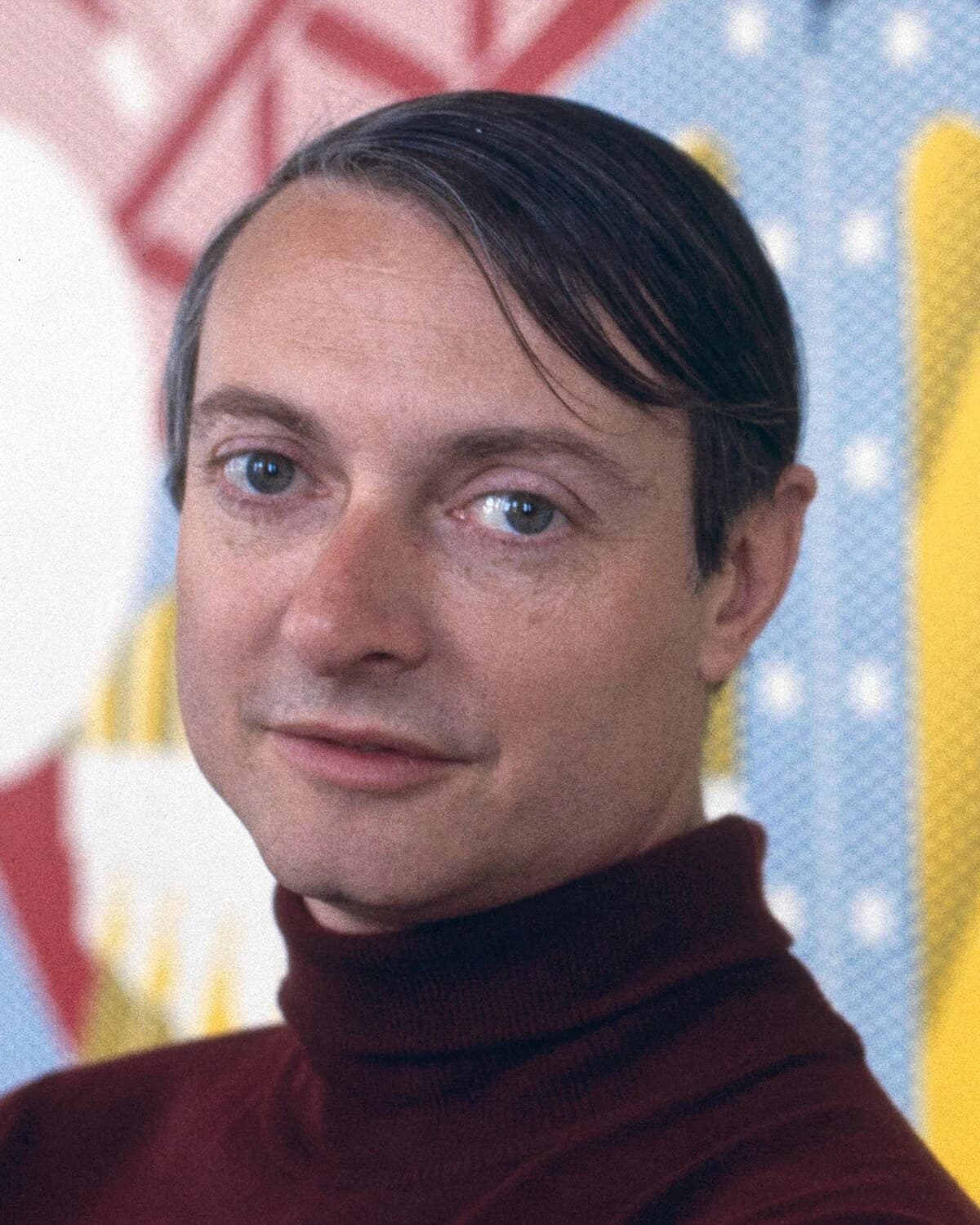
Artist image
Gotfryd, Bernard, photographer; Wikimedia Commons; Public domain.
