
15.02.1923–26.05.2021
Roser Bru
Roser Bru (1923–2021) arrived in Chile at sixteen aboard the Winnipeg, a ship carrying refugees from the Spanish Civil War, and lived in Santiago for more than eighty years. She studied painting under Pablo Burchard and printmaking at Taller 99 under Nemesio Antúnez; she is counted among the neo-figurative artists. In 2015 she received Chile’s National Prize for Plastic Arts.
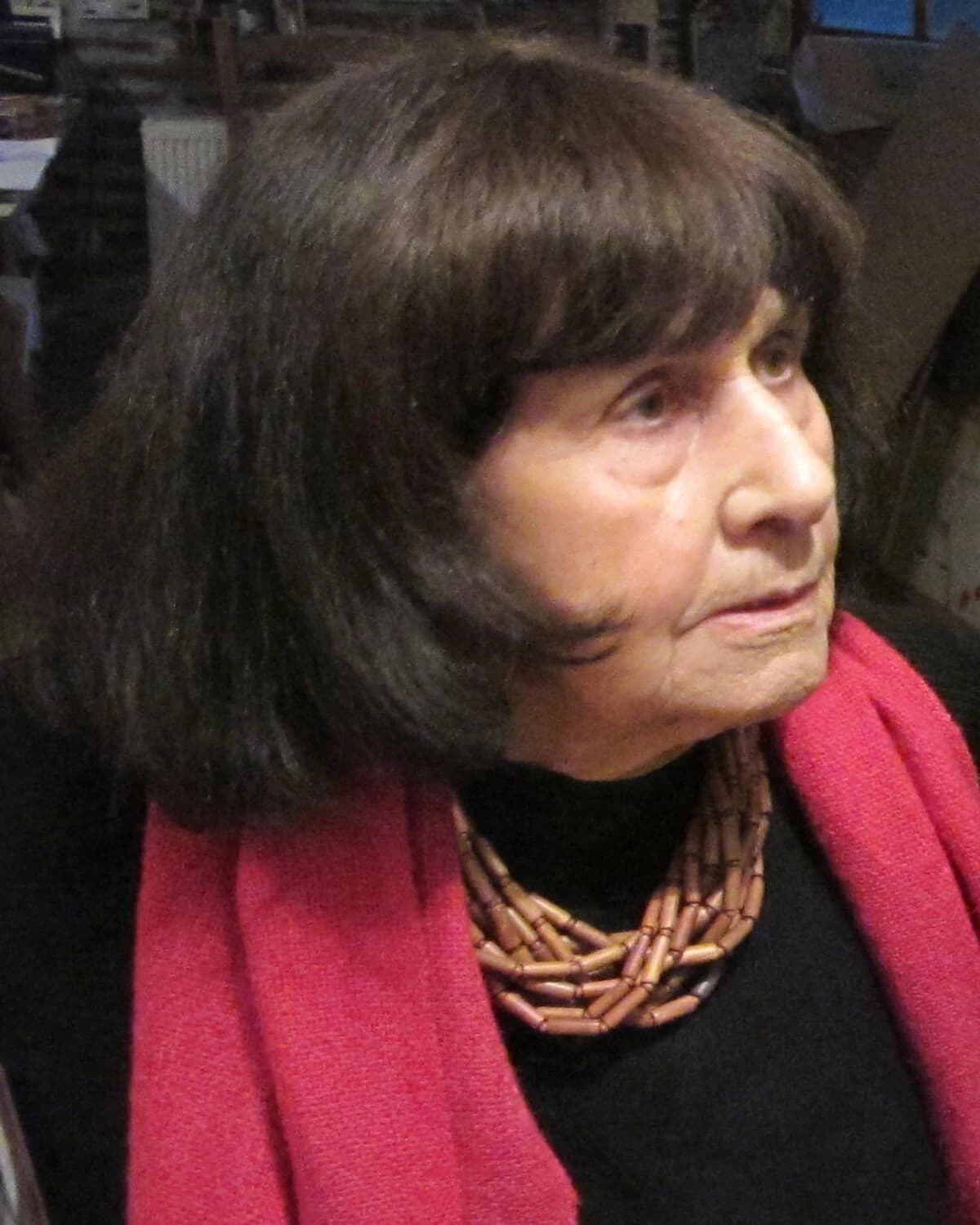
Biography
On 3 September 1939 the steamer Winnipeg docked at the Chilean port of Valparaíso with Spanish refugees who had left Europe after the defeat of the Republic in the Civil War. Among the passengers was the family of the Barcelona journalist Lluís Bru i Jardí, a deputy in the Parliament of Catalonia, and the artist Josepa Llop. Which members of the family made the crossing with their daughter is not specified in the available sources.
Roser was sixteen. She lived in Chile for the rest of her life.
She was born on 15 February 1923 in Barcelona. As early as 1924 the family went into exile in Paris because of the dictatorship of Miguel Primo de Rivera. In 1928 they returned, and the girl attended the Montessori school in Barcelona and, from 1931, the Institut-Escola of the Generalitat of Catalonia. After the Civil War, in 1939, the family found itself in France once more, and from there Roser sailed for Chile.
From 1939 to 1942 she studied painting at the School of Fine Arts of the University of Chile under Pablo Burchard and Israel Roa. In 1947 she joined the Group of Art Students (Grupo de Estudiantes Plásticos) together with José Balmes, Gracia Barrios and Guillermo Núñez. In 1957 she took up printmaking at Taller 99, run by Nemesio Antúnez; much of her career unfolded there, and there she later trained a new generation of printmakers. From 1964 to 1968 she taught drawing and painting at the School of Art of the Pontifical Catholic University of Chile, and she was among its founders. She also made murals in various techniques: for a school in Talcahuano, for the Casa de Arte on Cerro San Cristóbal and for the UNCTAD building in Santiago. Pablo Neruda wrote poems to accompany her prints, and so the book “Diez odas para diez grabados de Roser Bru” came about.
The 1960s gave her a theme she never afterwards abandoned: woman and the condition of women. In the painting “Woman with Her Parts” (1968), now in the National Art Museum of Catalonia, stands a totemic figure reminiscent of prehistoric female statuettes. The year it was made coincided with a rise in feminist demands. Her works are in the Museum of Modern Art and the Metropolitan Museum of Art in New York, the Brooklyn Museum, the National Museum of Fine Arts of Chile and the Museum of Contemporary Art in Santiago, the Museo de la Solidaridad Salvador Allende, the National Historical Museum of Chile, the museums of modern art on the island of Chiloé and in Rio de Janeiro, the Staatliche Museen in Berlin and the Museum of Contemporary Art in Barcelona. She exhibited in several countries of Latin America and in Spain. In 1995 King Juan Carlos I made her a Commander of the Order of Isabella the Catholic. She won Chile’s Altazor Award twice, in 2000 for “Enseñanzas de Goya” and in 2013 for “Vivir en obra”, and in 2004 and 2005 she was nominated in the printmaking and drawing category, once for 34 prints made for her eightieth birthday. In 2005 she received Chile’s Pablo Neruda Order of Artistic and Cultural Merit, in 2015 the National Prize for Plastic Arts, in 2018 the Spanish Gold Medal of Merit in the Fine Arts and in 2020 the Catalan Creu de Sant Jordi.
Roser Bru died at her home in Santiago on 26 May 2021, at the age of ninety-eight. In 2022 the artist Paula Bonet set up printmaking grants in her name: every two years they link Bonet’s studio in Barcelona with Taller 99 in Santiago. At the end of 2024 the Girona Art Museum showed about a hundred of her paintings, prints and documents in the exhibition “Roser Bru. Superar la distància”.
Profile notes
Profile and sources
Image
Artist image
Adevillota; Wikimedia Commons; CC BY-SA 3.0.
