
02.09.1911–12.03.1988
Romare Bearden
Romare Bearden drew cartoons for African American newspapers, studied with George Grosz, went through an abstract period, and in the 1960s found his own language in collage made from magazine cuttings and enlarged photocopies. His series on the life of Black Americans in the South and the North, his cycle on the “Odyssey” and his mosaics for transit stations made him one of the leading collagists in the United States.
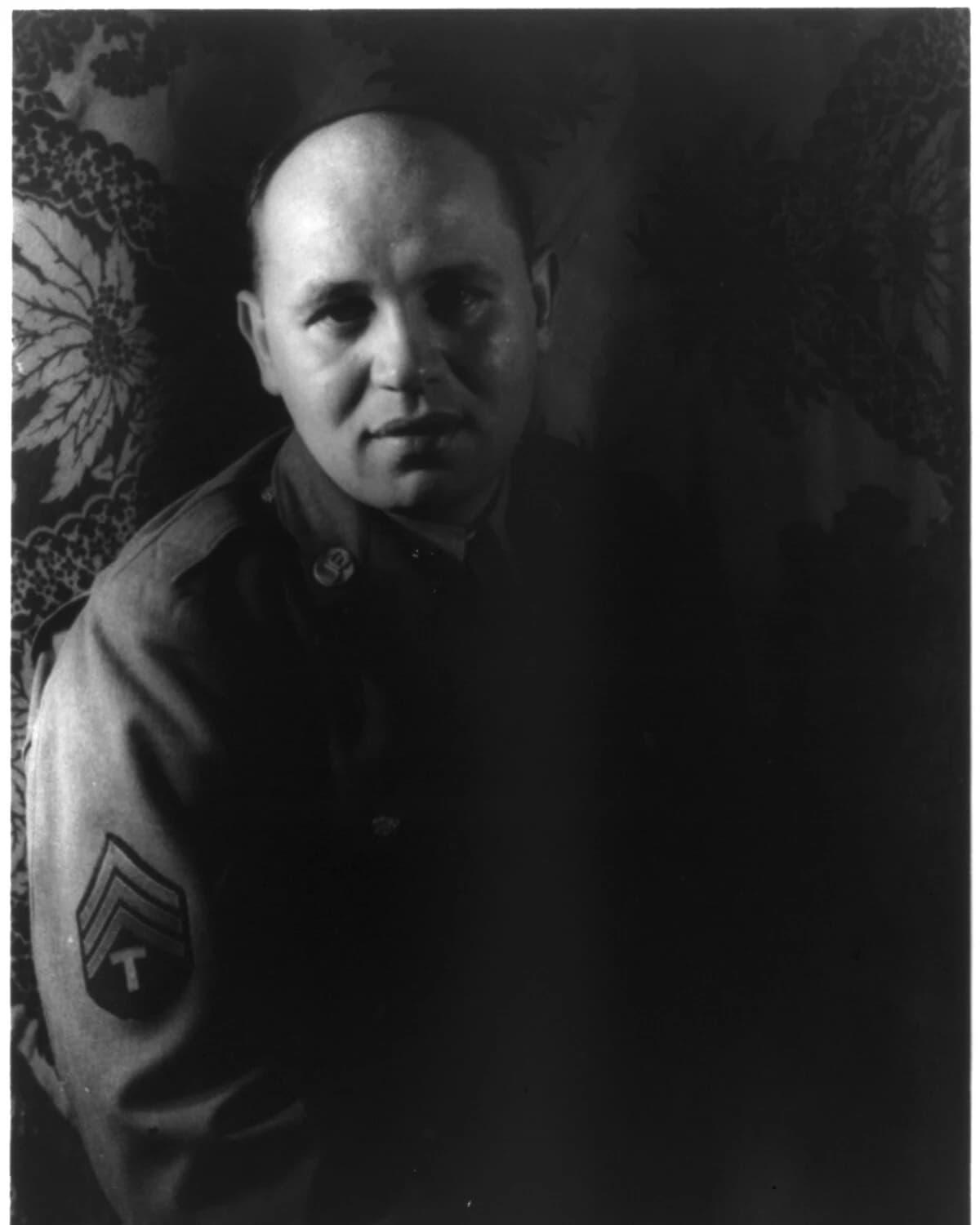
Biography
As a student at Boston University, Romare Bearden pitched for the Boston Tigers, a semi-professional Black team, and once players from the Philadelphia Athletics came out to play against the students. Bearden allowed them only one hit, and the club’s owner, Connie Mack, offered him a place on the team, fifteen years before Jackie Robinson became the first Black player in the major leagues. Sources disagree on whether Mack took him for white or openly suggested that he pass as white. Bearden turned him down.
He did not want to hide who he was. And after two seasons with the Tigers, an injury made him give up baseball for art.
He was born on 2 September 1911 in Charlotte, North Carolina, and as a small child moved with his family to New York, to Harlem, as part of the Great Migration of Black Americans from the South to the North. Many figures of the Harlem Renaissance visited their home; his mother, Bessye Bearden, was the New York correspondent of the Chicago Defender and founded the Colored Women’s Democratic League. He finished school in Pittsburgh, graduating from Peabody High School in 1929. Then came Lincoln University; Boston University, where he did the art for a student humour magazine; and New York University, where he became the lead cartoonist of the journal of a student society and in 1935 took a degree in science and education. From 1935 to 1937 he published a weekly political cartoon in the Baltimore Afro-American. In 1936–1937 he studied at the Art Students League under George Grosz. From 1935 onwards, on and off, he earned his living as a caseworker in the Harlem office of the city’s social services department.
His early paintings depicted the American South and show the influence of the Mexican muralists, above all Diego Rivera and José Clemente Orozco. From 1942 to 1945 he served in the US Army, mostly in Europe. After the war he was taken on by Samuel Kootz’s gallery in New York, which showed the avant-garde, and Bearden painted in a semi-abstract, expressive manner with an emphasis on line. In the series on the Passion of Christ, to which “Golgotha” belongs, the body of Christ at the centre is broken into geometric forms, while the crowds on either side are enclosed in large purple and indigo spheres. For Kootz this proved not abstract enough, and the gallery parted ways with him. In 1950, under the programme of aid to veterans, he went to Paris and attended lectures at the Sorbonne on philosophy, under Gaston Bachelard, and on art history. In these years he also took up songwriting: “Sea Breeze”, which he co-wrote, was recorded by Billy Eckstine, his schoolmate at Peabody, and by Dizzy Gillespie. In 1954 he married the dancer Nanette Rohan, later an artist and critic.
In the late 1950s his painting became still more abstract, with layers of oil that muted and concealed the colour. From 1956 Bearden studied with a Chinese calligrapher, who, as he said, taught him to think differently about space and composition. He spent a long time studying Vermeer, Pieter de Hooch and Rembrandt. In 1960 he began exhibiting again, and from 1961 to the end of his life he was represented by the Cordier and Ekstrom gallery.
On 5 July 1963 Hale Woodruff, Charles Alston, Norman Lewis and several other artists gathered in his studio in Harlem to discuss the duty of the Black artist in the struggle for civil rights. Woodruff named the group Spiral, after the Archimedean spiral, which keeps rising upwards. At the same time, in 1963 or 1964, the collages began: cuttings from glossy magazines and coloured paper, which he rubbed with sandpaper, bleached, worked over with graphite and paint, and then enlarged by photostat. An exhibition of these enlarged black-and-white works, called “Projections”, was held at Cordier and Ekstrom in 1964, and in its wake he was invited to have a solo exhibition at the Corcoran Gallery in Washington. In 1970 he received a Guggenheim Fellowship. In 1971 the Museum of Modern Art showed the retrospective “The Prevalence of Ritual”, a series on Black life in the South, and the city of Berkeley commissioned from him, for its City Council chamber, a collage mural about five metres wide with views of the city, installed at the end of 1973. In 1977 came a cycle of collages and watercolours based on the “Odyssey”; in “The Return of Odysseus”, at the Art Institute of Chicago, all of Homer’s heroes are Black.
In the 1980s he did a great deal of work on commissions for cities. In 1982 his Venetian glass mosaic “Baltimore Uproar”, featuring Billie Holiday, was unveiled at Upton station in Baltimore, and in 1984 his tile mural “Pittsburgh Recollections” appeared at Gateway Center station in Pittsburgh. He taught at Williams College and Yale University, was elected to the American Academy of Arts and Letters in 1972, and received the National Medal of Arts in 1987. He once said that the artist is a kind of enchanter in time. To my mind, this fits collage literally, with its scraps of the past glued into a single plane.
Romare Bearden died on 12 March 1988 in New York. The New York Times, in its obituary, called him the nation’s foremost collagist. After his death the New York subway unveiled the glass work “City of Glass”, on which he had begun working in 1982, and in Charlotte, near his childhood home, a park named after him opened in 2013.
Related context
Associations
Works connected through artistic movements, cultural context and period. Priced works available in this market appear first.








Profile notes
Profile and sources
Image
Artist image
Carl Van Vechten; Wikimedia Commons; Public domain.
