
11.12.1857–31.05.1941
Rodolfo Amoedo
In 1878 “The Sacrifice of Abel” won Rodolfo Amoedo a journey to Paris: the jury could not choose between him and Henrique Bernardelli, and the director of the academy named the winner. From eight years in Paris he brought back “Marabá” and “The Last Tamoio”, canvases on subjects from Brazil’s Indigenous past, and then for almost half a century taught painting in Rio de Janeiro; his pupils included Eliseu Visconti and Cândido Portinari.
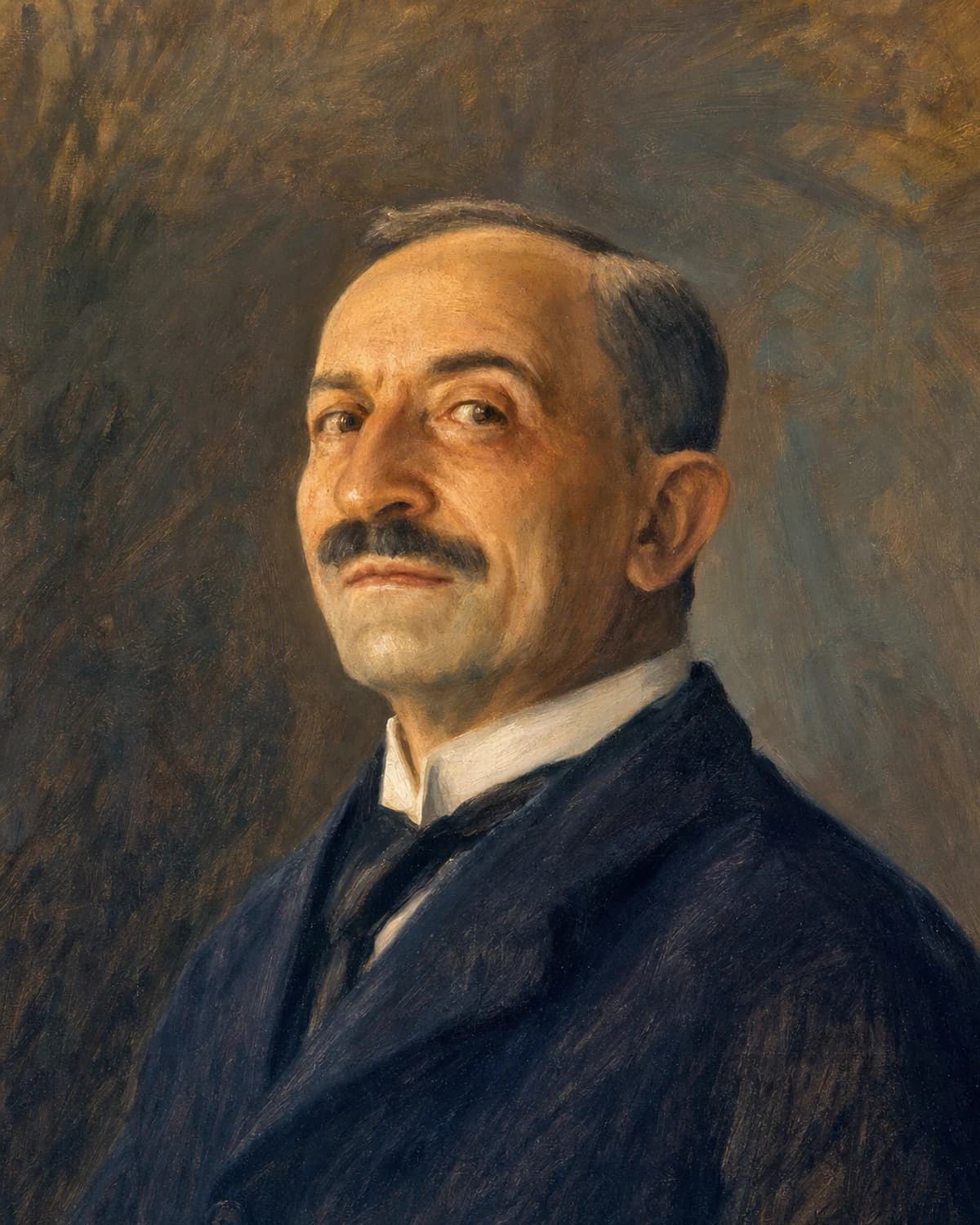
Biography
The Imperial Academy of Fine Arts in Rio de Janeiro very nearly settled its 1878 competition for a journey to Europe by drawing lots. The jury placed two men first at once, Rodolfo Amoedo with “The Sacrifice of Abel” and Henrique Bernardelli, and proposed that the rivals draw lots; the director of the academy would not allow it, a secret ballot again produced a tie, and then the director named the winner himself. That is how Amoedo, in his twenty-first year, received his scholarship to Paris.
He was born on 11 December 1857 in Salvador, in Bahia, into a family of actors, not well off and often short of money. In 1868 the family moved to Rio de Janeiro. His studies at the Colégio Pedro II had to be abandoned for lack of funds; his first trade was as an apprentice to the sign painter Albino Gonçalves, and his first commission was sketches for the Teatro São Pedro, where an acquaintance had brought him in. In 1873, at sixteen, he entered the Lyceum of Arts and Crafts, where he studied under Costa Miranda and Antônio Souza Lobo and caught the eye of Victor Meirelles, the empire’s leading history painter. A year later, with Costa Miranda’s help, he became a boarder at the Imperial Academy of Fine Arts: his teachers were João Zeferino da Costa, Agostinho José da Mota and the sculptor Chaves Pinheiro.
He lived in Paris from 1879 to 1887. He began at the Académie Julian, under Jules Lefebvre, and in May 1880 got into the École des Beaux-Arts, under Alexandre Cabanel, Paul Baudry and Puvis de Chavannes. From them he took what would persist in his painting for decades: careful drawing, restrained colour, a calm placing of the figure. He showed at the Salon in 1882, 1883 and 1884 with mythology (“The Narration of Philoctetes”), biblical scenes (“Jesus in Capernaum”, “The Departure of Jacob”), the portrait “Amuada” (the sulking girl) and with what is held to be his best work: the Indianist canvases drawn from Brazilian literature, “Marabá” (1882) and “The Last Tamoio” (1883). The naked Indigenous woman of “Marabá” is painted almost without narrative detail, a single body in tropical air; Cabanel praised it, the critics took time to accept it. Benedicto de Souza, correspondent of the Gazeta de Notícias, wrote from Paris in 1883 that he admired in Mr Amoedo “this fine wish to paint the things of his own country”, and expected excellent pictures from him once he returned to the nature he knew. “Study of a Woman (Woman with a Fan)” of 1884, another nude, is considered the most modern thing he made.
His return to Rio in 1887 was announced even in the provincial papers. In 1888 the academy made him an honorary professor; he showed what he had brought from Paris at an exhibition that Pedro II attended, and together with Souza Lobo, Zeferino da Costa and the brothers Henrique and Rodolfo Bernardelli he opened the Free Studio, modelled on the Académie Julian, as a counter to academic routine. After the proclamation of the republic, in 1889, this group entered the management of the renamed National School of Fine Arts; from 1893 Amoedo was its vice-director and more than once served as acting director. In 1895 he painted “Bad News”.
He taught strictly. He abolished the copying of prints, set up the live model, demanded exact drawing and a light palette without black or burnt earths; black, he said, belonged only among light colours. He had no wish to train specialists; he wanted those who passed through his hands to understand painting.
In 1906, after a quarrel with Rodolfo Bernardelli, he left for Europe and returned to teaching only in 1918, when he was given the second chair of painting, which he held until his retirement in 1934. Meanwhile commissions for the decoration of public buildings kept coming: in 1909 the Supreme Federal Court and the Itamaraty Palace, panels for the rare books section of the National Library, the Rio city council, the Ipiranga Museum in São Paulo, the Theatro José de Alencar in Fortaleza, in 1916 the Municipal Theatre of Rio de Janeiro; he also painted portraits of dignitaries. At the National Exhibition of 1908 marking the centenary of the opening of Brazil’s ports he was given a gold medal, at the General Exhibition of 1917 a medal of honour. Among his pupils: the brothers Arthur and João Timóteo da Costa, Lucílio de Albuquerque, Eliseu Visconti, Baptista da Costa, Eugênio Latour, the brothers Rodolfo and Carlos Chambelland, Cândido Portinari. To my mind this list explains his place in Brazilian art better than any single canvas; Brazilian historians themselves say the teacher in him was stronger than the artist.
Amoedo died in Rio de Janeiro on 31 May 1941, with no pension from the schools where he had taught; friends and former pupils paid for the funeral. In 1942 his family gave most of his works to the National Museum of Fine Arts, and out of that gift the museum’s library grew in 1943.
Related context
Associations
Works connected through artistic movements, cultural context and period. Priced works available in this market appear first.








Profile notes
Profile and sources
Image
Artist image
На основе открытого изображения: Rodolfo Amoedo; Wikimedia Commons; Public domain.
