
11.11.1911–23.11.2002
Roberto Matta
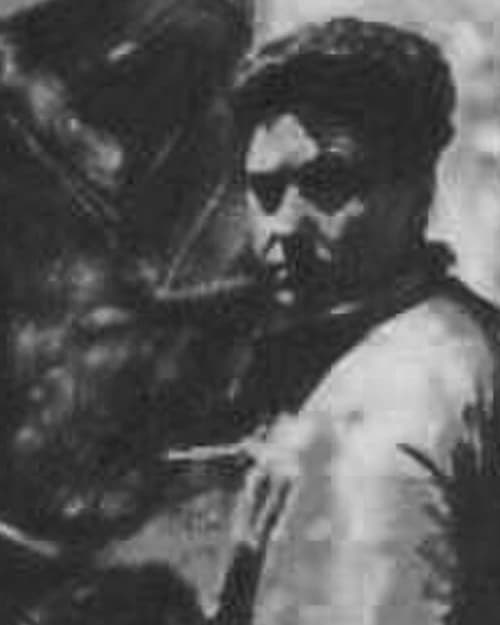
Roberto Matta (1911–2002) trained as an architect in Santiago, worked in Le Corbusier’s office in Paris and in 1937, at André Breton’s invitation, joined the Surrealist circle. His New York years produced the “inscapes”: diffuse light and sharp lines on an empty ground. Later he lived in Europe, painted large political canvases and supported the government of Salvador Allende.
Biography
In 2005 municipal workers in La Granja, in Santiago, found a mural under the paint, four metres high and twenty-four metres long. It was Roberto Matta’s “The First Goal of the Chilean People”. After the military coup of 1973 it had been painted over with sixteen coats, and for more than thirty years no one gave it a thought. In 2008 the mural was fully restored; it is now on view in the La Granja town hall.
By the time it was found, the artist himself had been dead for three years.
Roberto Sebastián Antonio Matta Echaurren was born on 11 November 1911 in Santiago, into a family of Spanish, Basque and French descent. He studied architecture and interior design at the Pontifical Catholic University of Chile. From here the accounts diverge. According to one, he left for Paris as early as 1933. According to another, he took his degree in 1935, travelled that spring from Peru to Panama, making Surrealist-minded drawings of the landscapes he saw, and reached Europe by signing on with the merchant marine.
In Paris he spent two years working in Le Corbusier’s architectural office. In the same period he grew close to Pablo Neruda and Federico García Lorca, and through them met Salvador Dalí and André Breton. Architecture still had a hold on him: in 1935 he travelled to Scandinavia and to the USSR, where he worked on designs for housing; in 1936 he lived briefly in London, working alongside Walter Gropius and László Moholy-Nagy; in 1937 he took part in designing the Spanish Pavilion for the World’s Fair in Paris. That same year Breton, struck by his drawings, invited him into the Surrealist movement. Matta illustrated the journal Minotaure and wrote articles for it, and saw at close range the work of Picasso and Marcel Duchamp. His first paintings show a debt to Yves Tanguy, but something of his own is already there: an amorphous, hazy medium in which space is sensed through light more than through objects.
The real beginning of his painting is usually dated to 1938, when he moved from drawing to oil. The move to the United States followed almost at once: Matta emigrated in 1939 and stayed until 1948. In New York he found himself among the older Surrealists and Dadaists, Duchamp affected him most of all, and in 1940 the Julien Levy Gallery gave him his first solo exhibition. Early canvases such as “Invasion of the Night” are built from scattered patches of light and bold lines on a ground with neither horizon nor objects. Out of them grew the series of “inscapes” and the related “psychological morphologies”. Their support was Freud, with his picture of the psyche as a three-dimensional space. I think his architectural training was at work here: Matta was still building space, only now it was the space of the mind.
From 1946 he painted a cycle inspired by the Second World War. In closed, isolated rooms, insect-like figures go about their business, and electrical machines appear beside them. The political anxiety of those years enters the pictures directly, together with an image of technological civilisation.
His parting with Breton’s group was a painful one. The cause was a conflict over Arshile Gorky and his family; Matta was expelled, but by then his name was already widely known.
In 1948 he returned to Europe and lived by turns in England, France and Italy, and in the 1950s and 1960s he divided his time between Europe and South America. His manner grew harsher and closer to reality; on huge canvases semi-abstract forms sat side by side with open politics. In the early 1960s he began adding clay to his paintings, giving the distortions physical volume. Matta believed that art and poetry could change lives, took part in the social movements of the 1960s and 1970s and firmly supported the socialist government of Salvador Allende. He also worked in ceramics, photography and video. Among his awards are the Chilean Order of Gabriela Mistral and the Cuban Haydée Santamaría Medal.
He did not, however, consider himself Chilean, and said that being born in Chile seemed to him a mistake. Nor did he consider himself French; national labels irritated him. I would keep this in mind when looking at the mural in La Granja.
Matta died on 23 November 2002 in Civitavecchia, Italy, eleven days after his ninety-first birthday. Several of his children became artists, among them Gordon Matta-Clark and Pablo Echaurren.
Related context
Associations
Works connected through artistic movements, cultural context and period. Priced works available in this market appear first.








Profile notes
Profile and sources
Image
Artist image
Autor desconocido; Wikimedia Commons; Public domain.
