
22.10.1925–12.05.2008
Robert Rauschenberg
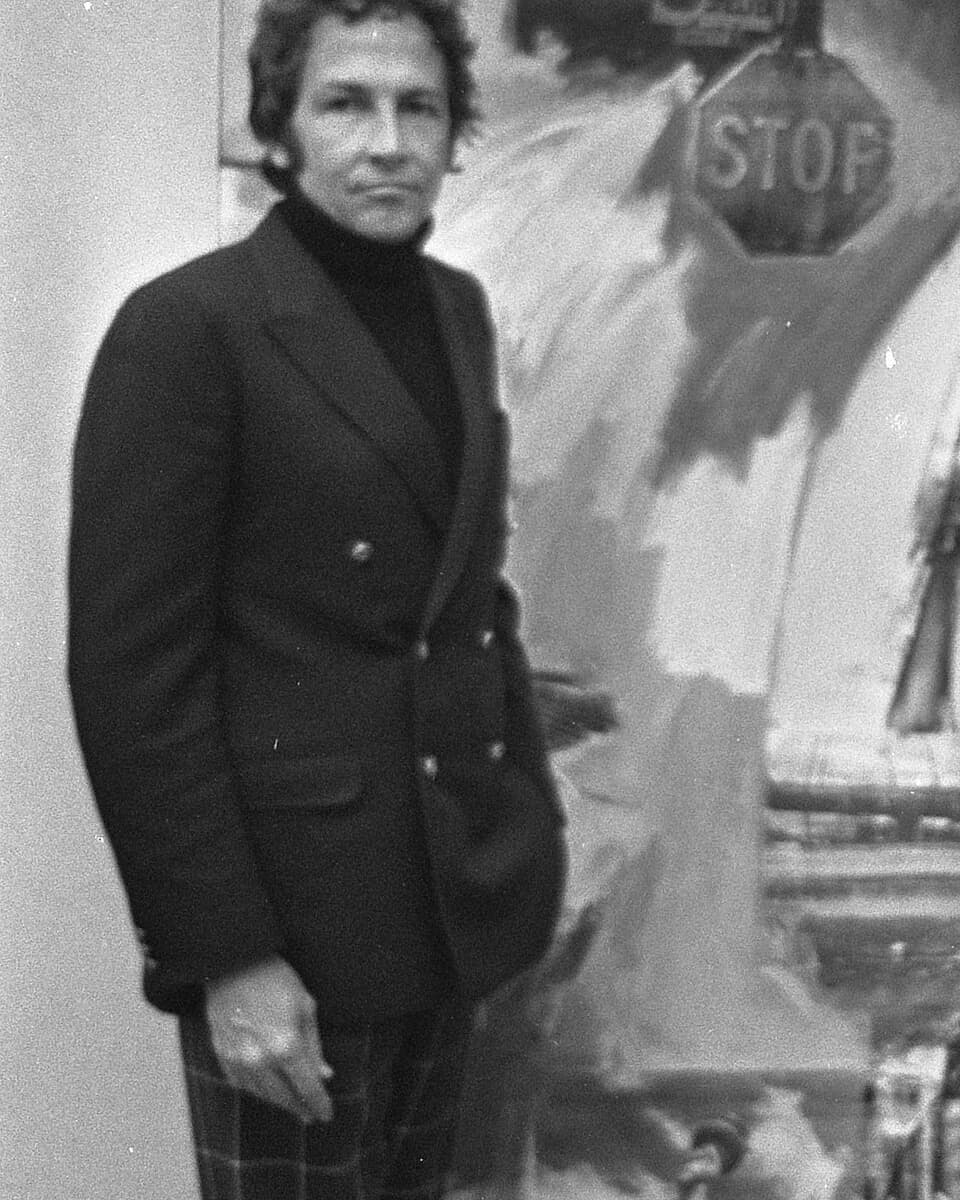
In the mid-1950s Robert Rauschenberg (1925–2008) began bringing things from the streets of New York into painting: a quilt, a stuffed goat, a car tyre. These Combines erased the boundary between painting and sculpture, and his silkscreens of the early 1960s brought him close to Pop art. In 1964 he won the Grand Prize for painting at the Venice Biennale.
Biography
In 1953 Robert Rauschenberg asked Willem de Kooning for a drawing for one purpose only: to erase it. The older artist agreed. Rauschenberg erased the drawing and exhibited what remained under the title “Erased de Kooning Drawing”, raising the question of what should count as a work of art at all.
He was not yet thirty, and he already had the navy, several art schools and his first exhibitions behind him.
He was born on 22 October 1925 in Port Arthur, Texas, and was named Milton Ernest at birth. His father, of German descent, worked for the local electric company; his mother came from a family of Dutch origin; both were fundamentalist Christians. At eighteen he entered the University of Texas at Austin to study pharmacology but soon dropped out: the work was hard for him (he did not yet know he was dyslexic), and he refused to dissect a frog in biology class. In 1944 he was drafted into the navy, and until his discharge he served in California as a technician in the neuropsychiatric ward of a naval hospital. Then came the Kansas City Art Institute and the Académie Julian in Paris, where he met the artist Susan Weil and changed his name from Milton to Robert. In 1948 they both enrolled at Black Mountain College in North Carolina.
Rauschenberg went there for Josef Albers, who had come out of the German Bauhaus, hoping that strict discipline would cure him of his sloppiness. It turned out otherwise: in his own words, he became “Albers’ dunce”, a prime example of what his teacher was not talking about. He still considered Albers his most important teacher, but he found a kindred spirit in the composer John Cage, with whom he remained a friend and collaborator for decades. In 1949–1952 he studied at the Art Students League of New York, where he met Cy Twombly. In 1950 he married Susan Weil (the marriage ended in 1953); together they made life-size blueprints. His first solo exhibition, at the Betty Parsons Gallery in the spring of 1951, was not a success with the critics.
That same year, 1951, came the White Paintings, several panels covered with ordinary white house paint using a roller. Cage called them “airports for the lights, shadows and particles”, and the artist himself said that from them you could almost tell how many people were in the room. Next came black paintings on a ground of newspaper and, by 1953, the Red Paintings: he considered red the most difficult colour and applied it in drips, pasted pieces and squeezed layers onto patterned fabric, newspaper, wood and nails. In the autumn of 1952 he left with Twombly for Italy and North Africa, made collages and small sculptures there from found objects and showed them in Rome and Florence. Some of them, to his surprise, were bought, and much of what did not sell he threw into the Arno on a critic’s advice.
Back in New York, he began collecting junk on the streets of Lower Manhattan. That is how the Combines began in 1954, works in which a found object was given the same rights as paint. “Bed” (1955) is a real quilt, sheet and pillow, smeared with red paint and hung on the wall like a picture; the artist himself called it one of his friendliest works. In “Monogram” (1955–1959) a stuffed angora goat is threaded through a car tyre, and in “Canyon” (1959) a stuffed golden eagle perches. At the time he made his living designing window displays for Tiffany and the Bonwit Teller department store, first with Weil and later with Jasper Johns, under a shared pseudonym. At Leo Castelli’s exhibition of the Combines in 1958 one work sold: “Bed” was bought by Castelli himself, and it is now in the Museum of Modern Art in New York. I think nothing describes Rauschenberg’s position at the time more precisely.
From 1962, after a visit to Andy Warhol’s studio, he began transferring photographs onto canvas by silkscreen. Critics linked the works of 1962–1964 with Pop art; in “Barge”, a canvas about ten metres long made mostly within a single day and night, trucks and spacecraft sit side by side with Velázquez’s “Rokeby Venus”. In 1963 the Jewish Museum in New York organised his first retrospective, and in 1964 he became one of the first Americans to win the Grand Prize for painting at the Venice Biennale.
Alongside all this came the stage. Rauschenberg designed sets, lighting and costumes for Merce Cunningham and Paul Taylor, in 1963 staged his first dance piece of his own, “Pelican”, and in 1966, together with Billy Klüver, a researcher at Bell Laboratories, he founded the organisation Experiments in Art and Technology. From 1970 he lived and worked in Florida, on Captiva Island, where he made works from cardboard, sand and fabric; a series made from brightly coloured fabrics (1975–1976) was inspired by a trip to Ahmedabad in India, a city of textiles. He campaigned for artists to receive a legal share when their works were resold, and in 1976 California passed such a law.
In 1984 he announced at the United Nations a cultural exchange project which, almost entirely at his own expense, he took to ten countries over seven years, from Mexico and Chile to the USSR, Tibet and Malaysia; in each country he took photographs, made works and showed them on the spot. In 1993 he received the National Medal of Arts of the United States. Robert Rauschenberg died on 12 May 2008 at his home on Captiva; the foundation that bears his name now hosts artists in residence on his property there.
Profile notes
Profile and sources
Image
Artist image
Jack de Nijs for Anefo; Wikimedia Commons; CC0.
