
14.10.1886–01.10.1958
Robert Falk
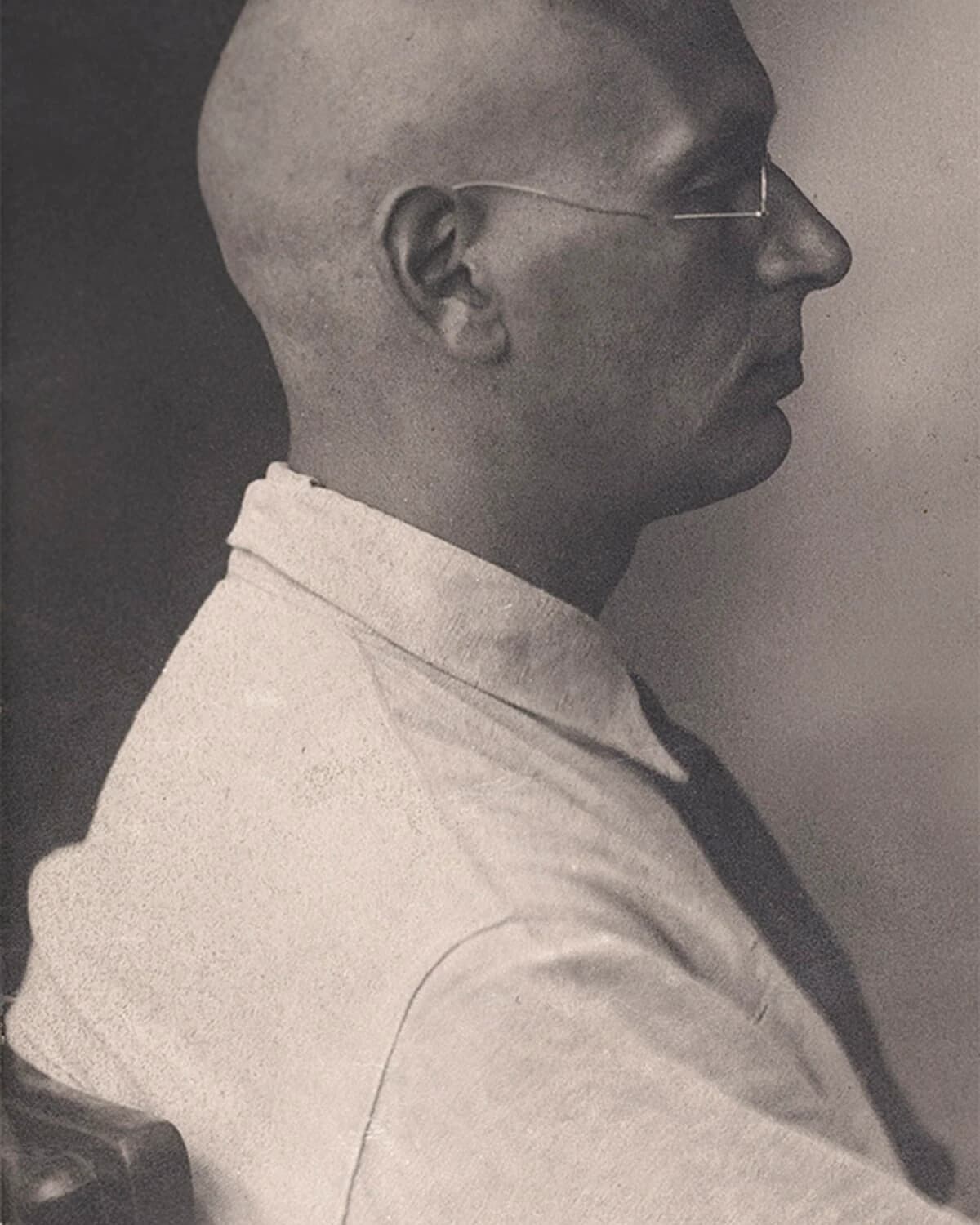
Robert Falk (1886–1958) was one of the founders of the Jack of Diamonds, taught at Vkhutemas for ten years and designed productions for the State Jewish Theatre. From 1928 to 1937 he lived in Paris, where he painted more than three hundred landscapes. After his return he worked in Moscow almost in isolation, and in the Thaw years young artists found in him a living link with the art of the early century.
Biography
In 1937, at the World’s Fair in Paris, Falk worked on the design of the Soviet pavilion. Over in the Spanish pavilion Picasso and Dora Maar were hanging “Guernica” at the time, and that is where the two men met. Afterwards Falk called on Picasso at his flat in the rue des Grands-Augustins and met the dealer Paul Rosenberg there. These meetings never grew into anything more, and neither did his acquaintance with Chagall, Kisling, Sonia Delaunay, Cocteau, Breton and Éluard.
That same year he went back to Moscow.
Falk was born in Moscow on 14 (26) October 1886. His father, Rafail Aleksandrovich, was a barrister, a candidate of law and a chess player; his mother, Maria Borisovna, came from the Bank family. He first learned to draw in the studio of Konstantin Yuon and Ivan Dudin and with Ilya Mashkov, and then, from 1905 to 1909, at the Moscow School of Painting, Sculpture and Architecture, where Valentin Serov and Konstantin Korovin influenced him most. At the school he became friends with Larionov, Goncharova, Konchalovsky, Kuprin, Lentulov and Rozhdestvensky. In December 1908, in order to marry a fellow student, Elizaveta Potekhina, he was baptised under the name Roman; after the revolution he took back his original name.
In 1910 this whole company set up the Jack of Diamonds, and Falk became one of its most active members (he belonged to the group until 1916). The “Jacks” rejected academicism and nineteenth-century realism and revered Cézanne, in their view the only artist worth learning from. Falk built up form in many layers of paint, so that an object on the canvas came out almost sculptural. In 1910–1911 he travelled to Italy. His studio was then in the Pertsova House in Kursovoy Lane. From those years come “Moscow Courtyard” and “Church of Elijah Obydenny” (both 1912) and “Crimea” (1914); the first is now in the National Gallery of Armenia, the last in the Nizhny Novgorod Art Museum.
After the revolution he found himself at the centre of the new art schools. From 1918 to 1928 he taught at the Free Studios, then at Vkhutemas and Vkhutein, and was dean of the painting faculty. Among his students were Semyon Chuikov, Georgy Nissky, Nikolai Romadin, Mikhail Ivanov-Radkevich and Eva Levina-Rozengolts. In 1918–1921 he worked on the Moscow board for art and art industry of Narkompros, and from 1921 he taught in Vitebsk from time to time. At the same time he joined the Kultur-Lige, an association that developed Jewish art on the basis of Yiddish culture, and began working for the State Jewish Theatre. For GOSET he designed “Night in the Old Marketplace” after Peretz (1922–1925) and “The Travels of Benjamin III” after Mendele Mocher Sforim (1927).
In 1928 Narkompros sent him to France “to study the classical heritage in painting”, and a short assignment stretched into nine years. He lived modestly, almost like a student: a cheap studio, private lessons in drawing and music (Falk was a pianist). He painted more than three hundred landscapes: the Bois de Boulogne, Longjumeau, Neuilly, the quays and bridges of the Seine, canals with barges, cafés in narrow streets. He described the city as a whole country, in which every quarter lives as a separate town. In these years he fell for Cézanne all over again and even went to Mont Sainte-Victoire. His brushwork, meanwhile, became lighter and more mobile than in the Jack of Diamonds years, and many scholars regard the Paris decade as the high point of his painting. He never became an insider in the French art world. By the mid-1930s Parisian life had grown uneasy: the economic crisis, the threat of fascism, the expectation of war. And he was drawn home.
He understood that in Moscow he might be arrested. His friends in France did not understand the decision. The main reason for his return is usually given as his wish to see his paintings in Russian museums.
He was given a studio in the Pertsova House again, the one where Pavel Sokolov-Skalya had worked before him. Help came from old comrades of the Jack of Diamonds, Alexander Kuprin and Vasily Rozhdestvensky, and from the airman Andrei Yumashev, with whom Falk had become friends back in 1936 at the Soviet embassy in Paris. In 1937–1938 the two of them travelled through Crimea and Central Asia: Yumashev gave lectures on his flight over the North Pole, and in his free time set up his amateur easel next to Falk’s.
Then came twenty years spent almost out of public view. A solo exhibition at the House of Writers in 1939; work for GOSET and other Jewish theatres, for the Mossovet Theatre, the Chamber Theatre and the Theatre of Satire. He spent the war in evacuation in Bashkiria and in Samarkand. In the campaigns of the late 1940s he was attacked as a “formalist”. He painted landscapes, still lifes and portraits in these years, muted, often almost white on white: Solomon Mikhoels (1947–1948), Viktor Shklovsky (1948), the art historian Alexander Gabrichevsky (1953). Falk himself considered his chief teacher to be Rembrandt rather than Cézanne, and to my mind that shows more clearly in the late portraits than in the landscapes.
He was married four times. His second wife, Kira Alekseeva, was Stanislavsky’s daughter; his third, Raisa Idelson, had been his student; the last, Angelina Shchekin-Krotova, collected and published after his death the book “Conversations about Art. Letters. Recollections of the Artist” (1981).
After 1953 young artists began making their way to his studio, and for them he became a bridge between the art of the early century and the Thaw; Mikhail Agursky, for one, recalled these visits. Falk died in Moscow on 1 October 1958 and is buried in the Kalitnikovskoye Cemetery. In 1992 the Russian Museum held a solo exhibition of his work, but its catalogue never came out. In 2020–2021 the New Tretyakov Gallery showed more than two hundred and fifty of his works. In 2018 a Robert Falk Street appeared in Moscow’s Danilovsky District.
Related context
Associations
Works connected through artistic movements, cultural context and period. Priced works available in this market appear first.








Profile notes
Profile and sources
Image
Artist image
Author is unknown; Wikimedia Commons; Public domain.
