
12.03.1908–25.01.1970
Rita Angus
The New Zealand painter Rita Angus (1908–1970) is regarded, together with Colin McCahon and Toss Woollaston, as one of the leading figures of twentieth-century New Zealand art. She worked in oil and watercolour, painting clear, hard-edged landscapes of Canterbury, Otago and Wellington and many portraits. In 2006 viewers voted her “Cass” (1936) the country’s best-loved painting.
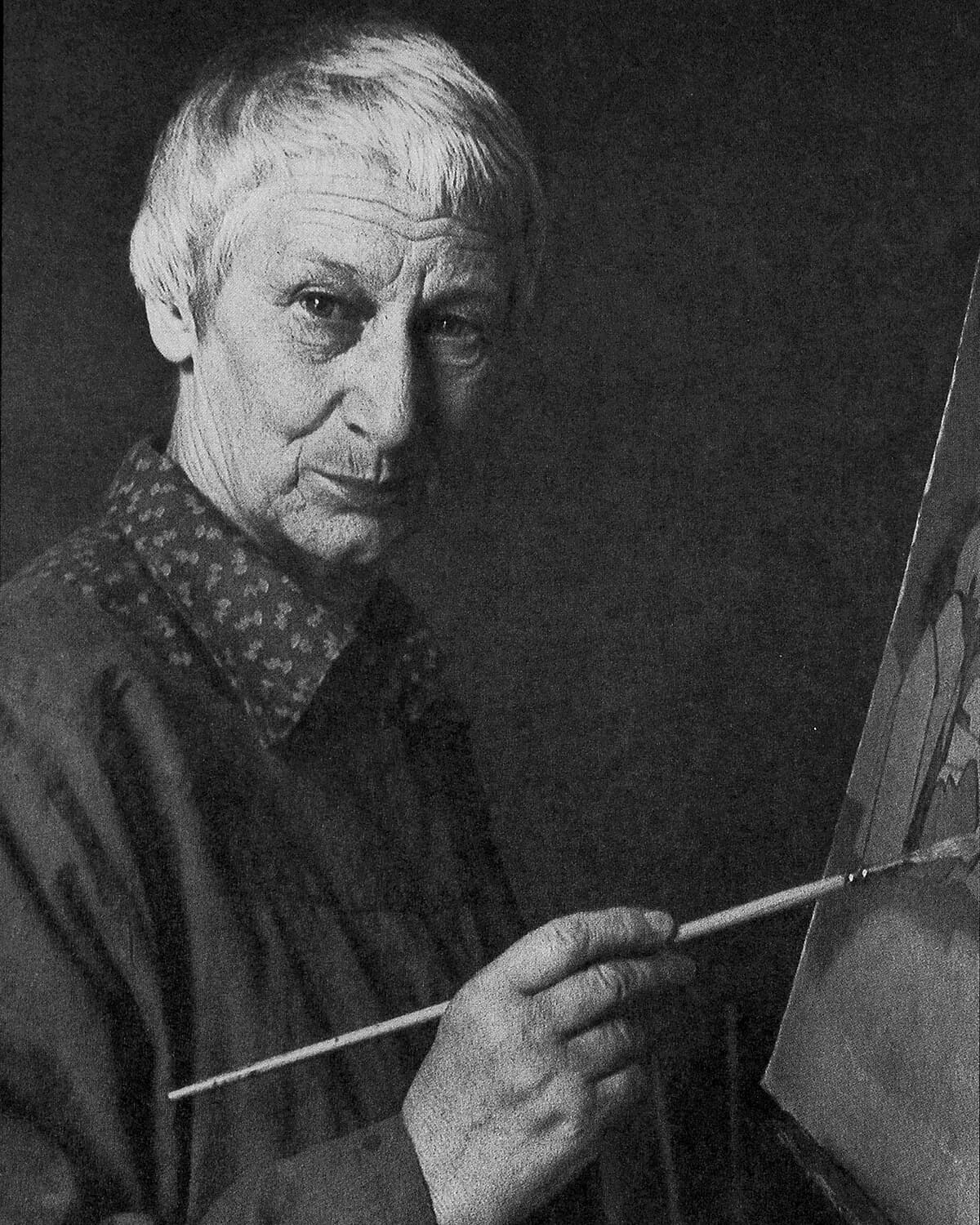
Biography
In 2006 New Zealand television asked viewers which of the country’s paintings they loved most. The winner was Rita Angus’s “Cass”, painted seventy years earlier: the bare, empty Canterbury plain, simplified forms and almost unblended colours laid out in sections, as on a poster.
By then the artist had been dead for thirty-six years.
Henrietta Catherine Angus was born on 12 March 1908 in Hastings, the eldest of seven children of a family of Scottish and English descent. Her father, William McKenzie Angus, started out as a carpenter and went on to found a major construction company; because of his contracts the family moved back and forth between Palmerston North and Napier. In 1921 the Anguses settled in Palmerston North, and at the girls’ high school the art teacher, G. H. Elliott, noticed the gifted pupil and persuaded her to continue her studies. In February 1927 she entered the Canterbury College School of Art. She never obtained her diploma, but she went on studying until 1933, including at the Elam School of Fine Arts in Auckland; she drew from life, painted still life and landscape, and encountered medieval and Renaissance art in earnest for the first time.
On 13 June 1930 she married the artist Alfred Cook; they separated in 1934 and divorced in 1939. From 1930 to 1946 she signed her paintings “Rita Cook”, and later she formally took her paternal grandmother’s surname, McKenzie, so that the signature “R. McKenzie” also occurs. Most of her works, though, are signed “Rita Angus”.
After a short spell of teaching in Napier, she lived mostly in Christchurch in the 1930s and 1940s and, short of money, took on various jobs, among them illustrating for the Press newspaper. She painted Canterbury and Otago. Among her teachers, if one may put it that way, were Byzantine art and Cubism, and also a 1931 painting of Mount Taranaki by the Englishman Christopher Perkins, which captures New Zealand’s particularly clear light. Many at the time were searching for a national style. Angus was searching for her own, and her pictures are clear, with crisp edges and sharply defined forms. For a while her neighbour was the artist Leo Bensemann; their adjoining flats became a meeting place, and they are said to have spurred each other on. To these years belong many of her finest portraits, such as “Head of a Maori Boy” (1938) and “Portrait (Betty Curnow)” (1942). Under the name Rita Cook she also drew comics.
During the Second World War, a committed pacifist, she avoided any kind of war work. Her task as an artist, she said, was to create life and not to destroy it. It was then that she painted three images of goddesses symbolising peace, the best known of them “Rutu”.
In 1950 Angus moved to Waikanae; in the early 1950s she travelled a great deal around the country, and in Central Otago she painted the picture of that name. From 1955 she lived in Wellington and painted the city’s surroundings and Hawke’s Bay, which she visited regularly; this is how “Boats, Island Bay” came about, for example. She painted fifty-five self-portraits. I think what matters most in her portraits is that she could convey a person’s character and go beyond a mere likeness.
In 1958 a New Zealand Art Societies’ Fellowship enabled her to go to London, where she studied at the Chelsea School of Art and the Institute of Contemporary Arts, and to visit Scotland and Europe as well. Much of 1960 went into a mural for Napier Girls’ High School, in memory of the schoolgirls who died in the Hawke’s Bay earthquake of 1931. It can still be seen in the school hall. Her first solo exhibition came only in 1957, at the Wellington Art Centre gallery, followed by exhibitions in 1961, 1963, 1964 and 1967.
Rita Angus died on 25 January 1970 in Wellington, at the age of sixty-one. In 1983, for the seventy-fifth anniversary of her birth, New Zealand Post issued stamps showing four of her paintings, and for the centenary, in 2008, Te Papa mounted a major retrospective.
Related context
Associations
Works connected through artistic movements, cultural context and period. Priced works available in this market appear first.








Profile notes
Profile and sources
Image
Artist image
[u:Eddaido]; Wikimedia Commons; CC BY-SA 2.5.
