
19.04.1968–present
Rita Ackermann
Rita Ackermann, born Rita Bakos, studied in Budapest, then moved to New York in 1992 and took her grandmother’s surname. In 1994 she was commissioned to make a faux stained-glass window for the New Museum, and that same year she had her first solo exhibition. She has worked in painting, drawing and collage; from 2014 she showed “chalkboard paintings” that resemble chalk marks on a school blackboard.
Biography
In 1994 the New Museum of Contemporary Art in New York commissioned a faux stained-glass window on Broadway from the twenty-six-year-old artist. It was titled “Who Are We? Where Did We Come From?” (in one version of the title there is a further question, “What Are We?”). It is reported to have shown a post-apocalyptic paradise inhabited by animals and teenage girls, with references to Gauguin.
Rita Ackermann was born on 19 April 1968 in Budapest and bore the surname Bakos. From 1989 to 1992 she studied at the Hungarian University of Fine Arts under the painter Károly Klimó. In 1992, on a scholarship from the Hanes Family Foundation, she moved to New York to attend the New York Studio School of Drawing, Painting and Sculpture. On arriving she changed her name to Ackermann, her grandmother’s maiden name. She later explained the move by saying that in New York she had to learn to reduce things to their bare essentials and to find a reason to make something where it seemed everything had already been done. Her first solo exhibition also took place in 1994, at the Andrea Rosen Gallery in New York; the critic Keith Seward reviewed it in Artforum. Her early work of the mid-1990s showed teenage girls, almost nymphets. In 1995 she designed the cover of Thurston Moore’s album “Psychic Hearts”. Around the same time she had exhibitions in Athens, London and Zurich, in 1998 in Budapest, and in 1999 in Tokyo.
At the same time she worked with more than a brush. She drew in red ballpoint pen on the faces of runway models instead of make-up, made multi-layered shadow puppet theatres, among them “Deer Killer” (1997), and was a member of the group Angelblood. With Olivier Zahm she curated the exhibitions “The Kate Moss Show” (2006) and “The Perfect Man” (2007). Her output also included T-shirts, a line of underwear and skateboard designs.
Her first institutional exhibition took place in 1999 at the Swiss Institute in New York. In 2002 the Museum Het Domein in Sittard, in the Netherlands, showed “Snowfall in August”: paintings, collages and works on paper. From 2006 to 2008 she worked only in collage, pressing it between two vertical sheets of Plexiglas. In 2008 she took part in the Whitney Biennial. In 2011, with the filmmaker Harmony Korine, she made the project “Shadow Fux” for the Swiss Institute. That same year the Ludwig Museum in Budapest held her first major survey, “BAKOS”, named after her former surname. In 2012 Bonnie Clearwater organised her retrospective at the Museum of Contemporary Art, North Miami: paintings, drawings and collages from 1993 to 2012.
The next phase is linked to the “chalkboard paintings”. In 2014 the Sammlung Friedrichshof in Austria showed “Meditation on Violence”, and in 2016 “The Aesthetic of Disappearance” opened at Malmö Konsthall in Sweden; the title is believed to refer to a book by Paul Virilio, and it was her first exhibition in Scandinavia. In 2018 her chalk works were shown at the Triennale in Milan (“Movements as Monuments”). Her paintings and drawings of 1993–1996, to my mind, look interesting beside the later ones. That is how they were shown in 2023 at MASI in Lugano, together with the “Mama” series, which she began in 2019.
Ackermann’s works are in the Museum of Modern Art in New York, the San Francisco Museum of Modern Art, the Dallas Museum of Art, the Museum of Contemporary Art in Los Angeles and other collections. She lives and works in New York.
Profile notes
Profile and sources
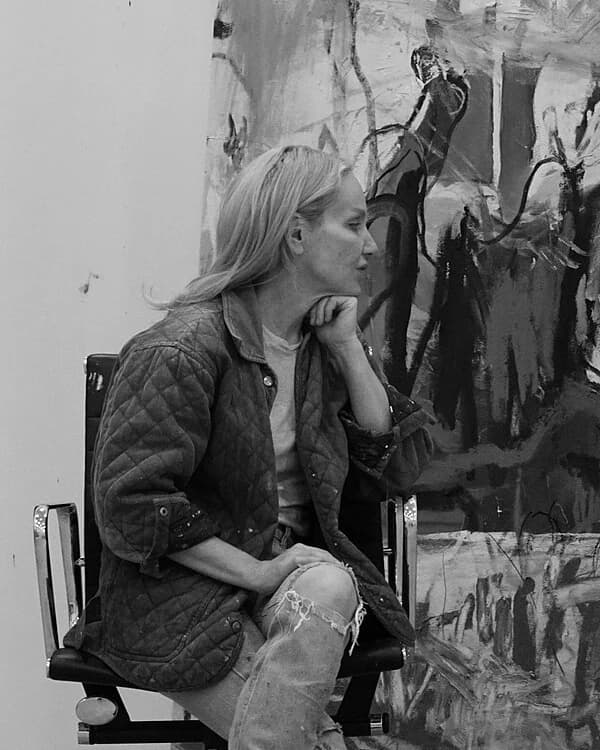
Image
Artist image
Rrarteditor; Wikimedia Commons; CC BY-SA 4.0.
