
02.11.1938–26.03.2024
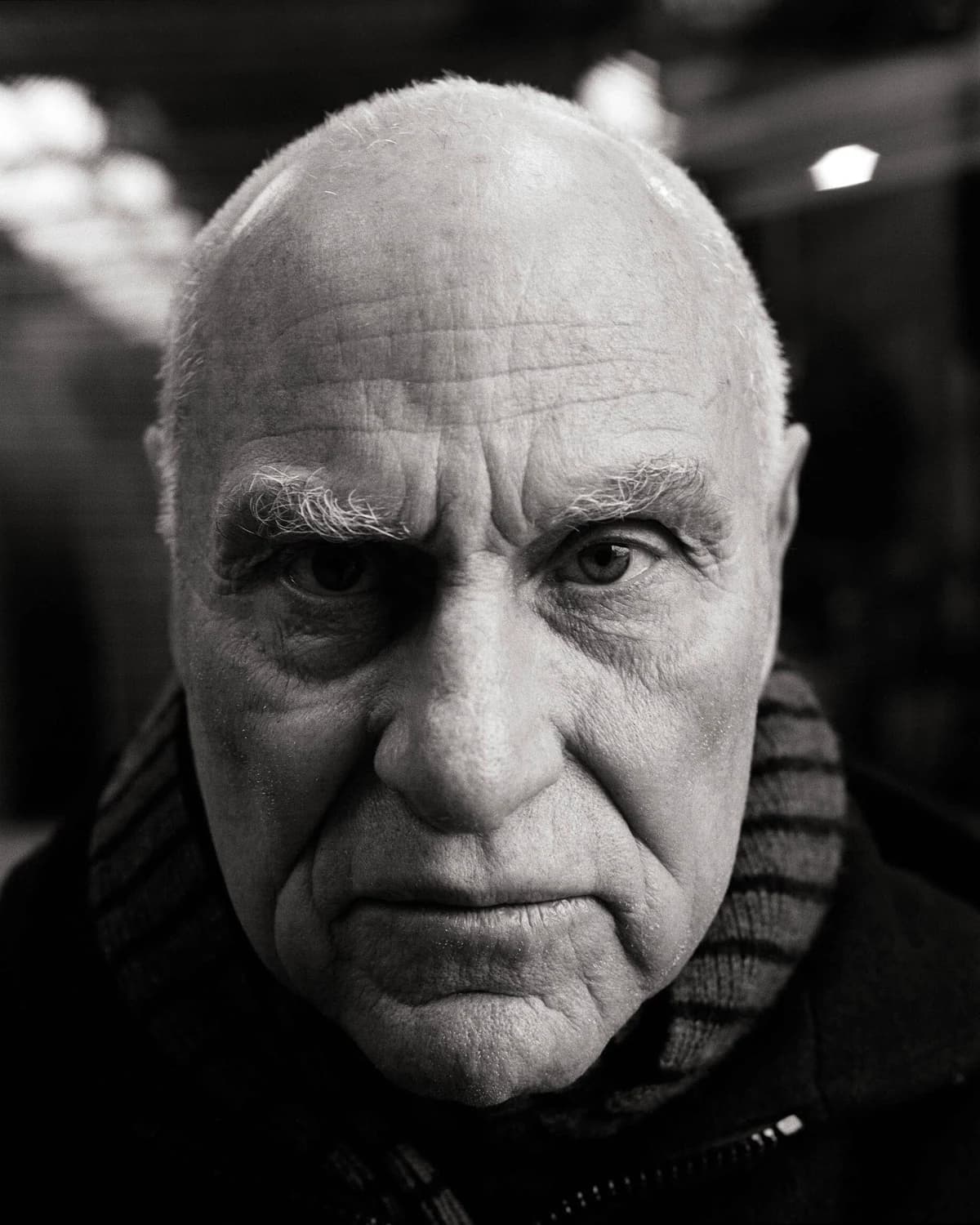
Richard Serra
Richard Serra (1938–2024) began by splashing molten lead into the angle between wall and floor, and became famous for huge sheets of steel that the viewer has to walk around and through in order to see the work. His “Tilted Arc” in New York’s Federal Plaza was removed in 1989 after an eight-year dispute; for the Guggenheim Museum Bilbao he made the cycle “The Matter of Time” (2005).
Biography
In 1969 Jasper Johns invited Richard Serra to make one of his splash pieces in Johns’s studio, the works in which molten lead is thrown into the angle between wall and floor. While the lead plates were heating, Serra took one of the larger ones and set it in the corner. The plate stood on its own. Soon afterwards came “Strike: To Roberta and Rudy” (1969–1971): a steel plate 2.4 by 7.3 metres, wedged into a corner, divides the room into two equal halves, and the space changes as you walk around it.
This was his break into space.
Serra was born on 2 November 1938 in San Francisco, the second of three sons. His father, Tony Serra, came from Mallorca and worked as a pipe fitter at a shipyard, later as a foreman at a candy factory; his mother, Gladys, née Fineberg, was the daughter of Jewish immigrants from Odessa. She encouraged his drawing and introduced her son to people as “Richard the artist”. One of his earliest memories: a four-year-old boy at the shipyard watching the enormous weight of a ship at its launch suddenly become buoyant. Later he said that all the material he needed lay in that memory. Between the ages of sixteen and twenty-five he worked on and off in steel mills.
In 1957 he studied English literature at Berkeley, then transferred to the University of California, Santa Barbara, and took his bachelor’s degree there in 1961; there, too, the muralists Rico Lebrun and Howard Warshaw took him under their wing. At Yale University he studied painting, and in 1964 he received a BA in art history and an MFA. His fellow students included Chuck Close, Nancy Graves, Brice Marden and Robert Mangold, and Guston, Rauschenberg, Reinhardt and Stella came as visitors. In his last year Serra taught a course on colour theory himself, and after graduating he helped proofread Josef Albers’s book “Interaction of Color”. A Yale travelling fellowship took him to Paris in 1964: there he became friends with the composer Philip Glass and sketched in the reconstructed studio of Brâncuși. He spent 1965 in Florence on a Fulbright grant, and in 1966, at the Prado in Madrid, he saw Velázquez’s “Las Meninas”, realised he could never paint like that, and gave up painting. His first solo exhibition, “Animal Habitats”, was held in 1966 at the Galleria Salita in Rome: it consisted of assemblages with live and stuffed animals.
That same year he settled in New York and began working with rubber, latex, fibreglass, neon and lead. Around 1967 Serra drew up his “Verb List”: to roll, to tear, to fold, to prop and so on, and each verb became a task for a sculpture. This produced “To Lift” (1967), “Thirty-Five Feet of Lead Rolled Up” (1968), which he rolled up together with Glass, and “One Ton Prop (House of Cards)” (1969), in which four lead plates hold one another up without any fastening. From 1968 to 1979 he made films; in one of the first, “Hand Catching Lead”, a hand tries to catch falling pieces of metal. In 1969, at the Kaiser steel yard, for the Los Angeles County Museum of Art’s “Art and Technology” exhibition, he spent ten weeks using a crane to build stacks of steel up to 12 metres high, and at the end of each day the workers knocked them down. That was when he first sensed what real scale could be.
In 1970, with a Guggenheim Fellowship, Serra went to Japan and spent most of his time in the Zen gardens of the Myōshin-ji temple in Kyoto: a garden can only be understood on foot, by moving through it. From this came his landscape works, in which plates and stones are placed according to the lie of the land: the piece for the Pulitzers, collectors near St. Louis (1970–1971), “Shift” in Ontario (1970–1972), “Afangar”, nine pairs of basalt columns on the Icelandic island of Videy (1990), a steel contour 257 metres long in New Zealand (2000–2002), and four plates in the desert of Qatar (2014).
In the city, one of his works turned into a conflict. “Tilted Arc”, commissioned by the US General Services Administration and installed in 1981 in New York’s Federal Plaza, a steel wall 36 metres long and 3.6 metres high, was disliked by the employees of the federal building next to it. The campaign to remove it lasted eight years, and on 15 March 1989 the arc was taken away. Serra insisted that the work had been made for that place and did not exist outside it: “to remove Tilted Arc is to destroy it”.
His late work grew out of an error of the eye. In 1991, in Borromini’s church of San Carlo alle Quattro Fontane in Rome, it seemed to him that the oval of the dome was offset from the oval of the floor. He cut two wooden ellipses, joined them with a dowel, turned them at right angles to each other and wrapped them in a sheet of lead. To my mind, there is no better key to his late sculpture. From this model grew the “Torqued Ellipses” of 1996–2004, then the spirals; in 2005 eight works from 1994–2005 made up “The Matter of Time” at the Guggenheim Museum Bilbao. In 2008, in the Grand Palais in Paris, he installed “Promenade”, five plates almost 17 metres high. He always drew in black: with paintstick, lithographic crayon, charcoal. From 1972 onwards he made more than two hundred prints. The Museum of Modern Art in New York gave him retrospectives in 1986 and 2007, and in 2001 the Venice Biennale awarded him the Golden Lion for lifetime achievement.
From 1981 his wife was the art historian Clara Weyergraf, with whom, before they married, he had made the film “Steelmill” (1979). In 2019 Serra gave all his films and videos to the Museum of Modern Art. He died on 26 March 2024 at his home in Orient, New York.
Profile notes
Profile and sources
Image
Artist image
Неизвестен; Wikimedia Commons; CC BY-SA 4.0.
