
04.05.1867–07.04.1930
Ricardo Acevedo Bernal
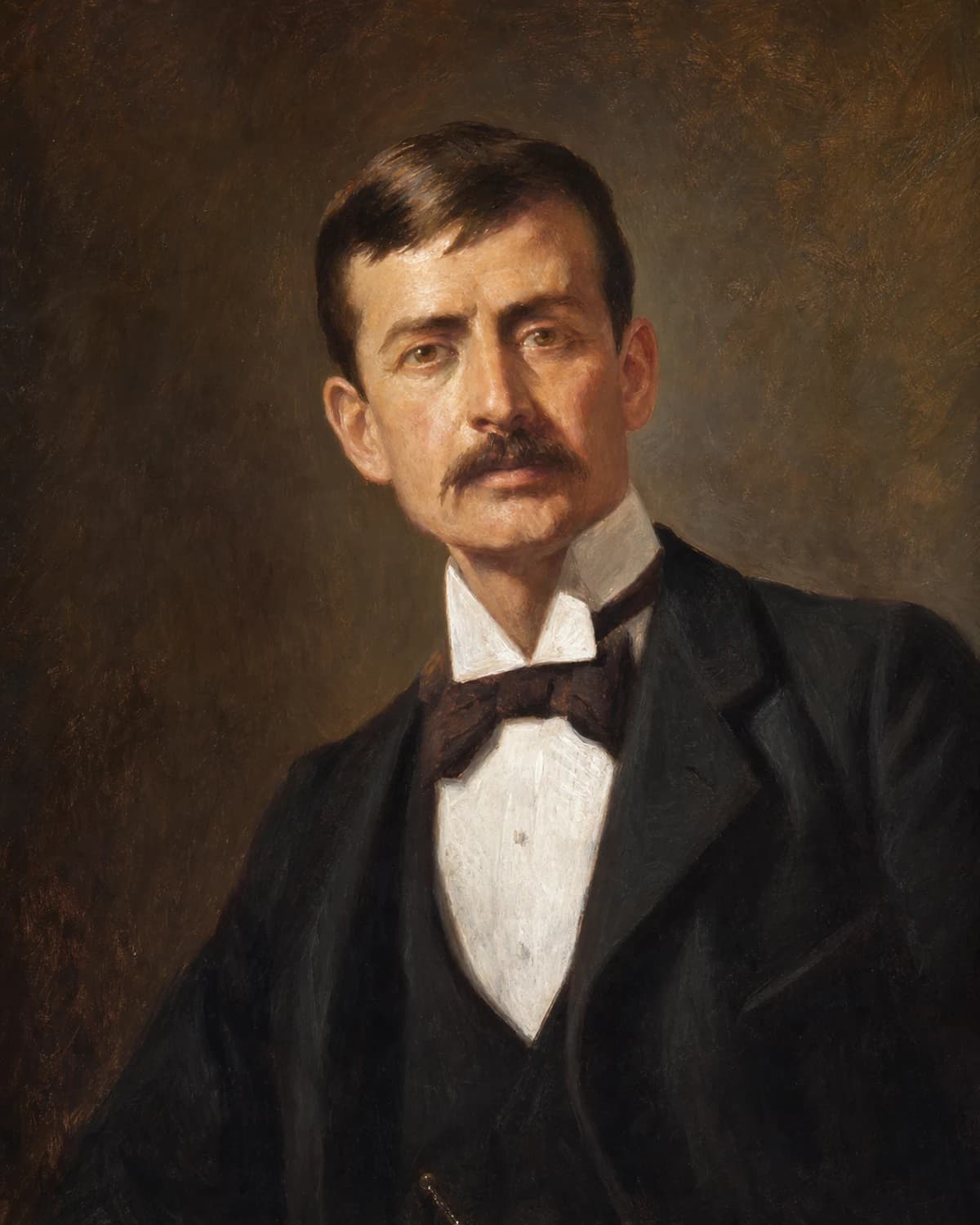
Ricardo Acevedo Bernal (1867–1930) spent eight years in his youth working in New York photography studios, then returned to Bogotá, painted church murals and became director of the National School of Fine Arts. He founded the picture gallery of the National Museum of Colombia, painted portraits of figures from the country's history and composed pasillos. He spent the last year of his life in Rome as consul.
Biography
Acevedo Bernal received his first prize on 20 July 1883, when he was sixteen. His career that followed began not with the brush but with photography.
He was born on 4 May 1867 in Bogotá, then the capital of the United States of Colombia. He studied at the Colegio Mayor de San Bartolomé, where his mentor was the Jesuit Father Santiago Páramo, and then at the Academy of Fine Arts in Bogotá; Pantaleón Mendoza is named among his teachers. After that he went to New York and stayed for eight years, working in various photography studios. During this time he joined the Art Students League and studied with William Merritt Chase. “The Girl in the Column” (1894), one of his best-known pictures, dates from this period, but where it was painted I cannot say from the data available. In 1898 he returned to Colombia and took up religious painting in the churches of Bogotá. He also worked as a designer, making sketches for altarpieces and church façades, among them the church of the Hospicio in Bogotá. He became a teacher at the National School of Fine Arts, and in 1901 opened an art school of his own. Among his religious works, “The Apotheosis of the Virgin of Carmel” (1895) is known.
In 1902 Acevedo Bernal went to Paris, to the Académie Julian, where he studied with Léon Bonnat and Tony Robert-Fleury. On his return he won a medal at an exhibition in Bogotá marking the centenary of independence. From 1911 to 1918 he directed the National School of Fine Arts and founded the picture gallery of the National Museum of Colombia.
His main body of portraits took shape in these years. He painted “General Manuel Casabianca” (1904), and portraits of Francisco de Paula Santander (1917), Antonio Nariño (1918) and Simón Bolívar (1920) are known. His historical subjects include “The Battle of Boyacá” (1920) and “The Fathers of the Nation Leaving Congress” (1922). He also left a self-portrait of 1916 and a portrait of his wife, Rosa Biester de Acevedo (1905). Occasionally he painted landscapes and still lifes.
He loved Colombian folk music and composed pasillos, a form of dance music. With his friend, the composer Guillermo Uribe Holguín, he played in the chamber orchestra Brahms Verein. In the 1920s he guided the training of younger Colombian artists, among them Sara Dávila and Sergio Trujillo Magnenat.
In 1928 President Miguel Abadía Méndez honoured him with the title “Artista Máximo” (“Supreme Artist”). In 1929 Acevedo Bernal was appointed Colombian consul in Italy, and in the same year his work was shown at the Ibero-American Exposition in Seville. He died in Rome on 7 April 1930.
The remains of the artist and his wife were brought back to Colombia on 10 January 1963. They rest in the ossuary crypt of the Basilica of the National Vow in Bogotá, a church decorated with frescoes by Acevedo Bernal himself.
Related context
Associations
Works connected through artistic movements, cultural context and period. Priced works available in this market appear first.








Profile notes
Profile and sources
Image
Artist image
На основе открытого изображения: Ricardo Acevedo Bernal; Wikimedia Commons; Public domain.
