
10.04.1854–19.01.1937
Ramón Subercaseaux Vicuña
Ramón Subercaseaux Vicuña (1854–1937) gave up law studies in Santiago for painting, studied in Rome and became a friend of John Singer Sargent in Paris. Alongside painting he was a deputy, consul in Paris, senator and ambassador to the Holy See, and in 1915 he headed Chile's foreign ministry for a year. He painted views of Valparaíso, Rome and church interiors.
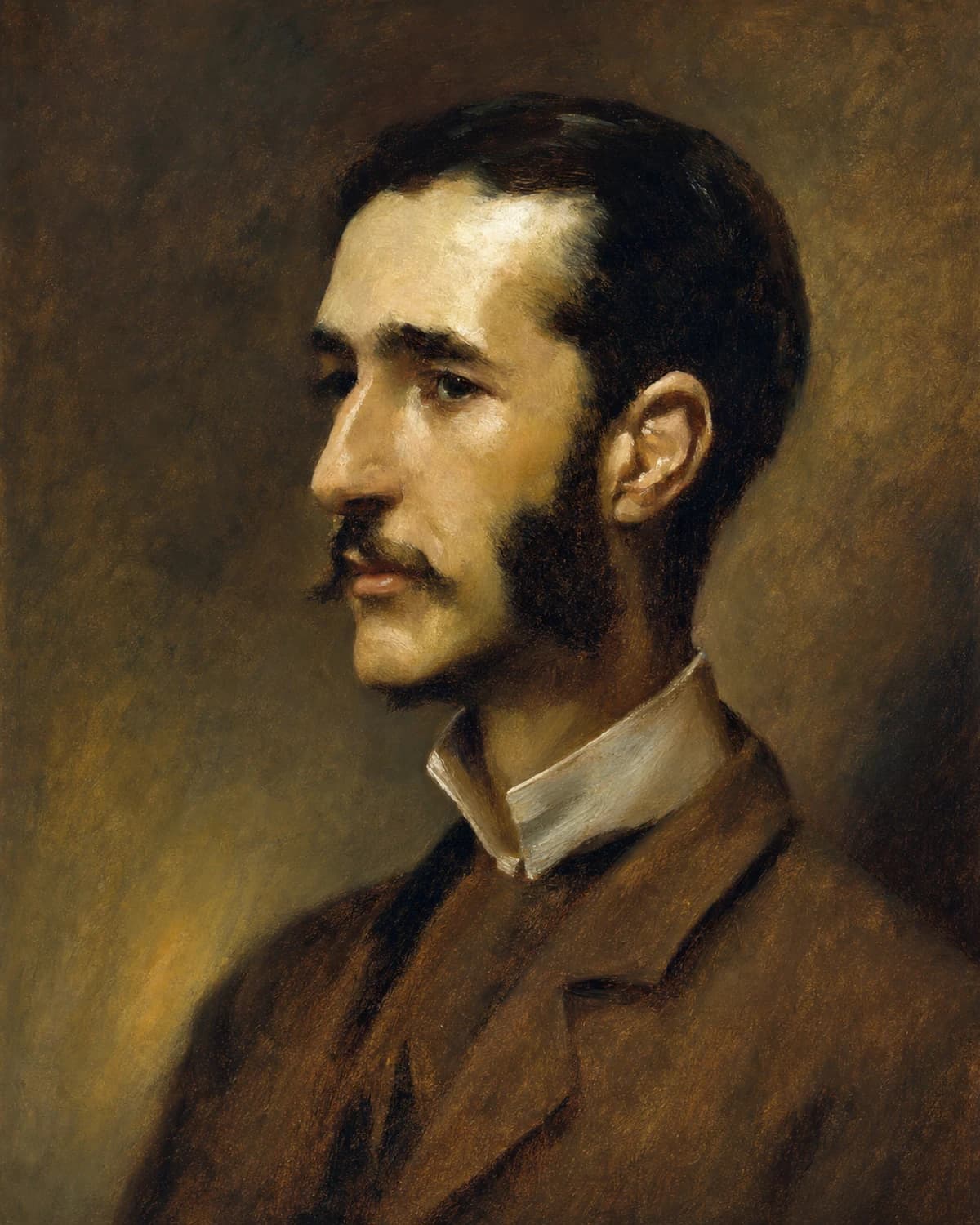
Biography
The portrait “Madame Ramón Subercaseaux” was painted by John Singer Sargent: the American had been a friend of the sitter's husband, and of the sitter, Amalia, since their Paris years. The portrait is often called the best evidence of their connection, and it seems to me that it also speaks of the circle in which this Chilean painter and diplomat moved.
Ramón Subercaseaux was born on 10 April 1854 in Valparaíso, the youngest of thirteen children (by other accounts, fourteen) in a wealthy family. His grandfather, Francisco Subercaseaux, a native of Dax in France, had moved to Chile and invested in mining. His father, Ramón Subercaseaux Mercado, a businessman and senator, continued in the same line. His mother was Magdalena Vicuña Aguirre.
From 1871 to 1874 Ramón studied law at the University of Chile and at the same time took private lessons from the German Ernesto Kirchbach, director of the Academy of Painting in Santiago. He did not become a lawyer: in painting and drawing he remained largely self-taught, and he left for Europe. He spent time in Paris and in Rome, where he studied with the Spaniard José García Ramos, both at the academy and in his studio. In Paris his friends included Pascal Adolphe Dagnan-Bouveret, Luc-Olivier Merson, Giovanni Boldini and Sargent. Scholars regard Sargent's influence on his manner as the strongest. In 1879 he married Amalia Errázuriz Urmeneta, sister of the painter José Tomás Errázuriz and daughter of Maximiano Errázuriz. They had six children (by other accounts, ten), among them Pedro, a painter and Benedictine monk, Luis, a diplomat and athlete, and Juan, the future bishop of La Serena. In that same year, 1879, Ramón was elected to the Chamber of Deputies for the Conservative Party, representing Angol. He remained a deputy until 1882, and in that year he was appointed Chilean consul in Paris.
In the 1880s he produced many city views, above all of Valparaíso; the influence of French Impressionism is noticeable in them. Among them is “Diques de Valparaíso” (1884), now in the National Museum of Fine Arts in Santiago. In 1884 he and some friends founded the magazine “Revista de Artes y Letras”.
In 1897 Subercaseaux returned to Europe as a full-fledged diplomat and represented Chile at the celebrations of Queen Victoria's sixtieth year on the throne in London. He worked in Italy and Germany. In Germany, by some accounts, he succeeded in securing Kaiser Wilhelm II's support for Chile, and this played a part in preventing a war with Argentina. In those same years he began to write prose and memoirs. In 1903 he returned home, in 1906 was elected senator for Arauco Province and sat until 1912 (the previous record gives 1913). From 23 December 1915 to 27 April 1916, under President Juan Luis Sanfuentes, he was Minister of Foreign Affairs. He also headed the extension school of the Catholic University.
In 1924 Subercaseaux became Chile's ambassador to the Holy See and remained in the post for six years. During his tenure the Chilean Congress enacted the Constitution of 1925, which separated church and state, yet relations with Pope Pius XI remained cordial. In Rome he painted city views: the Arch of Titus, the Piazza del Popolo, and church interiors, including St Peter's. Works of these years include “Interior de Iglesia San Clemente, Roma” (1920) and “Entrada al Taller del Llano” (1912), both in the National Museum of Fine Arts.
He was awarded the Prussian Order of the Crown, First Class, and the Grand Cross of the Order of the Crown of Italy. His books include “Memorias de 50 años” (1908), “El genio de Roma” (1911) and “Memorias de ochenta años” (1936). Ramón Subercaseaux died on 19 January 1937 in Viña del Mar.
Related context
Associations
Works connected through artistic movements, cultural context and period. Priced works available in this market appear first.








Profile notes
Profile and sources
Image
Artist image
На основе открытого изображения: John Singer Sargent; Wikimedia Commons; Public domain.
