
11.08.1931–24.02.2013
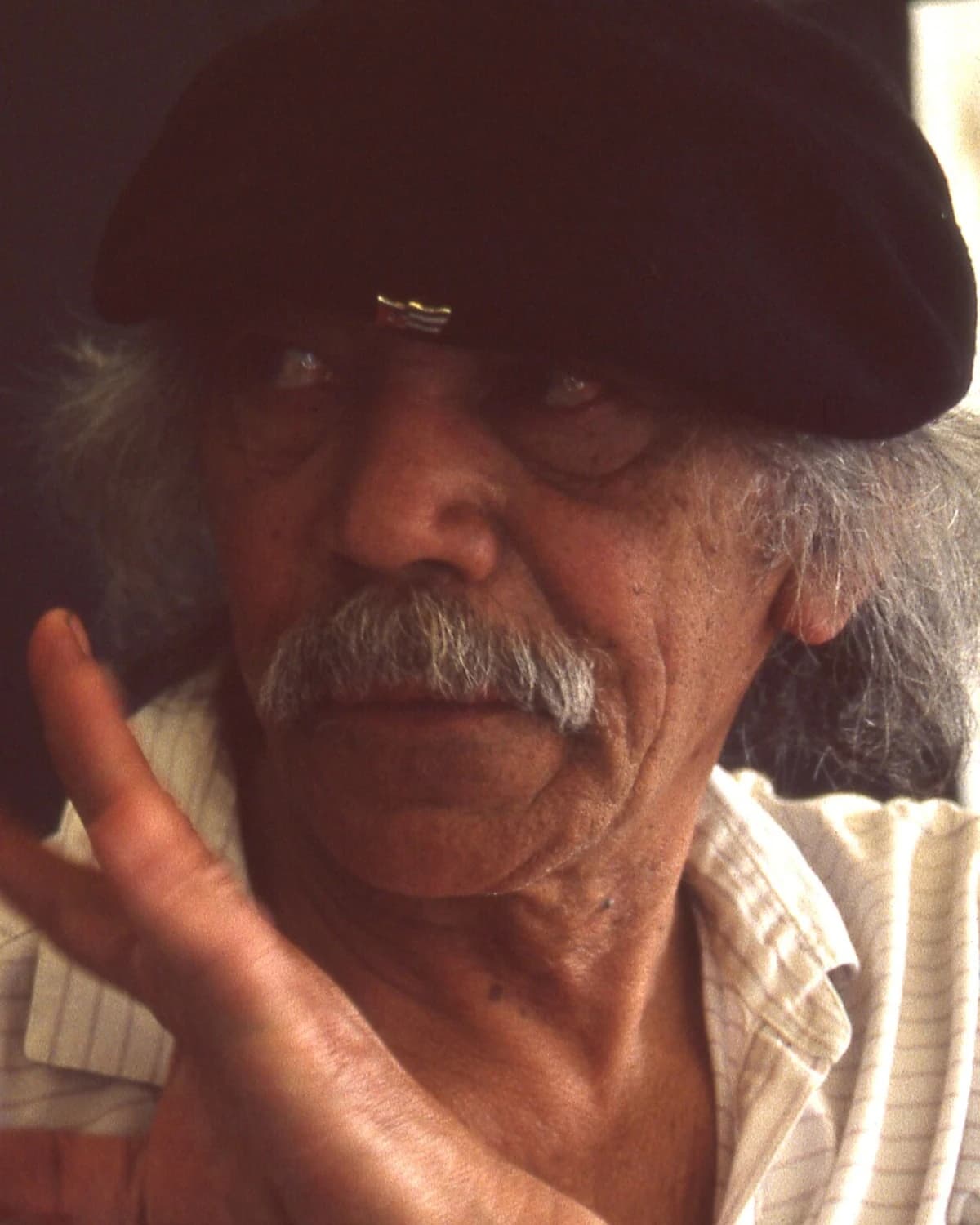
Ralph Hotere
Ralph Hotere, a Māori of the Te Aupōuri and Te Rarawa iwi, was born at Mitimiti on the shore of the Hokianga Harbour and lived most of his life in Port Chalmers near Dunedin. His best-known works are the “Black Paintings”, begun in 1968: almost unbroken black, thin coloured stripes, crosses, lines of poetry. In his paintings he responded to the threat of nuclear weapons, to apartheid and to the sinking of the Rainbow Warrior.
Biography
“Black Phoenix” (1984–1988) is made from the burnt remains of a fishing boat. In front stands the bow, at the sides are charred planks, and several more planks are laid out in front of it as a path, each with a strip scraped back to show the pale wood under the soot. The planks are inscribed with a Māori proverb about the fern: as one frond dies, another is born in its place. One word in it has been changed: instead of “passes over” it reads “the path forward”, which seems to refer to the cleared path in front of the bow. The work fills a space of five by thirteen metres.
Hone Papita Raukura Hotere, whom everyone called Ralph, was born on 11 August 1931 at Mitimiti, by the Hokianga Harbour in the north of the North Island, one of fifteen children. When he was nine his elder brother Jack went into the army; in 1943 he was killed in Italy.
From 1946 to 1949 Hotere studied at Hato Petera College in Auckland and then at Auckland Teachers’ College, where he was taught drawing by J. D. Charlton Edgar. In 1952 he moved to Dunedin and studied at the local art school while training as a teacher. In the second half of the 1950s he worked as an art education adviser to schools in the Bay of Islands district.
In 1961 a New Zealand Art Societies Fellowship took him to London, to the Central School of Art and Design. In the following years, 1962–1964, he lived in France and travelled around Europe, watched Pop Art and Op Art taking shape and, among other places, visited the war cemetery in Italy where his brother is buried. That journey and the European politics of the 1960s produced the “Sangro” series, and in 1964 came “Cruciform II” from the “Human Rights” series. By 1965 Hotere was exhibiting in Dunedin, and in 1969 he returned there as the University of Otago’s Frances Hodgkins Fellow. It was then that words appeared in his paintings. He worked with the poets Hone Tuwhare and Bill Manhire, made works for the literary journal “Landfall”, and the title of one 1970 painting says as much: “Black Painting IIIa: From ‘Malady’, a poem by Bill Manhire”. Port Chalmers, with its Careys Bay, became his home for almost the rest of his life.
The main series, the “Black Paintings”, ran from 1968. Black is almost everywhere: sometimes narrow coloured stripes run through it, partly recalling Barnett Newman, sometimes crosses barely surface from the darkness, black on black. From the 1970s corrugated iron and steel, which he worked with power tools, joined the canvas.
Politics was in his work from the very beginning. The “Aramoana” series grew out of a protest against an aluminium smelter that was to be built on the Aramoana wetlands near his home (“Black Window: Towards Aramoana”, 1981; “Aramoana Nineteen Eighty-Four”, 1984). “Black Union Jack” is connected with the rugby matches between New Zealand and apartheid South Africa in 1981, the “Polaris” series with the threat of nuclear warheads, and “Black Rainbow” with the sinking of the Rainbow Warrior in 1985. Later came works about the Middle East, such as “Jerusalem, Jerusalem”.
In 1992 he filled a gallery in Wellington with kilometres of the steel wire that New Zealanders call “number eight”.
In 1994 the University of Otago awarded him an honorary doctorate, in 2003 he received an Icon Award from the Arts Foundation of New Zealand, and in 2012 he was appointed to the Order of New Zealand. In 2001 the director Merata Mita made a documentary about him, “Hotere”, which was shown at the Sundance festival in 2002. His studio stood on the headland of Observation Point above the Port Chalmers container terminal; when the port was expanded, part of the headland was cut away together with the studio, despite protests from local people. Nearby, in 2005, the Hotere Garden Oputae sculpture garden was laid out with Hotere’s own involvement; it holds both his works and those of other New Zealand sculptors. I think the fate of this headland resembles his paintings: something cut away, something left, and everything in plain view.
Ralph Hotere died on 24 February 2013 in Dunedin, at the age of eighty-one, and was buried in his native Mitimiti.
Profile notes
Profile and sources
Image
Artist image
Manymanydogs; Wikimedia Commons; CC BY-SA 4.0.
