
29.04.1848–02.10.1906
Raja Ravi Varma
Raja Ravi Varma (1848–1906), a painter from the aristocratic Kilimanoor family in the princely state of Travancore, combined European academic oil painting with Indian subjects: Shakuntala, Nala and Damayanti, the gods and heroines of the Mahabharata and the Ramayana. His lithographic press near Bombay printed these gods in thousands of oleographs, and many people in India still picture the epics through his paintings.
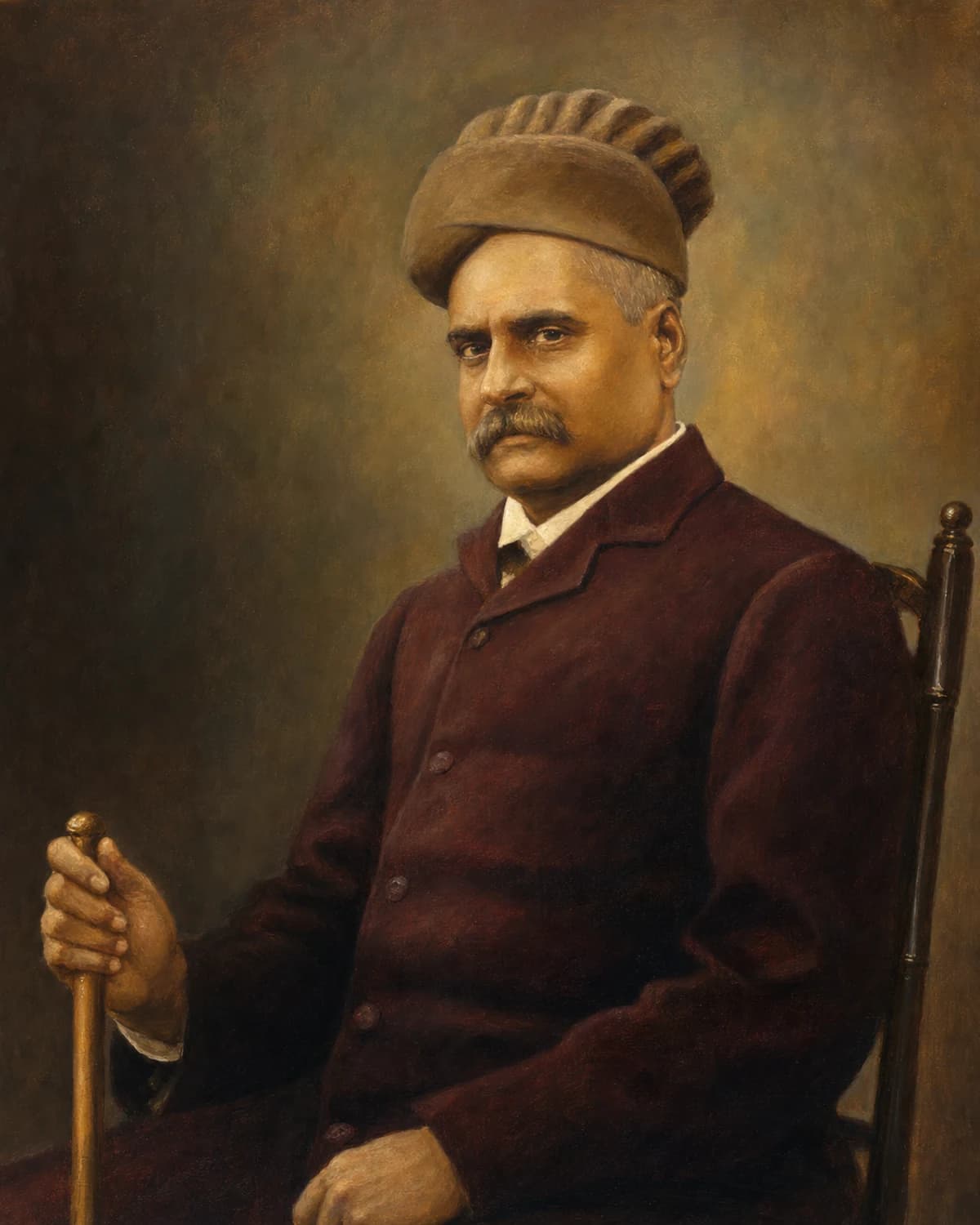
Biography
Ravi Varma was taught oil painting by the British portraitist Theodore Jenson, who had been invited to the Travancore court, and, as his biographers put it, Jenson taught him reluctantly. By one account the lessons took place in 1863 and lasted only a month.
He was born on 29 April 1848 in Kilimanoor palace, not far from Thiruvananthapuram, in present-day Kerala. His family was one of those that for more than two centuries had supplied husbands for the princesses of Travancore, where the throne passed through the female line. His mother, Uma Ambabayi, wrote poetry; her poem “Parvati Swayamvaram” was published by her son after her death. His father, Ezhumavil Neelakanthan Bhattatiripad, knew Sanskrit and Ayurveda. An uncle noticed his gift for drawing and encouraged it. The young man’s patron was Ayilyam Thirunal, the future Maharaja of Travancore; Varma learned the basics of painting in Madurai, watercolour from Rama Swami Naidu, and traditional Indian painting at court from the age of fourteen. His younger brother, Raja Varma, also became a painter and worked beside him all his life.
In 1866 Varma was married to Bhageerathi Bayi of the house of Mavelikkara, a branch of the Travancore royal family. In August 1900 their granddaughters were adopted by the ruling house, and one of them became the mother of Chithira Thirunal, the last ruling Maharaja of Travancore. So the entire present-day Travancore family descends from the artist. His daughter Mahaprabha appears in two of his best-known paintings.
Recognition came in 1873. At the art exhibition in Madras his “Nair Lady Adorning Her Hair” was awarded first place, and in Vienna that same year he received an award that made his name in Europe. The brothers’ careers were promoted by a British official, Edgar Thurston. In 1893 Varma’s paintings were sent to the World’s Columbian Exposition in Chicago and won three gold medals. He travelled widely across India in search of subjects and models; he painted his goddesses from Indian women he found beautiful. He is remembered above all for scenes from the Mahabharata, of Shakuntala and Dushyanta, of Nala and Damayanti. Many of these canvases are now in the Lakshmi Vilas Palace in Vadodara.
Here, I think, a caveat is needed. His Indian gods are dressed, lit and posed like the heroes of a European salon picture, and that is exactly why some historians call him the father of modern Indian art while others dismiss him as kitsch.
Geeta Kapur wrote of him as the indisputable father figure of modern Indian art. The artist and historian Ratan Parimoo, on the other hand, saw in him the source of the “vulgarity” of mass-produced images, those garish gods that later passed onto calendars and into the cinema. The dispute, to my mind, comes down largely to the prints.
The idea of printing apparently came from T. Madhava Rao, the dewan (first minister) of Travancore. In 1894 the Ravi Varma lithographic press opened at Ghatkopar near Bombay, and in 1899 it was moved to Malavli near Lonavala. It turned out oleographs of Hindu gods and scenes from the Mahabharata, the Ramayana and the Puranas, cheap and very popular. The business was run by his brother, and commercially it failed: by 1899 the press was in debt, and in 1901 it was sold to a German printer, Fritz Schleicher, who had worked there as a technician. Schleicher went on printing Varma’s pictures, then hired other artists and began producing advertising labels.
In 1904 the Viceroy, Lord Curzon, presented Varma with the Kaisar-i-Hind gold medal on behalf of the King. According to some sources, Curzon also conferred on him the title of raja as a personal title; according to others, he held no official title and was called raja in Europe. Around his fifty-seventh birthday Varma announced that at sixty he would take sannyasa and leave worldly life. His last years were darkened by the death of his brother.
Ravi Varma died on 2 October 1906. Oleographs of his gods went on being printed in their thousands for many years. The press of Schleicher and his successors kept working until 1972, when a fire destroyed the factory; many of Ravi Varma’s original lithographs were lost in it.
Related context
Associations
Works connected through artistic movements, cultural context and period. Priced works available in this market appear first.








Profile notes
Profile and sources
Image
Artist image
На основе открытого изображения: Bhawani Ram; Wikimedia Commons; Public domain.
