
21.01.1780–16.10.1832
Rai San'yō
Rai San'yō (1781–1832), a historian, poet and painter of the late Edo period, worked for about a quarter of a century on the “Nihon Gaishi”, an “Unofficial History of Japan” in 22 volumes, from the Taira and Minamoto to the shogun Tokugawa Iemitsu. In the last decades of the shogunate the book was read avidly by supporters of the slogan “Revere the Emperor”. He wrote poetry in Chinese and ink landscapes in the Nanga manner.
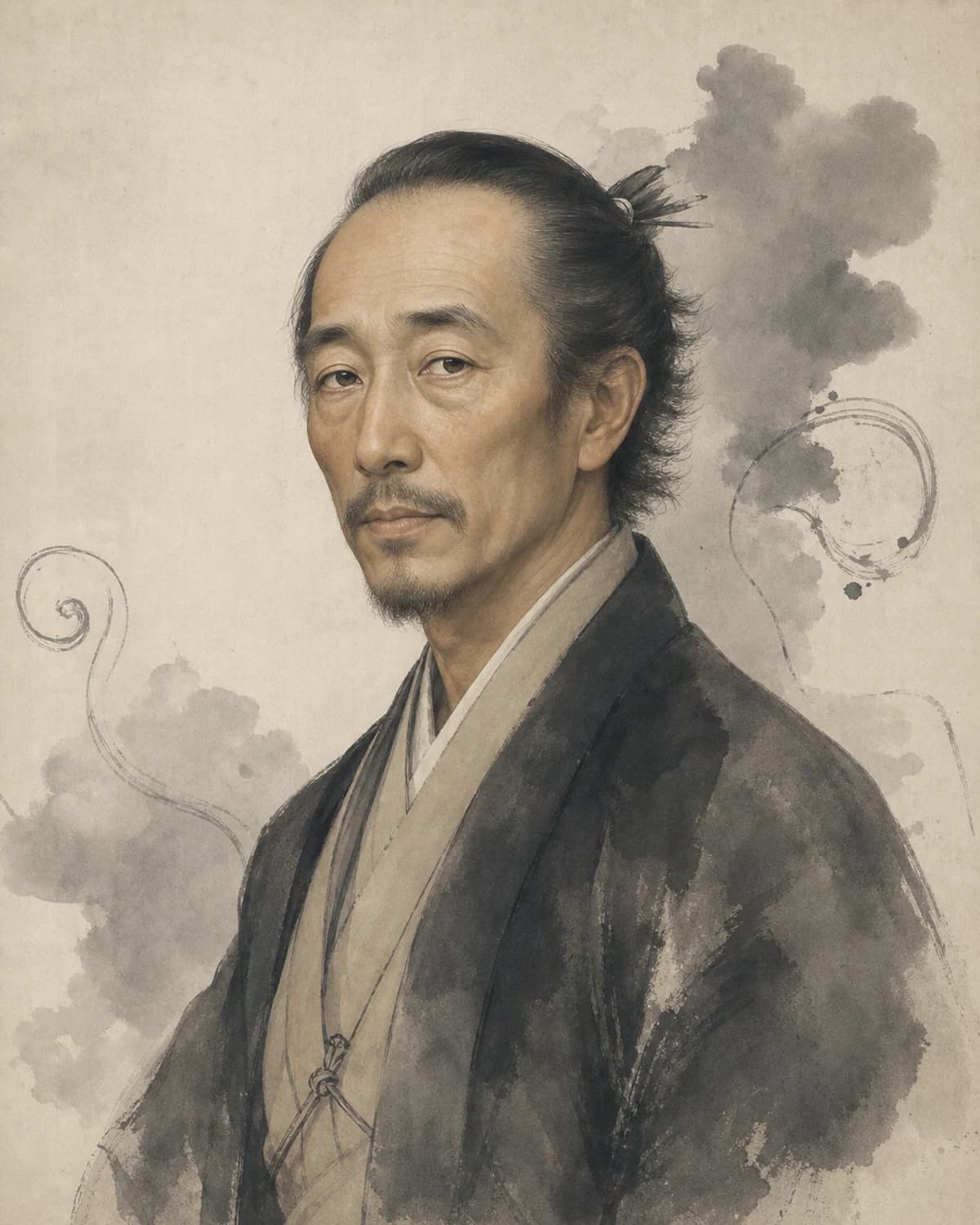
Biography
In 1910–1915 a Russian translation of the “Nihon Gaishi”, made by Vasily Mendrin under the title “A History of the Shogunate in Japan”, appeared in Vladivostok in the Proceedings of the Oriental Institute. In that edition the author is called Rai Dzio Sisei, after his personal name Jō (also read Noboru) and his courtesy name Shisei. San'yō was his literary pseudonym.
He was born in Osaka, in the Edobori quarter, where his father, the Confucian scholar Rai Shunsui, kept a private school. By the Japanese calendar this was the 27th day of the 12th month of the 9th year of An’ei, by the Gregorian calendar 21 January 1781. His mother, Baishi, wrote poetry. Soon afterwards his father was invited to teach at the new school of the Hiroshima domain, and the boy grew up in Hiroshima, in the Fukuro-machi quarter.
In 1788 he entered the domain school and studied with his uncle, the Confucian Rai Kyōhei; in 1797 he went to Edo and studied with his father’s friend Bitō Nishū. In the ninth month of 1800 he suddenly fled the domain for Kyoto. For a samurai to leave his domain without permission was a grave offence; his uncle found the runaway and brought him back to Hiroshima, his father disinherited him, and he spent three years under house arrest in his own room. Those years went into reading and writing. It was there, it is believed, that he conceived the “Nihon Gaishi” and wrote its first chapters, and by another account even completed a first draft. The room survives: the house in Hiroshima has become a memorial museum, and the room itself is protected as a historic site. It seems to me that this confinement is what made him a historian. Once released, he taught at the domain school, and in 1809 the Confucian scholar Kan Chazan invited him to be senior tutor at his school, the Renjuku.
In 1811, dissatisfied with this post as well, he left for Kyoto and opened a school of his own. In 1816 his father died, and the son published his posthumous collection. In 1818 he travelled through Kyushu and met Hirose Tansō. In 1822 he bought a house in the Sanbongi quarter with a view of the Higashiyama hills and named it Suiseisō, and in 1828 he built a study next to it, the “Sanshi Suimei”, “Purple Mountains, Clear Water”. In Kyoto he grew close to Yanagawa Seigan and Ōshio Heihachirō and came under the influence of the Kokugaku school. A circle called the Shōsha formed around him, attended by the painters Uragami Shunkin, Okada Hankō, Tanomura Chikuden and Nakabayashi Chikutō, the potter Aoki Mokubei and the calligrapher Nukina Kaioku, and all of them wrote poems and made pictures. From 1813 he corrected the Chinese verse of the painter Ema Saikō and sent her his own poems so that she could practise calligraphy on them.
He finished the “Nihon Gaishi” in 1826 and in 1827 presented it to the shogunate dignitary Matsudaira Sadanobu. His model was Sima Qian’s “Records of the Grand Historian”; the book is built as a history of the samurai houses from the Taira and Minamoto to Tokugawa Iemitsu. It is written with vigour and passion, and among the author’s sources were war tales, so historians find many inaccuracies in it. Sadanobu approved it, but later it was banned in several domains, possibly for the idea of strengthening the power of the emperor. In the last decades of the shogunate it was read avidly by supporters of the movement “Revere the Emperor, Expel the Barbarians”. He also wrote the “Nihon Seiki” (“Records of Japan’s Government”, 16 volumes), the treatise “Tsūgi” (“Morality and Duty”), books of verse and travel diaries. His poem on the Battle of Kawanakajima, which opens with the line “Quietly the whips whistle as we cross the river by night”, is still chanted today in the shigin style.
As a painter San'yō was more modest than as a historian. He painted monochrome ink landscapes in the Nanga manner, such as “Withered Trees on a Cold Rock” (1820, Seikadō Library), and often inscribed his friends’ pictures with poems; a landscape by Nakabayashi Chikutō of 1825 bears his inscription.
In his last years he hurried to finish the “Nihon Seiki” and the “Tsūgi” and worked to the very end. Rai San'yō died on 16 October 1832 in Kyoto, at his house in Sanbongi; he is buried at the Chōraku-ji temple by Maruyama Park. In 1891 he was posthumously given the senior fourth court rank, and in 1931 the junior third.
Related context
Associations
Works connected through artistic movements, cultural context and period. Priced works available in this market appear first.








Profile notes
Profile and sources
Image
Artist image
На основе открытого изображения: Rijksmuseum; Wikimedia Commons; CC0.
