
24.10.1892–15.02.1965
Rafał Malczewski
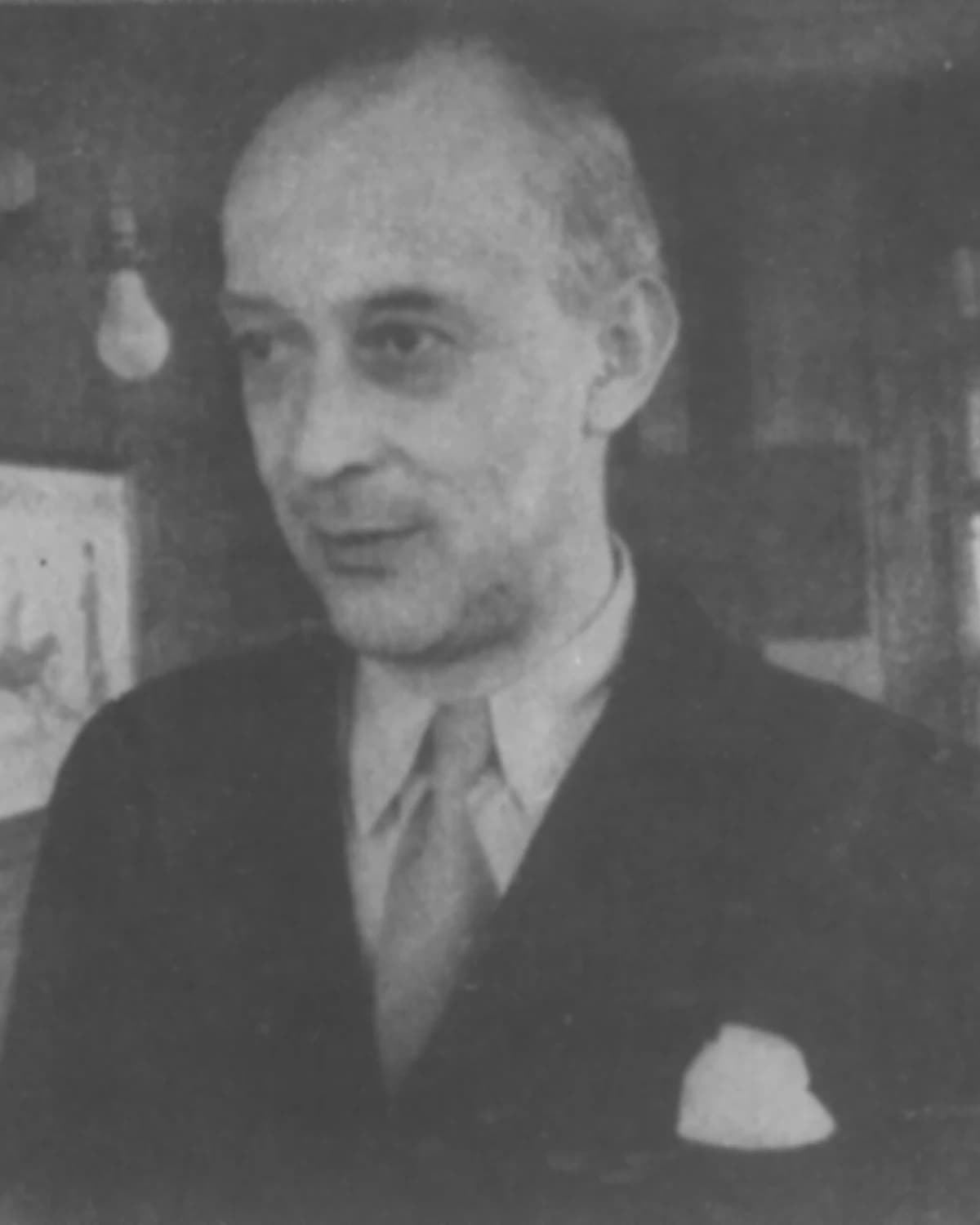
Rafał Malczewski, son of the Kraków Symbolist Jacek Malczewski, lived in Zakopane from 1915 to 1939: he climbed in the Tatras, served in the TOPR mountain rescue team, and painted mountain landscapes and wrote books about Zakopane. The war took him through Paris and Brazil to Canada, where he exhibited in Montreal and died in 1965.
Biography
In 1917, on the south face of Zamarła Turnia in the Tatras, Rafał Malczewski and his climbing partner Stanisław Bronikowski were caught in an accident. Bronikowski died, and Malczewski hung from a hook all night waiting for rescuers.
As researchers write of him, he never forgot this death for the rest of his life.
He was born on 24 October 1892 in Kraków, four years after his sister Julia. His father, Jacek Malczewski, was a well-known Symbolist painter and professor; his mother was Maria, née Gralewska. Rafał graduated from the Saint Jacek High School in Kraków and from 1910 to 1915 studied at the University of Vienna, where he took courses in philosophy, architecture and agronomy and studied Freud and psychoanalysis, but he took no degree. Back in Kraków, he entered the Jan Matejko Academy of Fine Arts and worked in his father’s studio. By some accounts his father wanted him to have a more reliable career than his own; painting, however, came to the son of its own accord as he watched his father at work. From 1915 until the outbreak of the Second World War he spent long periods in Zakopane: he climbed, skied, painted, and joined the mountain rescue service TOPR. His circle there included Stanisław Ignacy Witkiewicz, Karol Szymanowski, Kornel Makuszyński and Jarosław Iwaszkiewicz. In 1923 his father bought him and his family a chalet called “Marysin”, as money was short. In 1932 Malczewski joined the “Rhythm” Association of Polish Artists (Stowarzyszenie Artystów Polskich “Rytm”) and designed sets at the Formist Theatre in Zakopane, including for plays by Strindberg and Witkiewicz.
His first exhibition took place in 1924 at Garliński’s salon in Warsaw, together with Witkiewicz. Solo shows followed in Zakopane (1926), Warsaw (1928, 1929, 1935, 1938), Kraków (1930, 1932), Łódź (1935) and Katowice (1938). As a member of the Society for the Propagation of Polish Art Abroad he exhibited in Prague, Helsinki, Vienna, Paris, Brussels, The Hague, Budapest, Copenhagen, Moscow, Edinburgh and Berlin; in 1932 his work was shown at the Venice Biennale. His work was part of the art competitions at the 1932 and 1936 Olympic Games. He received the prize of President Ignacy Mościcki (1930), the Golden Academic Laurel of the Polish Academy of Literature “for services to Polish art” (1937), and a gold medal for “Spring in the Mountains” at the Paris International Exposition of 1937. He painted empty mountain vistas, snowy slopes, glassy lakes, sleepy railway stations, muddy roads, the industrial landscapes of Silesia, and portraits. He simplified forms deliberately, and his paint lay smooth and glossy; Witkiewicz called this hyper-realism, while others spoke of “naivety”. I would not try to find a single category for him.
He also wrote about Zakopane: the collections “Narkotyk gór” (“Addicted to Mountains”, 1928), “Tatry i Podhale” (“The Tatras and Their Foothills”, 1935) and “Góry wołają” (“The Mountains Beckon”, 1939), and later the memoir “Pępek świata” (“The Navel of the World”). In 1938 he left part of his works to the new building of the National Museum in Warsaw, to which a few years earlier, out of need, he had sold everything he had inherited from his father.
In 1939, after the outbreak of war, he fled through Slovakia with Zofia Mikucka, reached Paris by way of Budapest and Venice, and received help there from the Polish embassy. In 1940 they went on to Spain and Portugal, where they stayed four months, and at the beginning of 1941 they moved to Brazil. In Rio de Janeiro he sold watercolour views of Rio, Curitiba and Paraná; in 1942 he moved to Curitiba to stay with his cousin Maria Bochdan-Niedenthal. Soon afterwards he obtained Canadian visas for himself and Mikucka. In December 1942 his first Canadian exhibition opened at the Montreal Museum of Fine Arts. The Canadian railways sponsored his journeys across Canada and the United States in search of subjects; he spent the winter of 1943 in the Rocky Mountains, and the trip produced a series of canvases with which he exhibited until 1949. In 1950 he painted a great deal in New York and sold some of the work there. There were also shows in Washington (1944, 1949) and Detroit (1945).
In 1953 his first wife died in Warsaw, and he married Zofia Mikucka. After a stroke in 1957 caused partial paralysis, he gave up oil painting and worked in watercolour; he was helped by Radio Free Europe and the government of Quebec. In 1959, at his daughter’s invitation, he visited Poland but stayed in Canada, and he described the trip in “Memories of Poland” for the London émigré newspaper “Wiadomości”. In 1962 he was awarded the prize of the magazine “Kultura”. His last exhibition took place in Montreal in 1964.
Malczewski died in Montreal on 15 February 1965 and was buried there.
Related context
Associations
Works connected through artistic movements, cultural context and period. Priced works available in this market appear first.








Profile notes
Profile and sources
Image
Artist image
Photo from Aleksander Janta archive, non specified.; Wikimedia Commons; Public domain.
