
04.01.1890–12.02.1929
Rafael Barradas
Rafael Barradas (1890–1929), the son of Spanish immigrants, was almost entirely self-taught and became one of the most visible artists of the Spanish avant-garde of the 1910s and 1920s. He began with magazine illustrations in Montevideo, devised his own version of Cubism, “Vibrationism”, in Europe, worked in Barcelona and Madrid, and designed stage sets and books. He returned to Uruguay in 1928; his collection is in the National Museum of Visual Arts in Montevideo.
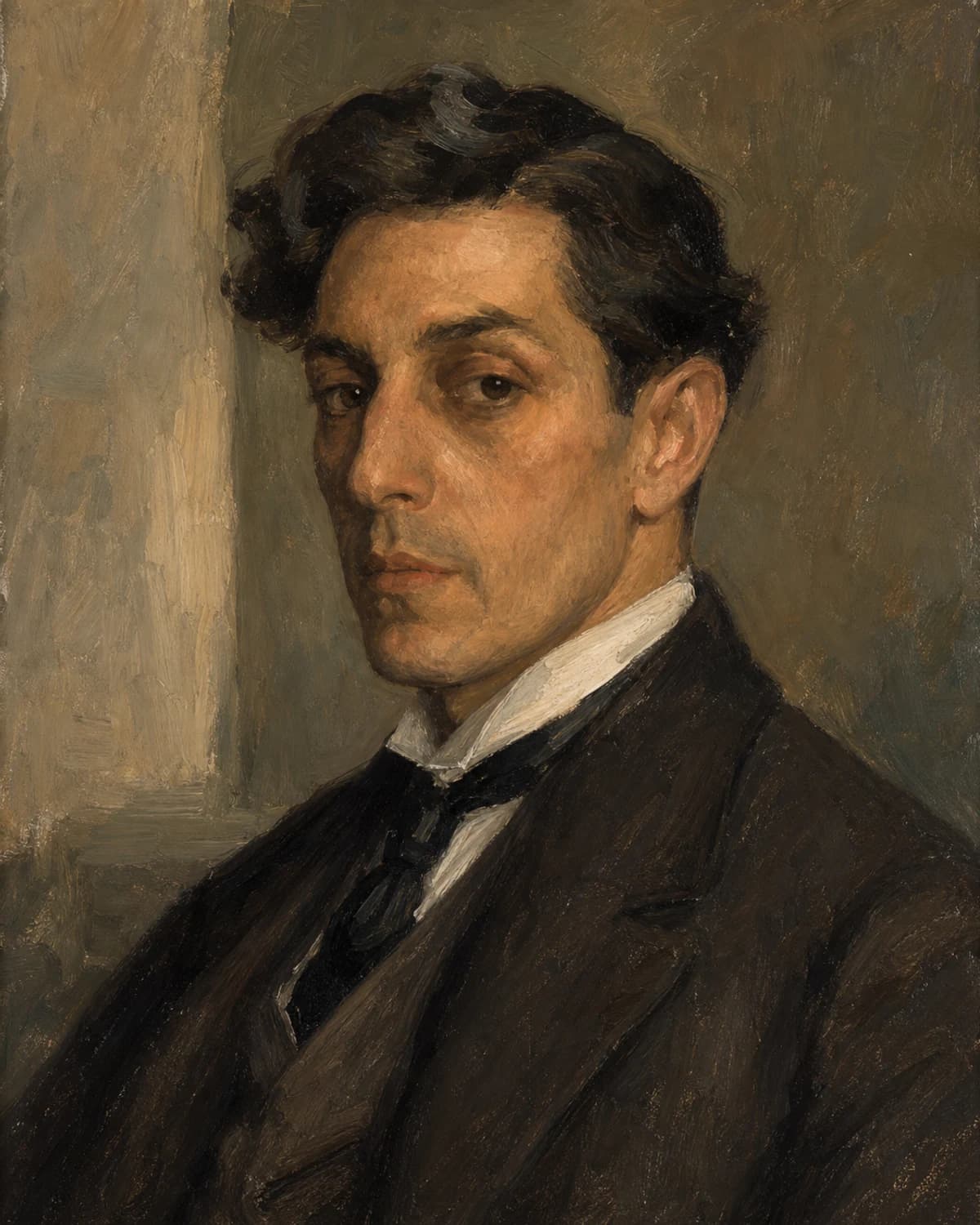
Biography
In the winter of 1914 Barradas set out from Barcelona on foot for Madrid. He never reached it: in Aragón his strength and food gave out, and a peasant family took him in.
He was born on 4 January 1890 in Montevideo, to a family of Spanish immigrants. His older sister Carmen became a pianist and composer, and his younger brother Antonio wrote poetry under the name Antonio de Ignacios. Rafael took his interest in drawing from his father and was almost entirely self-taught. His first professional work was magazine illustration, and in 1912 he held his first exhibition together with Guillermo Laborde. In 1913 a friend who had won a government grant to study singing at La Scala in Milan invited him to come to Europe. In Milan Barradas met the Italian Futurists, then spent some time in Paris and saw the latest trends there. From this grew his own version of Cubism, which he called “Vibrationism”: drawing built on the energy of line and colour. In 1914 he moved to Barcelona and grew close to a circle of young Catalan poets led by Joan Salvat-Papasseit.
That is how he came to be in Aragón. The peasants who had saved him had a daughter, Pilar, and in 1915 he married her in Zaragoza. In the same year his first solo exhibition was held in Zaragoza. In 1923 he went back to the Aragonese village of Luco de Jiloca and painted the series “Los Magníficos”: villagers at their daily tasks, in very expressive black tones. With this dark palette he gave up Vibrationism.
In 1916 Barradas and his wife settled again in Barcelona; his mother moved there from Uruguay as well. There he met a fellow Uruguayan, Joaquín Torres García, who had been living in Spain since 1891. Apparently Vibrationism impressed Torres García, and some of its devices entered his “Constructive Universalism”. Sources give different years for the meeting.
In 1919 Barradas finally reached Madrid and opened a studio near Atocha. He became a regular at the gatherings of writers, poets and artists in the local cafés; among his acquaintances are named Ramón Gómez de la Serna, Jorge Luis Borges, Federico García Lorca, Salvador Dalí and Luis Buñuel. Gregorio Martínez Sierra commissioned him to design costumes and scenery for the Teatro Eslava. Martínez Sierra also published books in the Biblioteca Estrella series, which Barradas illustrated, as he did books by Gómez de la Serna. He contributed to art and literary magazines, among them Alfar, edited by the Uruguayan poet Julio Casal. In 1925 and 1926 he took part in several exhibitions and spent some time in Saint-Jean-de-Luz, where he made watercolours of the port and its people.
After his return he broke abruptly with Martínez Sierra and moved to L’Hospitalet de Llobregat, near Barcelona. There he produced a series of religious works, “Los Místicos”, followed by “Estampones Montevideanos”, inspired by the port and the Barrio Sur of his native city. He expected these to be his last works, as his health was failing fast. His last undertaking in Spain was helping to organize the first and only exhibition of drawings by Federico García Lorca, at the Dalmau gallery in Barcelona.
In November 1928 Barradas returned to Uruguay and a few months later, on 12 February 1929, died in Montevideo. He left most of his works to his family, and they were displayed in the family home. In 1969 the family donated them to Uruguay’s Ministry of Education and Culture to create a Barradas Museum. Today the collection is in the National Museum of Visual Arts in Montevideo, where in 1972 the first major exhibition, of about 500 works, was held.
Related context
Associations
Works connected through artistic movements, cultural context and period. Priced works available in this market appear first.








Profile notes
Profile and sources
Image
Artist image
На основе открытого изображения: Rafael Barradas; Wikimedia Commons; Public domain.
