
1811–23.04.1880
Raden Saleh
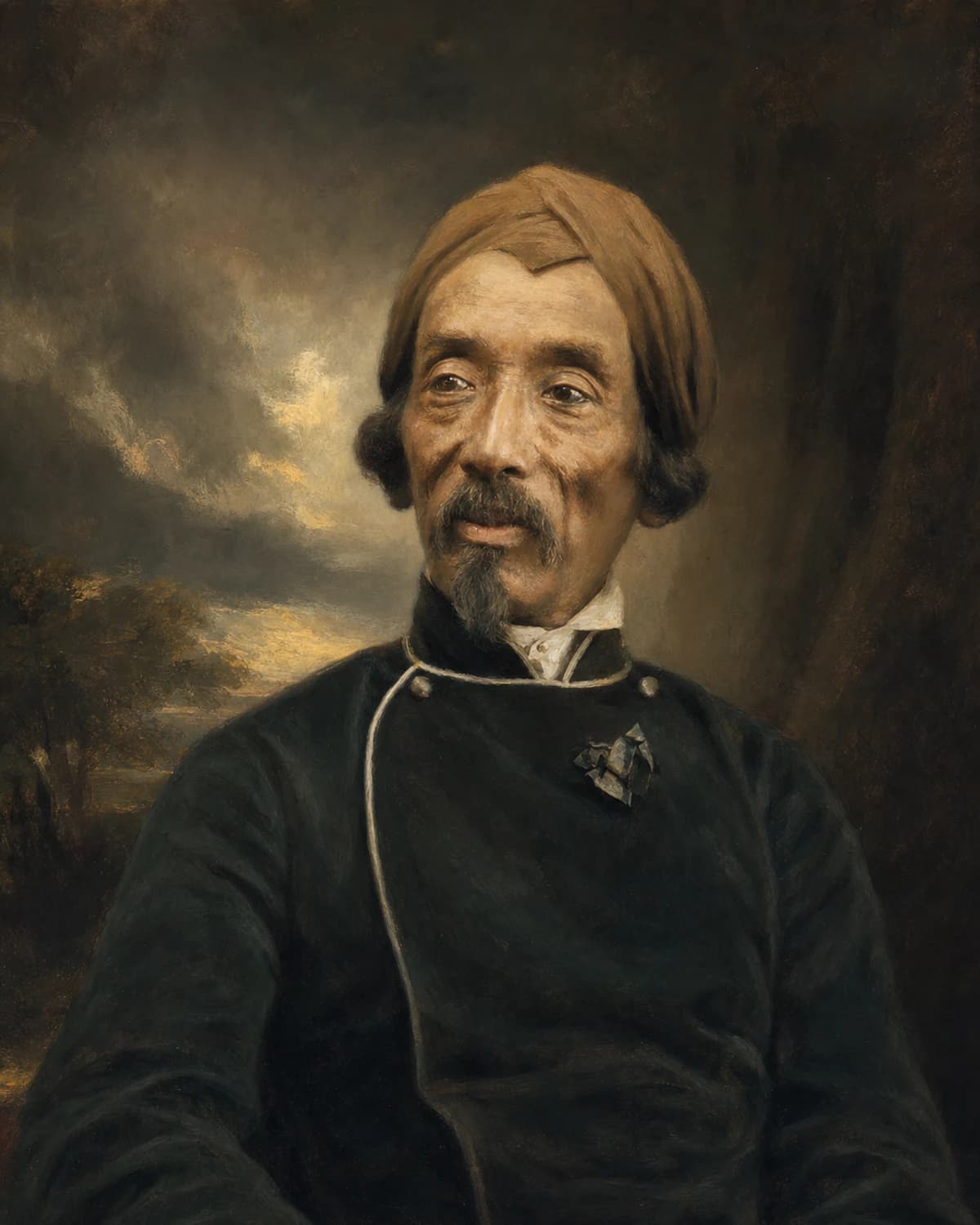
Raden Saleh was born around 1811 near Semarang on Java into a noble Arab-Javanese family, and in 1829 he left to study painting in the Netherlands. He spent twenty years in Europe, painting portraits and lion hunts and working at the court of the Duke of Saxe-Coburg and Gotha. His painting “The Arrest of Pangeran Diponegoro” (1857) is now in Jakarta, in the museum of the Merdeka Palace.
Biography
The subject of “The Arrest of Pangeran Diponegoro” had been painted before Saleh by the Dutchman Nicolaas Pieneman, on a commission from General de Kock. Pieneman looked at the scene from the right and called his picture “The Submission of Prince Diponegoro”; his prince is resigned to defeat. Saleh turned the same scene round and viewed it from the left, and his Diponegoro is furious. Pieneman had never been to Java and dressed the prince’s men in Arab fashion, whereas Saleh’s wear batik and the Javanese headcloth called blangkon. The Dutch officers, it is generally believed, he deliberately gave heads larger than they should be. The event belongs to 1830, when the prince, leader of the Java War, was lured to Magelang, supposedly for talks on a truce, and taken into custody there.
Saleh finished the painting in 1857 and presented it to King William III of the Netherlands. It came back to Java only in 1978.
The artist was born in the village of Terboyo near Semarang. His year of birth is given differently: most often 1811, though 1807 and 1814 also appear. The family was noble and traced its descent from Hadhrami Arabs who had reached Java by way of Surat in India back in the seventeenth century. The boy took his first painting lessons in Bogor from the Belgian artist A. J. Payen. It was Payen who persuaded the colonial authorities to send his gifted pupil to study in the Netherlands.
In 1829 Saleh arrived in Europe. He learned portraiture from Cornelis Kruseman and landscape from Andreas Schelfhout. As early as 1835–1836 he was painting governors-general of the East Indies, Jean Chrétien Baud and Johannes van den Bosch; there is also a posthumous portrait of Herman Willem Daendels by him. In 1836 he was admitted to a Masonic lodge and, as far as is known, became the first native of Indonesia to join the Freemasons. From 1839 he spent five years at the court of Ernest I, Duke of Saxe-Coburg and Gotha, who became his patron. He travelled around Europe and visited Algiers. In The Hague the lion tamer Henri Martin allowed him to study his lion, and from this came the pictures of fighting animals that made Saleh’s name: “Lion Attacking a Horse” (1840), “The Lion Hunt” (1841). In Paris he met Horace Vernet, and in the composition of the 1840 “Lion Hunt” scholars see an echo of Delacroix’s “Liberty Leading the People”. I would not insist on direct borrowing: as the researcher Werner Kraus observes, Saleh himself never mentions Delacroix anywhere.
He returned to Java in the early 1850s. The colonial government made him keeper of its art collection; he served as portraitist to the governors-general and painted the local elite: European officials, the Javanese nobility, the leading families of the Peranakan Chinese. He painted landscapes as well. Life in the colony weighed on him, and in one letter he complained that here people talked only about coffee and sugar, and then about sugar and coffee.
He married a wealthy heiress, Constancia von Mansfeld, and with her money a house was built on the Cikini estate (then a suburb of Batavia), modelled on Callenberg Castle near Coburg, where Saleh had been a guest in Europe. The park around the house was opened to the public in 1862. Later the Taman Ismail Marzuki cultural centre went up on the site of the gardens, and the house itself is now a hospital. In 1867, after the death of his first wife, he married Raden Ayu Danudirdja, of the aristocracy of the Yogyakarta Sultanate, and moved to Bogor, to a house by the Botanical Gardens with a view of Mount Salak. Among his later works are “Six Horsemen Chasing Deer” (1860), “A Flood in Java”, composed on the model of Géricault’s “The Raft of the Medusa”, “View of the Dieng Plateau” (1872) and “Javanese Mail Station” (1876). With his wife he travelled to Europe once more: the Netherlands, France, Germany, Italy. In Paris she fell ill, and they went home.
Saleh died on 23 April 1880 in Bogor. Two days later he was buried in Kampung Empang; the newspaper “Java-Bode” reported that landowners, Dutch officials and curious schoolchildren came to the funeral. His wife outlived him by three months. In 1883, on the initiative of William III and the Duke of Saxe-Coburg and Gotha, an exhibition of his paintings was held in Amsterdam. Some of his pictures perished in a fire in 1931: according to some sources at the Rijksmuseum in Amsterdam, according to others in the Dutch colonial pavilion in Paris.
The grave itself was afterwards lost for a long time. In 1923 Mas Adung, a descendant of the Sundanese aristocrat Raden Panoeripan, was clearing undergrowth to the west of his house in Bogor and came upon two marble slabs with Dutch inscriptions: they were the gravestones of Saleh and his wife. In 1953 President Sukarno visited the grave and commissioned the architect Friedrich Silaban to restore it. It is looked after, too, by a descendant of Panoeripan, whose family grave lies right beside it.
Related context
Associations
Works connected through artistic movements, cultural context and period. Priced works available in this market appear first.








Profile notes
Profile and sources
Image
Artist image
На основе открытого изображения: Woodbury & Page (Walter B. Woodbury died in 1885); Wikimedia Commons; Public domain.
