
07.05.1861–07.08.1941
Rabindranath Tagore
Rabindranath Tagore (1861–1941), the Bengali poet and the first non-European to win the Nobel Prize in Literature (1913), took up drawing seriously only at around sixty. He left some 2,500 drawings in ink, pen and watercolour; his first exhibition was held in Paris, and his work was then shown across Europe. He wrote “Gitanjali”, about 2,230 songs and the national anthems of India and Bangladesh.
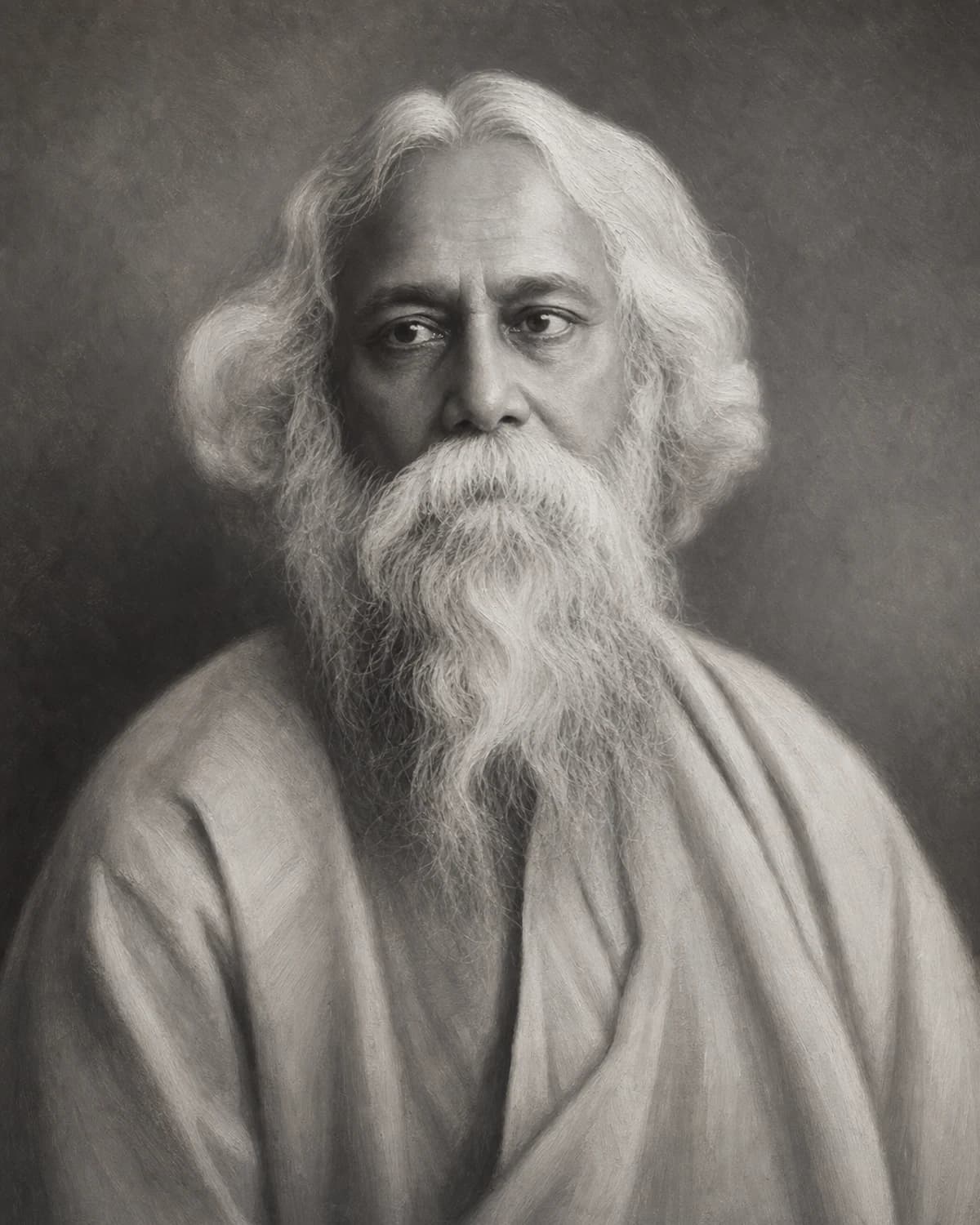
Biography
In 1900 Tagore, almost forty and already known as a writer, told the scientist Jagadish Chandra Bose in a letter that he was sitting with a sketchbook, drawing. These pictures, he joked, were not meant for any Paris salon. He was drawn to the very skill that came to him least easily, just as a mother loves her ugliest son best. By his own admission he used the eraser more than the pencil, and in the end he decided that he was not meant to be a painter.
He came back to it more than twenty years later, at around sixty.
Rabindranath was born on 7 May 1861 in Calcutta, in the family mansion of Jorasanko, the youngest of the thirteen surviving children of Debendranath Tagore and Sarada Devi. The family of wealthy landowners stood at the centre of the Bengal Renaissance: literary magazines were published in the house, plays were staged, and Indian and European music was played; his brothers included a philosopher, a poet, a composer and the first Indian in the elite colonial civil service, and his nephew Abanindranath became one of the founders of the new Bengal school of painting. The boy disliked school and was taught mostly at home. In 1873, after the upanayana rite, his father took him on a long journey through India: Santiniketan, Amritsar, the Himalayas. At sixteen he published poems under the name Bhanusimha, passing them off as an old manuscript that had been discovered, and the experts believed him. In 1878 he was sent to study in England, first at a school in Brighton, then on the law course at University College London, but in 1880 he returned to Bengal without a degree.
From 1890 Tagore managed the family estates at Shilaidaha (now in Bangladesh), travelling round them on the barge Padma. In 1891–1895 he wrote more than half of the eighty-four stories later collected in the three-volume “Galpaguchchha”, most of them about the Bengali village. In 1901 he moved to Santiniketan and set up an ashram there with an experimental school, gardens and a library. In 1905 he was among the leaders of the Swadeshi movement against the partition of Bengal, but withdrew from it when the protest turned towards revolutionary struggle.
“Gitanjali” came out in Bengali in 1910. In 1912 in London Tagore showed his own English translations of these poems to a friend, the painter William Rothenstein, and then to Yeats and Ezra Pound; the India Society of London published them in a small edition with a preface by Yeats. In November 1913 Tagore learned that he had been awarded the Nobel Prize, and he gave the money to his school. The knighthood conferred on him in 1915 he gave back in 1919, after the massacre at Amritsar. The foundation stone of Visva-Bharati University was laid in 1918 and the university opened in 1921; in the same year, 1921, together with the agronomist Leonard Elmhirst, Tagore founded the Institute for Rural Reconstruction in nearby Surul. Between 1878 and 1932 he visited more than thirty countries on five continents.
He began drawing seriously in the early 1920s. A draughtsman’s eye shows in his manuscripts too: crossed-out lines and blots grow simple rhythmic patterns. In a letter to Rani Mahalanobis he described how first there is a hint of a line, and then the line becomes form. In London in 1920 he was impressed by Stella Kramrisch’s lectures and invited her to Santiniketan to speak on world art. Scholars name unexpected influences: the carvings of the Malanggan people of New Ireland, Haida carving from the north-west coast of America, the woodcuts of Max Pechstein. Tagore was probably unable to tell red from green, hence his strange colour combinations. His portraits have angular, upward-thrusting lines and narrow, elongated forms; the late sheets are grotesque and dramatic. It seems to me that these drawings are best understood if one remembers what he once admitted: the only training he had in his youth was in rhythm, in thought and in sound.
The first exhibition was arranged in Paris at the urging of artists Tagore had met in the south of France; in 1930 his works were shown in Paris and London, and then throughout Europe. In all he made about 2,500 drawings in ink, pen and watercolour. In 1937 the Nazi authorities removed his works from the Crown Prince’s Palace in Berlin, and five of them were entered in the inventory of “degenerate art” compiled in 1941–1942. India’s National Gallery of Modern Art lists 102 of his works in its collection.
From 1937 Tagore was ill for long periods. On 30 July 1941 he dictated his last poem, and on 7 August 1941 he died in Calcutta, in the same Jorasanko mansion where he had grown up.
Related context
Associations
Works connected through artistic movements, cultural context and period. Priced works available in this market appear first.








Profile notes
Profile and sources
Image
Artist image
На основе открытого изображения: Che Lan sr Ca, L.; Wikimedia Commons; CC BY 4.0.