
1787–15.08.1848
Pyotr Sokolov
Pyotr Sokolov (1787–1848) made the watercolour portrait an independent genre in Russian art: he worked fast, usually in a single sitting, and left more than five hundred works. His sitters included Pushkin, Zhukovsky, Vyazemsky and the future Alexander II. In 1839 he became the first to be made an Academician of painting for watercolour portraits; three of his sons also became artists.
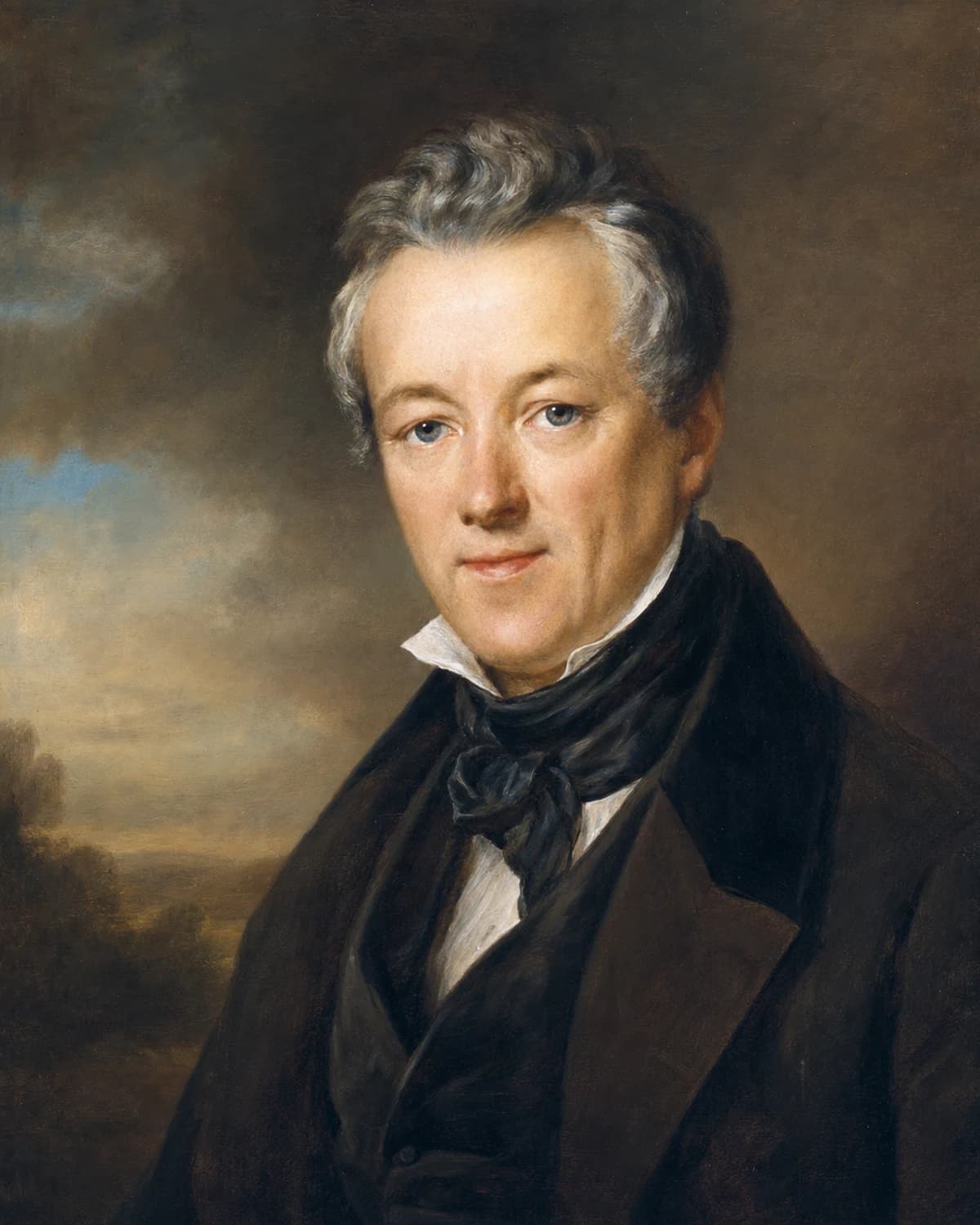
Biography
Pyotr Sokolov portrayed Ekaterina Bakunina three times. In 1816 in pencil, as a young girl; in 1828 in watercolour, with the polite prettiness then expected of a portrait; in 1834 as a married lady, Mrs Poltoratskaya. Clients came back to him for years, and these three portraits of one woman perhaps show best what he meant to his circle.
Only one of his narrative paintings survives.
He was born in Moscow; the year of his birth is given differently, as 1787 or 1791. In 1800 he was admitted to the Imperial Academy of Arts, where he studied under Vasily Shebuyev and Alexei Yegorov. In 1807 and 1808 he won the small and the large silver medals for drawings from life, and in 1809 the small gold medal for the competition piece “Andromache Mourning the Slain Hector”. This is that single surviving narrative work: from the Academy’s collection it passed to the Rumyantsev Museum, and since 1931 it has been in the Tretyakov Gallery. He completed the course in 1809 with the rank of artist of the 14th class and stayed on at the Academy as a pensioner. The subject set for the large gold medal, which carried a journey abroad at state expense, was Dmitry Donskoy before the battle with Mamai, receiving the blessing of Sergius of Radonezh and taking leave of his wife. Sokolov did not win the medal and in 1810 left the Academy.
He became a tutor in one family, and through it commissions began to come; in the 1810s he spent four years teaching drawing in the Levashov family. History painting was not his vocation. After his first successful attempts in watercolour he turned entirely to the watercolour portrait and was the first Russian artist to show how watercolour differs from miniature. He made the preliminary drawing in graphite pencil and sometimes used it for special effects on top of the colour as well. Over the 1820s to 1840s such portraits displaced the portrait miniature that had been fashionable in Russia before. He painted quickly, as a rule in a single sitting, and the commissions kept growing.
He painted many people of the Pushkin era: Pyotr Vyazemsky (1824), Vasily Zhukovsky (1820s), Pushkin himself (about 1836–1841), Alexei Lvov (1836), Elizaveta Khitrovo (1838), Leonty Dubelt (1834), a lady usually taken to be Idalia Poletika (about 1825–1830), veterans of the war of 1812, his fellow artists. The imperial family invited him to the Anichkov Palace, where he painted Grand Duke Alexander Nikolayevich (1828), and the portrait was liked. Well known are his portraits of Baroness Klodt and her husband the sculptor, both in the Tretyakov Gallery, and the “Portrait of Princess Cherkasskaya” in the Russian Museum. His skill and the demand for his work allowed him to build his own house in St Petersburg on Gryaznaya Street, later Nikolayevskaya and now Marata Street, to a design by Egor Dimmert. In 1839 the Academy made him an Academician; it was the first time the title was given for watercolour portraits. A plaster cast of his bust by Ivan Vitali is kept at the Academy of Arts. At the Historical and Art Exhibition of Russian Portraits in the Tauride Palace in 1905, seventy-one of his portraits were shown at once. In our own time, major Sokolov exhibitions have been organised by the State Pushkin Museum (2003) and by the Museum of V. A. Tropinin and the Moscow Artists of His Time (2017).
In November 1820 Sokolov married Yulia Pavlovna Brullo, the younger sister of Alexander and Karl Bryullov, with whom he was on friendly terms. There were at least six children; three sons, Pyotr, Pavel and Alexander, became artists and members of the Academy. He lived in St Petersburg but preferred Moscow, and in the 1830s often went there to study its old monuments, staying with his friend E. I. Makovsky. In 1842 he went abroad and in Paris painted many members of the Russian colony there. Returning in 1843, he settled in St Petersburg again, and in 1846 moved, as it seemed for good, to Moscow.
In 1848 he was invited to stay at Stary Merchik in Valki uyezd, Kharkov province, an estate of the Counts Orlov-Denisov that had formerly belonged to the Shidlovsky family. There he died on 15 (27) August 1848, and there he was buried. Within a few years the grave was forgotten, and before the revolution it had disappeared together with the Shidlovsky burials.
Related context
Associations
Works connected through artistic movements, cultural context and period. Priced works available in this market appear first.








Profile notes
Profile and sources
Image
Artist image
На основе открытого изображения: Vasily Andreevich Tropinin; Wikimedia Commons; Public domain.
