
1901–05.09.1991
Princess Fahrelnissa Zeid
Fahrelnissa Zeid (1901–1991), born Şakir into an Ottoman family in Istanbul, was one of the first women to study painting in the city. In the 1950s, in London and Paris, she painted huge abstract canvases with kaleidoscopic patterns and exhibited with the artists of the New School of Paris. She spent her last sixteen years in Amman, where she founded an art institute and returned to portraiture.
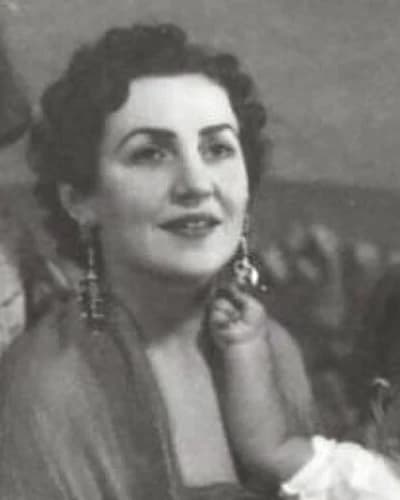
Biography
At the age of fifty-seven Fahrelnissa Zeid cooked a meal herself for the first time in her life. It happened in a Paris flat, where the family had moved after being given twenty-four hours to vacate the Iraqi Embassy in London. The meal left behind chicken bones, and she began to paint on them. Later the bones, cast in resin, became sculptures, which were given the name “paléokrystalos”.
Not long before, she had been the hostess of an embassy and one of the more prominent women painters in London and Paris.
She was born on 6 December 1901 on Büyükada, the largest of Istanbul’s Princes’ Islands, into the Ottoman family of Şakir Pasha. Her father was a diplomat; her mother, Sara İsmet Hanım, saw to the children’s education: languages, drawing, the piano. Her brother, Cevat Şakir, later became famous as a writer under the pen name “the Fisherman of Halicarnassus”; her sister Aliye Berger became a painter and engraver, and her niece Füreya Koral is known as a ceramist. Fahrelnissa began drawing as a small child; her earliest surviving work, a portrait of her grandmother, was painted, according to one account, at the age of fourteen. In 1919 she entered the Academy of Fine Arts for Women in Istanbul.
In 1920 she married the writer İzzet Melih Devrim, and on their honeymoon in Venice she saw European painting for the first time. A son from this marriage, Nejad Devrim, would also become a painter. In 1928 she went to Paris and studied at the Académie Ranson under Roger Bissière. Back home in 1929, she gave up her academic manner for an expressionist figuration and enrolled again at the Istanbul Academy of Fine Arts, where her teacher was Namık İsmail. In 1934 she divorced and married Prince Zeid bin Hussein of the Hashemite dynasty of Iraq. In 1935 he became Iraq’s first ambassador to Germany, and she lived in Berlin for several years. After the annexation of Austria in 1938 the family was recalled to Baghdad; she soon left and for years moved between Paris, Budapest and Istanbul. By 1941 she was back in Istanbul and working.
In the 1940s she joined Istanbul’s D Group, an avant-garde association that sought a meeting of Turkish tradition and Western modernism. The connection was brief, but it gave her the confidence to exhibit on her own. She held her first solo exhibition in her own flat in Maçka, clearing out the reception rooms for it. Then came İzmir and Istanbul again, and in 1946 her husband became Iraq’s first ambassador in London, and one of the embassy’s rooms was turned into her studio. From 1947 her painting moves from the figure to abstraction; the title of a work from that year is telling: “Fight Against Abstraction”. The critic Charles Estienne became a committed supporter, and in 1952 she took part in the founding exhibition of the New School of Paris at the Galerie Babylone. The following years, between London and Paris, brought her strongest works: the five-metre “My Hell” (1951), “Towards a Sky” (1953), “The Octopus of Triton”, “Sargasso Sea”. These enormous canvases draw the viewer into a kaleidoscope of line and colour. In 1953 the Galerie Dina Vierny in Paris showed her work; in 1954 the exhibition moved to the Institute of Contemporary Arts in London, and Fahrelnissa Zeid became the first woman to exhibit there. She was friends with Jean-Michel Atlan, Jean Dubuffet and Serge Poliakoff, and regularly showed at the Salon des Réalités Nouvelles. She described painting as flow, movement, speed.
On 14 July 1958 there was a military coup in Iraq, and the royal family perished. Prince Zeid and his wife were on the island of Ischia at the time and survived.
The sixties were for her a time of looking back. Portraits reappeared alongside the abstractions, and in 1964 two large retrospectives were held in Istanbul and Ankara. A major exhibition in Paris was also being prepared after she met André Malraux, but it never took place; even so, she went on exhibiting in Paris until 1972. Critics saw in her art now an Islamic and Ottoman foundation, now a Byzantine and Christian one; she herself stressed that she did not regard her work as the product of Turkish tradition alone. I think she felt cramped in any of these frames. A portrait, she said, was for her an abstraction too, because what she painted was a person’s inner world, not a face.
In 1970 Prince Zeid died in Paris, and in 1975 she moved to Amman, where her son, Prince Ra’ad, lived. In 1976 she founded the Royal National Jordanian Institute of Fine Arts that bears her name, and for fifteen years she taught young women artists there. In the mid-1980s she took up stained glass. Her first retrospective in the West was held at the Museum Ludwig in 1990. Fahrelnissa Zeid died on 5 September 1991 in Amman and is buried in the royal mausoleum at the Raghadan Palace.
Related context
Associations
Works connected through artistic movements, cultural context and period. Priced works available in this market appear first.








Profile notes
Profile and sources
Image
Artist image
Unknown author Unknown author; Wikimedia Commons; Public domain.
