
24.01.1823–03.11.1870
Prilidiano Pueyrredón
Prilidiano Pueyrredón (1823–1870), son of the Supreme Director of the United Provinces of the Río de la Plata, trained in Paris as an engineer and in Buenos Aires became the country’s first notable painter: portraits of the elite, the city’s first nudes, gauchos and washerwomen on the banks of the Río de la Plata. He also rebuilt the Pyramid of May and the Casa Rosada and designed a bridge over the Riachuelo whose opening he did not live to see.
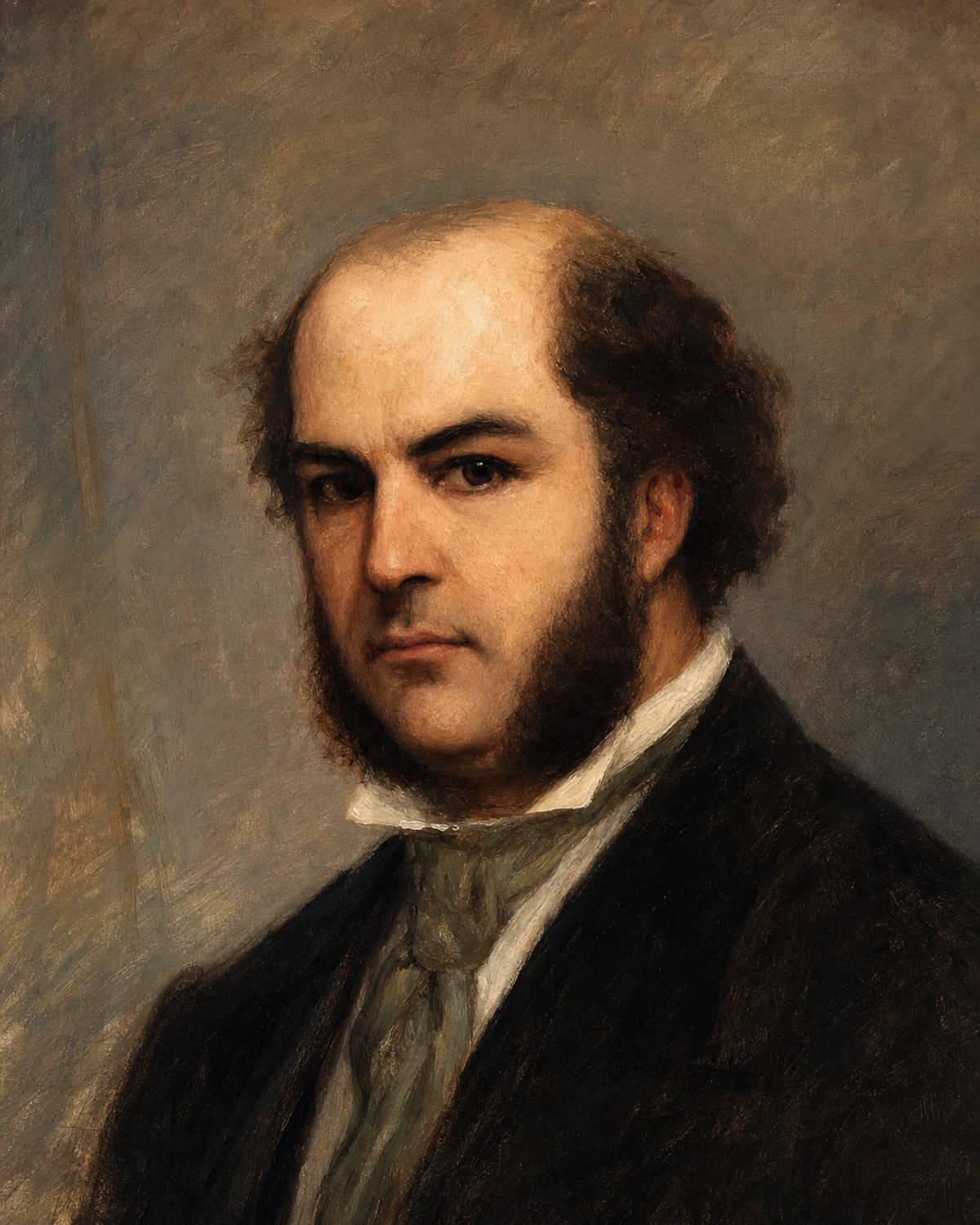
Biography
In 1862 Pueyrredón was commissioned to build a bridge over the Riachuelo at Barracas, and he conceived a swing bridge, unheard of in the Buenos Aires of the day. At the opening the piles, driven without proper calculation, gave way, the ground subsided, and the bridge went into the water. The contractors had put considerable money into it; in 1867 Pueyrredón signed a new contract with the government and finished the bridge at his own expense. It was opened on 9 November 1871, a year after its author’s death, and named after him.
Prilidiano Paz Pueyrredón was born on 24 January 1823 in Buenos Aires, the only son of General Juan Martín de Pueyrredón, Supreme Director of the United Provinces of the Río de la Plata in 1816–1819, and María Calixta Tellechea y Caviedes, of an old family of the capital. He finished primary school at the aristocratic Colegio de la Independencia, run by Percy Lewis. In 1835 the family moved to Europe: the boy spent the school year in Paris and the summers in Cádiz, where his father kept a business importing Argentine leather. Six years later, when Rosas refused French ships trading privileges and relations between France and Argentina soured, the Pueyrredóns moved to Rio de Janeiro. It was in the free air of the Brazilian capital that the young man decided to become an artist; when the family returned to Paris three years later, his father allowed him to study engineering at the École Polytechnique.
In 1849 his father fell gravely ill, the family returned to Buenos Aires, and the following year the general died at the estate in San Isidro. His portrait by his son is considered one of the artist’s best works. A qualified engineer of twenty-six, he cut an odd figure in the society of the capital and rumours circulated about him, but he quickly found a place that nobody disputed: portraitist to the elite. In 1851 he painted Manuelita, Rosas’s daughter, a few months before the caudillo lost power at Caseros. He was the first in Buenos Aires to attempt the nude; of these pictures two survive, “La siesta” and “El baño”, both now in the Museo Nacional de Bellas Artes.
In the middle of 1851 he left again for Cádiz and returned for good only in 1854.
The city, which had by then separated from the Argentine Confederation, was building a great deal, and Pueyrredón was useful to it as an engineer and architect. He restored and enlarged the Recoleta chapel, the Pyramid of May on the main square and the Casa Rosada, laid out the Plaza de la Victoria, a park on what was then the Paseo de Julio and the bridge at Barracas; to his designs Miguel de Azcuénaga built a mansion in Olivos, later given to the state as the presidential residence. Painting, meanwhile, took most of his energy precisely in the 1850s and above all in the 1860s. More than two hundred works survive from those years, and more than half of them are commissioned portraits. Alongside them he was among the first in the country to paint the outskirts and the gauchos, and he painted them in the Romantic manner he had brought back from Europe: “Un alto en el campo” (1861), “Capataz y peón de campo” (1864), “Lavanderas del Bajo Belgrano” (1865), “Recorriendo la estancia” (1865). In the “Lavanderas” women with their washing stand at the water’s edge below a low bank, and this, as far as I can judge, is the first picture by an Argentine of work on the river. Nobody in Buenos Aires had taken up such subjects before him.
Pueyrredón died on 3 November 1870, at forty-seven, at the family estate in San Isidro; he is buried in the Recoleta cemetery. The bridge over the Riachuelo that bore his name stood until 1884, when the river swept it away; almost a hundred years later his name was given to a new bridge. As a painter he was forgotten until the 1930s, when Argentine critics reread him as the forerunner of the national school. His name is borne by the visual arts department of the National University of the Arts in Buenos Aires, the former Higher School of Fine Arts.
Related context
Associations
Works connected through artistic movements, cultural context and period. Priced works available in this market appear first.








Profile notes
Profile and sources
Image
Artist image
На основе открытого изображения: Prilidiano Pueyrredón; Wikimedia Commons; Public domain.
