
20.08.1869–26.08.1945
Pío Collivadino
Pío Collivadino studied drawing at an Italian cultural society in Buenos Aires, then spent seven years in Rome, where he worked on frescoes under Cesare Mariani. In 1908 he became director of the Academy of Fine Arts in his native city and held the post until 1935. He is known for “Workday Break”, which won a gold medal in Venice, and for “Power Plants” (1914).
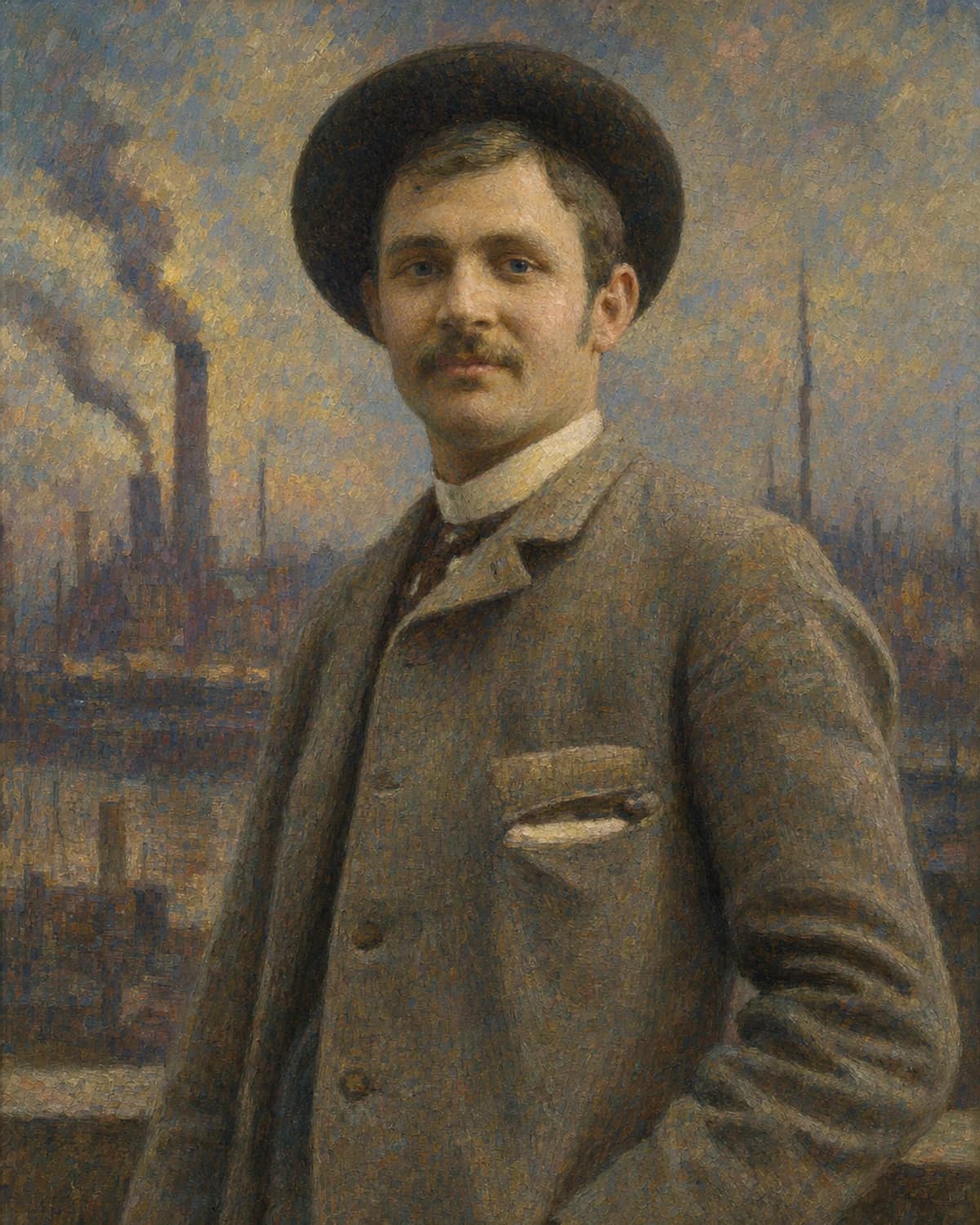
Biography
Collivadino showed his best-known picture in Venice in 1903. It is “Workday Break”, also called “Lunch Break” (La hora del reposo, La hora del almuerzo), and it won a gold medal.
He was born on 20 August 1869 in Buenos Aires, according to some sources in the Barracas district. He studied drawing at the Società Nazionale, a cultural society of Argentines of Italian descent. In 1889 he left for Rome, and in 1891 he was admitted to the Accademia di San Luca. His teacher there was the painter and architect Cesare Mariani; together with him Collivadino took part in the decorative frescoes in the building of the Constitutional Court of Italy. He completed the academy course seven years after his arrival in Rome.
In 1896 he returned to Argentina and soon became known for lithographs in a Romantic manner. From 1903 to 1907 his work was shown three times at international exhibitions in Venice. In 1904 he also took part in the Louisiana Purchase Exposition (the world’s fair) in St. Louis and won a gold and a silver medal there. These successes, it is generally held, pushed him towards Post-Impressionism, which Argentine art patrons did not then support. He joined the Nexus Group, led by the painters Fernando Fader and Martín Malharro and the sculptor Rogelio Yrurtia. The group met with a cool reception at first but in time helped to establish the style in the country. Sources give different dates for his joining: 1907, or simply “after these successes”. Collivadino himself, as the accounts have it, was more interested than the other members in the contrast between the familiar Buenos Aires and the modernity advancing on it.
In 1905 he was awarded the Order of the Crown of Italy, and the Brera Academy in Milan elected him an honorary member.
In Argentina he remained in demand: he sat on the juries of many exhibitions, in 1908 he was appointed director of the Academy of Fine Arts, and in 1910 he had a prominent place at the Centennial International Exposition in Buenos Aires. The following years produced, by general agreement, his best-known works, among them “Power Plants” (Usinas, 1914). He was director of scenography at the Teatro Colón, by some accounts also chaired its board, and founded a theatre of his own, La Higuerita. He ran the Academy and taught there until his retirement in 1935. His students are said to include Lino Enea Spilimbergo, Miguel Victorica, Raquel Forner, Héctor Basaldúa and Benito Quinquela Martín. I cannot check this against documents, but the list looks plausible for a school he headed for nearly three decades.
In 1939 Collivadino helped organize the Prilidiano Pueyrredón School of Fine Arts, and later, according to different sources in 1939 or 1941, took part in founding a museum associated with the name of Ernesto de la Cárcova. From 1941 to 1944 he was director of the Pueyrredón School. He then had to resign: the military government of General Pedro Pablo Ramírez had come to power in the country, and its cultural policy was hostile to European influence and relied on what it called “criollo virtues”.
Collivadino died in Buenos Aires on 26 August 1945. His family gave the National University of Lomas de Zamora more than a hundred works: oils, drawings, watercolours, prints, lithographs and sculptures. In 1992 the Pío Collivadino Museum opened on the basis of this gift in Banfield. It was closed from 2010 for restoration and digitization of the collection, and reopened in 2018.
Related context
Associations
Works connected through artistic movements, cultural context and period. Priced works available in this market appear first.








Profile notes
Profile and sources
Image
Artist image
На основе открытого изображения: Unknown author Unknown author; Wikimedia Commons; Public domain.
