
28.07.1890–05.04.1981
Pinchus Kremegne
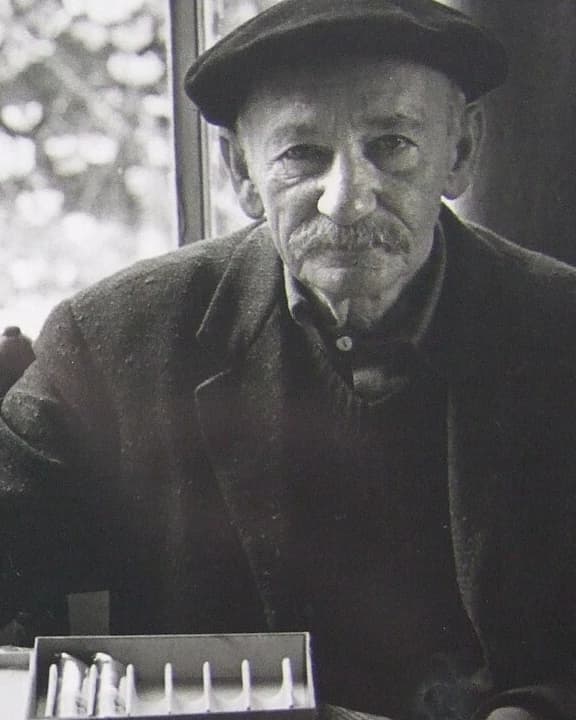
Pinchus Kremegne (1890–1981) left the Lida region for Paris in 1912, settled in La Ruche and in 1914 showed three sculptures at the Salon des Indépendants. From 1915 he painted mostly in oil, and from 1918 he lived in Céret in the eastern Pyrenees, where he built a house with a studio. A friend of Soutine and Kikoine, he remained in the shadow of both.
Biography
Pinchus Kremegne made his first Paris showing as a sculptor: three of his works hung in the Salon des Indépendants in 1914. A year later, by some accounts, he gave up sculpture for painting, and he is known mainly as a painter from then on.
He was born on 28 July 1890 (16 July, Old Style) in the small town of Zhaludok (in Belarusian, Zhaludok; in Russian, Zheludok) near Lida, into a Jewish family. His father was a craftsman: by some accounts, he made and sold small objects inspired by Slavic folklore, and Pinchus was the youngest of nine children. In 1909 he entered the art school in Vilnius and studied sculpture. There he grew close to Chaim Soutine and Michel Kikoine: the three of them talked about Paris, where, as they saw it, an entirely new art was being made.
Kremegne was the first to leave, in 1912. Russian authorities were reluctant to issue passports to Jews and, by some accounts, he crossed the border illegally, paying a smuggler. Kikoine and Soutine followed. In Paris Kremegne settled in La Ruche, a residence for artists in the south-west of the city, with no gas, electricity or running water. Among his neighbours were Marc Chagall, Fernand Léger, Jacques Lipchitz and Ossip Zadkine; in Montparnasse he met Amedeo Modigliani and André Derain. By some accounts, it was he who urged Soutine to come to Paris.
During the First World War Kremegne stayed in Paris. Dealers and gallery owners became interested in his work, among them Paul Guillaume and Léopold Zborowski.
In 1918 he went to Céret for the first time, on the advice of the painter Pierre Brune. Soutine was there too, sent by Zborowski to paint landscapes. From 1918 to 1920 Kremegne painted a series of red nudes; in 1919 his first solo exhibition was held at the gallery of Jacques Powolotzky. A contract with Guillaume in 1923 gave him enough money to move out of La Ruche. That year he also married a Swede, Birgit Strömbäck, and in 1924 he travelled to Corsica. His relations with Soutine had cooled by then: some explain this by success and differing temperaments, while by other accounts there was a quarrel over a shared patron. I have no documents, so I leave the cause open.
In the 1920s he travelled a great deal: Corsica, Cagnes, Sweden in 1927, Périgord in 1929. He belonged to the Pré-Saint-Gervais group. In 1930 a book about him was published in Paris.
Kremegne spent the Second World War in the south of France. After the defeat of the French army in June 1940 he left Paris, settled in the Corrèze department and worked as a farm labourer until the end of the war. Returning in 1945, he found his paintings in the studio undamaged. That same year he bought a plot of land in Céret. From 1949 he visited Israel several times. In 1960 his house with a studio was built near the former Capuchin monastery in Céret, a modest house set into the hillside above the town. From 1966 he lived between Céret and Paris.
During his lifetime he had solo exhibitions in Paris, London, Philadelphia, Lausanne and Geneva. His works are in museums in Céret, Béziers, Grenoble, Toulouse and Troyes, in the Museum of Jewish Art and History in Paris and in the National Museum Cardiff. Today he is less esteemed than Soutine and Chagall; in his late canvases some find a more structured vision of nature than Soutine’s.
Kremegne died on 5 April 1981 in Céret. He is buried in Paris, in Montparnasse Cemetery.
Related context
Associations
Works connected through artistic movements, cultural context and period. Priced works available in this market appear first.








Profile notes
Profile and sources
Image
Artist image
Zaloudock; Wikimedia Commons; CC BY-SA 4.0.
